
Featured Bright Annealed & Precision Alloy Products
Explore our direct factory catalog of precision seamless and welded tubing manufactured under strict ASTM, ASME, and EN metallurgical specifications.



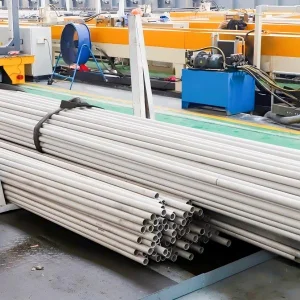




Technical Analysis: Metallurgy & Physics of Bright Annealed (BA) Tubing
In modern high-purity process piping and thermal exchange systems, the choice of tube heat treatment dictates operational lifespan, fluid dynamics, and resistance to localized corrosion. As a premier Custom Bright Annealed Supplier, Spezilla utilizes advanced furnace engineering to achieve superior metallurgical stability and ultra-smooth surface topography.
The Bright Annealing Thermal Cycle
Bright Annealing (BA) is a high-temperature heat treatment process conducted in a strictly controlled gaseous atmosphere (typically 100% pure Hydrogen or a Hydrogen-Nitrogen/Argon mixture). The cold-worked stainless steel tube is heated to temperatures between 1040°C and 1150°C, dissolving precipitated chromium carbides back into the austenitic matrix.
Rapid cooling follows without exposing the metal to oxygen. Because oxygen is completely purged from the furnace environment, zero oxide scaling forms on the tube surfaces. This preserves a mirror-like finish, eliminates the need for chemical acid pickling, and avoids intergranular corrosion vulnerabilities.
Comparing Annealed & Pickled (AP) vs Bright Annealed (BA)
Conventional Annealed & Pickled (AP) tubes undergo open-air heat treatment followed by acid bath descaling. This leaves a matte finish with surface roughness values ($Ra$) ranging from $0.8\,\mu m$ to $1.5\,\mu m$. Microscopic pits and valleys in AP tubing act as stagnation sites for bio-fouling, chloride accumulation, and fluid drag.
Conversely, Bright Annealed tubing yields an ultra-clean interior surface with $Ra \le 0.2\,\mu m$ ($8\,\mu in$). This ultra-smooth morphology significantly enhances corrosion resistance by promoting a uniform, self-healing passive Chromium Oxide ($Cr_2O_3$) layer across the entire tube length.
Metallurgical Benchmark: AP vs. BA vs. EP Tubing
| Feature Parameter | Annealed & Pickled (AP) | Bright Annealed (BA) | Electropolished (EP) |
|---|---|---|---|
| Atmosphere Type | Open Air / Oxidizing | Controlled Pure H₂ / Ar gas | Post-BA Chemical Electropolishing |
| Surface Roughness (Ra) | 0.8 µm – 1.6 µm | 0.2 µm – 0.4 µm | 0.05 µm – 0.15 µm |
| Oxide Scale Layer | Formed & Acid Etched | Zero Scale Formation | Chemically Passivated Layer |
| Fluid Friction Coeff. | Moderate to High | Ultra Low | Near Zero Friction |
| Primary Sectors | Structural & General Process | Semiconductor, Pharma, Heat Exchangers | Ultra-High Purity (UHP) Gas Systems |
China Supply Chain Integration & Manufacturing Mastery
As global enterprise procurement shifts toward resilient, cost-efficient, and highly scalable industrial partners, China’s high-precision tubing mills have emerged at the forefront of advanced metallurgy. Spezilla integrates world-class raw material sourcing with computerized cold-drawing lines to supply premium custom bright annealed products globally.
Direct Mill Raw Material Control
Our manufacturing ecosystem partners directly with tier-1 raw material master suppliers (such as Tsingshan, Baosteel, and Yongxing). By securing high-purity mother hollows with controlled chemical heats (strictly monitored Carbon, Nickel, Molybdenum, and Nitrogen ratios), we prevent inclusion defects and ensure consistent PREN (Pitting Resistance Equivalent Number) performance.
Advanced Cold Pilgering & Drawing
Utilizing multi-roll cold pilgering and precision bench drawing mills in our Huzhou manufacturing facility, we achieve tight dimensional tolerances on wall thickness (WT) and outside diameter (OD). This guarantees seamless concentricity required for orbital welding in critical chemical, aerospace, and semiconductor installations.
Scalable OEM & Custom Tolerances
Whether your project calls for straight lengths up to 25 meters, complex U-bent tubes for feedwater heaters, or continuous coiled tubing, our facility offers rapid tooling flexibility. We manufacture to non-standard outer diameters (4.00mm to 114.30mm) and custom wall thicknesses (0.40mm to 3.05mm) without compromising delivery timelines.
Global Procurement Compliance & Rigorous QA Protocols
Procurement managers and engineering directors face immense operational risks when sourcing high-pressure and corrosion-resistant tubing. Spezilla mitigates risk through a multi-tier Quality Management System fully compliant with international industrial standards.
Full Material Traceability & Certification
Every shipment of custom bright annealed tubing is accompanied by comprehensive EN 10204 3.1 Mill Test Certificates (MTC). Independent third-party inspection (TUV, SGS, Lloyd's Register) can be arranged for EN 10204 3.2 compliance.
Our MTCs detail actual chemical heat analysis, mechanical tensile strength, yield strength, elongation percentage, hardness test results (Rockwell/Vickers), and grain size determination in accordance with ASTM E112.
Non-Destructive Examination (NDE) Suite
Prior to packaging and dispatch, 100% of manufactured tubes undergo non-destructive examination to guarantee zero leakage and flawless surface integrity under high pressure:
- Eddy Current Testing (ECT): Performed to ASTM A1016 / EN 10246 to detect longitudinal and transverse surface flaws.
- Hydrostatic Testing: Pressure testing up to 300 bar (4,350 psi) ensuring structural yield safety.
- Pneumatic Air Under Water Test: Essential for heat exchanger and instrument tubes to identify micro-porosities.
- Positive Material Identification (PMI): XRF spectrographic analysis verifying grade chemistry.
Localized Application Scenarios & Industry Use Cases
Bright annealed tubing serves critical roles in high-tech sectors where internal cleanliness, micro-smoothness, and chemical inertness are non-negotiable.
Semiconductor Fabs
Used in Ultra-High Purity (UHP) toxic, corrosive, and inert gas distribution lines. The mirror-bright interior surface prevents particle traps and outgassing.
Pharmaceutical & Biotech
Sanitary water-for-injection (WFI) and Clean-In-Place (CIP) piping systems. Excellent surface finish prevents bacterial adhesion and biofilm formation.
Instrumentation Lines
High-pressure hydraulic and control system lines in offshore oil platforms, hydrogen refueling stations, and subsea sampling skids.
Power Generation & Boilers
High-temperature heat exchangers, condensers, and feedwater superheaters utilizing 316L, 309H, 310H, 321, and Nickel Alloys for oxidation resistance.
Future Trends in Bright Annealed Tubing Tech
The industrial tubing landscape is rapidly evolving alongside green hydrogen initiatives, submicron semiconductor manufacturing, and decarbonized power generation.
1. Hydrogen Embrittlement Mitigation
As global energy sectors shift toward green hydrogen fuel cells and distribution networks, standard stainless steel alloys face severe risk of hydrogen embrittlement under high pressures (350 bar to 700 bar). Advanced bright annealing processes alter micro-structural grain boundaries to minimize hydrogen permeability, ensuring long-term integrity in Type 316L and Alloy 625/800HT tubing systems.
2. Industry 4.0 Smart Furnace Automation
Next-generation thermal processing utilizes optical continuous sensors and real-time gas mass flow controllers. By monitoring hydrogen atmosphere purity and furnace dew points down to $-65^\circ C$ in real time, automated feedback loops eliminate micro-oxidation events during high-speed tube continuous bright annealing runs.
Global Logistics, Custom Compliance & Engineering Support
Spezilla operates an international hub in Shanghai coupled with modern manufacturing bases in Huzhou, Zhejiang. We streamline cross-border procurement for industrial clients across North America, Europe, the Middle East, and Southeast Asia.
Protective Packaging
Bright annealed tubing requires immaculate protection against sea moisture, mechanical scratching, and airborne particles. Every tube end is fitted with plastic caps, wrapped in protective sleeve foil, and packed into ISPM-15 compliant seaworthy wooden cases.
Compliance Standards Mapping
Our engineering support team cross-references domestic and international design codes: ASTM A213/A249/A269/A270/A312, ASME SA213/SA249, EN 10217-7, EN 10216-5, DIN 17458, and JIS G3463, eliminating specification mismatches.
Flexible Logistics & IncoTerms
We offer comprehensive shipping solutions including FOB, CIF, CFR, DDP, and DAP terms. With quick access to Shanghai Port and Ningbo Port, emergency spare orders can be air-freighted globally within short turnaround windows.
Frequently Asked Questions (FAQ) - Procurement & Engineering Guide
Detailed technical answers to common queries regarding custom bright annealed tubes, alloy selection, and manufacturing tolerances.
Explore Additional Alloy & Titanium Tube Products
Browse our additional precision product lines including high-grade nickel alloys, titanium, and heat-resistant stainless steel tube grades.








