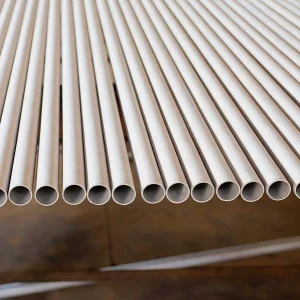
Featured Specialty Alloy Products
Precision-engineered tubing, heat exchanger pipes, and customized stainless steel solutions manufactured to rigorous ASTM, ASME, and EN specifications.








Executive Technical Whitepaper: Metallurgical Foundations
An In-Depth Engineering Analysis of Ferritic and Martensitic Stainless Steels in Modern High-Stress Applications
In contemporary industrial engineering, selecting the optimal stainless steel chemistry requires a sophisticated evaluation of mechanical behavior, corrosion dynamics, thermodynamic stability, and lifecycle economics. As a leading premier manufacturer and global factory supplier of specialized Ferritic & Martensitic Steels, Spezilla operates at the intersection of advanced metallurgy and precision tube manufacturing. While austenitic grades (such as 304L and 316L) dominate general commercial applications, ferritic and martensitic stainless steels present critical, irreplaceable engineering advantages—specifically immunity to chloride-induced Stress Corrosion Cracking (SCC), elevated yield strength, superior thermal conductivity, low coefficients of thermal expansion, and optimized cost stability due to zero or minimal nickel additions.
Core Metallurgical Distinction: BCC vs. BCT Crystal Lattices
Ferritic Stainless Steels feature a Body-Centered Cubic (BCC) crystal structure across their entire operational temperature spectrum. Containing chromium levels ranging from 10.5% to 30% with very low carbon fractions, these alloys do not undergo phase transformation during rapid cooling, preserving a ductile, highly stable ferromagnetic structure. Conversely, Martensitic Stainless Steels contain moderate-to-high carbon content (0.10% to 1.20%) combined with 12% to 18% chromium. Upon heat treatment (austenitizing followed by quenching), they undergo a shear-type phase transformation from Face-Centered Cubic (FCC) austenite into a hard, distorted Body-Centered Tetragonal (BCT) martensite matrix, delivering extraordinary tensile strength, hardness, and wear resistance.
Understanding these distinct physical mechanisms allows piping designers, thermal engineers, and procurement specialists to engineer high-efficiency systems capable of enduring aggressive thermal cycles, high-velocity particulate erosion, and acidic chemical streams without premature material degradation.
Global Industrial Landscape & Macro-Economic Drivers
Strategic supply chain dynamics, nickel volatility hedging, and decarbonization trends reshaping specialty steel specification.
Economic Hedging Against Volatility
Global nickel supply chain disruptions and extreme LME market fluctuations have forced process plants to re-evaluate nickel-intensive austenitic alloys. Ferritic grades (such as 439, 441, and 444) eliminate nickel surcharge risk entirely while delivering equal or superior corrosion resistance in specific media.
Thermal Efficiency & Carbon Footprint
Ferritic steels offer up to 30% higher thermal conductivity compared to 300-series stainless steels. In heat exchanger applications, this translates directly to enhanced thermal transfer coefficients, smaller required surface areas, reduced equipment footprints, and lower energy consumption across operating lifetimes.
Stress Corrosion Cracking (SCC) Resilience
Chlorides present in cooling water, steam condensates, and process fluids frequently trigger catastrophic intergranular SCC failure in austenitic pipes. Due to their BCC crystallographic structure, ferritic stainless steels are inherently immune to chloride SCC, serving as the benchmark standard for utility boilers and feedwater heaters.
Extreme Wear & Mechanical Load Capacity
High-carbon martensitic alloys (including 410, 420, and 440C) provide the extreme hardness and shear strength demanded by valve trim, hydraulic actuators, slurry pumps, and automotive injection components operating under combined mechanical wear and corrosive attack.
Comprehensive Material Specification Matrix
Metallurgical analysis, chemical composition, PREN ratings, and physical properties across core Ferritic & Martensitic grades.
| Grade Designation | UNS / EN Number | Microstructure | Cr / Mo / C Composition (%) | Yield Strength (MPa) | PREN Value | Primary Industrial Applications |
|---|---|---|---|---|---|---|
| AISI 405 | UNS S40500 / 1.4002 | Ferritic | 11.5-14.5 Cr / 0.08 C / 0.1-0.3 Al | ≥ 205 | ~12 | Petroleum refining tower linings, annealing boxes, steam nozzles |
| AISI 409L | UNS S40900 / 1.4512 | Stabilized Ferritic | 10.5-11.7 Cr / 0.03 C / Ti Stabilized | ≥ 205 | ~11 | Automotive exhaust manifolds, mufflers, catalytic converter shells |
| AISI 410 | UNS S41000 / 1.4006 | Martensitic | 11.5-13.5 Cr / 0.08-0.15 C | ≥ 290 (Annealed) / ≥ 700 (Q&T) | ~13 | Pump shafts, turbine blades, valve seats, oil refinery fittings |
| AISI 420 | UNS S42000 / 1.4021 | Martensitic | 12.0-14.0 Cr / ≥ 0.15 C | ≥ 345 (Annealed) / ≥ 800 (Q&T) | ~14 | Surgical instruments, shear blades, needle valves, wear rings |
| AISI 430 | UNS S43000 / 1.4016 | Ferritic | 16.0-18.0 Cr / ≤ 0.12 C | ≥ 260 | ~17 | Nitric acid production equipment, interior architectural trim, appliances |
| AISI 439 | UNS S43035 / 1.4510 | Dual Stabilized Ferritic | 17.0-19.0 Cr / ≤ 0.03 C / Ti+Nb | ≥ 240 | ~18 | Sugar mill evaporator tubes, boiler tubes, heat exchangers |
| AISI 441 | UNS S43932 / 1.4509 | Nb-Ti Stabilized Ferritic | 17.5-18.5 Cr / ≤ 0.03 C / Nb+Ti | ≥ 250 | ~18.5 | High-temperature exhaust manifolds, heat exchangers, solar receivers |
| AISI 444 | UNS S44400 / 1.4521 | Dual Stabilized Mo-Ferritic | 17.5-19.5 Cr / 1.75-2.5 Mo / Nb+Ti | ≥ 310 | ~24.5 | Solar water heaters, brewery tanks, potable water storage, seawater equipment |
| AISI 446 | UNS S44600 / 1.4762 | High-Cr Ferritic | 23.0-27.0 Cr / ≤ 0.20 C | ≥ 345 | ~26 | Recuperators, kiln liners, glass mold pins, soot blower tubes |
Note on PREN (Pitting Resistance Equivalent Number): Calculated via PREN = %Cr + 3.3(%Mo + 0.5%W) + 16(%N). Molybdenum-bearing ferritic stainless steel AISI 444 (UNS S44400) delivers a PREN exceeding 24.5, outperforming standard AISI 304L and matching AISI 316L pitting resistance while maintaining total immunity to stress corrosion cracking in hot chloride-laden waters.
Manufacturing Quality Control & Global Compliance
Rigorous Quality Assurance Protocols, Non-Destructive Testing (NDT), and Mill Test Certifications per EN 10204 3.1 / 3.2.
Precision Cold Drawing & Pilgering
Our factory facilities employ automated high-precision cold pilger mills and cold drawing benches capable of maintaining ultra-tight wall thickness tolerances (±5%) and flawless surface finishes down to Ra < 0.4 μm for critical fluid circuits.
Bright Annealing & Vacuum Heat Treatment
To ensure optimal ductility and maximum corrosion resistance, ferritic alloys undergo continuous atmosphere-controlled bright annealing (100% pure hydrogen atmosphere), preventing surface oxidation and grain growth while mitigating sensitization risk.
Comprehensive NDT Inspection Suite
100% of manufactured tubes undergo non-destructive inspection: Eddy Current Testing (ECT) per ASTM E426, Hydrostatic Testing up to 300 bar, and Ultrasonic Testing (UT) to identify micro-inclusions, longitudinal flaws, or wall thickness variations.
Complete EN 10204 Traceability
Every shipment is backed by an authentic EN 10204 3.1 Mill Test Certificate detailing chemical ladle heat analysis, mechanical tensile/hardness properties, intergranular corrosion testing (ASTM A262 Practice E), and grain size analysis. Third-party inspection (TUV, SGS, Lloyd's) per 3.2 is fully supported.
Engineering Application Scenarios & Regional Solutions
Tailored industrial piping and tube deployment strategies addressing severe operational micro-environments across global territories.
Automotive Exhaust & Thermal Systems
Region: Europe & North America (Euro 6d / US EPA Tier 3 Compliance)
Applied Grades: AISI 409L, AISI 439, AISI 441
Technical Solution: Dual titanium-niobium stabilization prevents intergranular chromium carbide precipitation in exhaust gas recirculation (EGR) coolers and hot-end manifolds exposed to cyclic temperatures up to 850°C.
Power Generation Feedwater Heaters
Region: Asia-Pacific & Middle East
Applied Grades: AISI 439, UNS S44400 (ASTM A268)
Technical Solution: High thermal conductivity combined with absolute immunity to chloride SCC allows super-critical thermal power plants to replace costly copper-nickel and 304L heater tubes, extending bundle service life beyond 30 years.
Solar Thermal Collectors & Boilers
Region: MENA Region & Southern Europe
Applied Grades: AISI 444, AISI 446
Technical Solution: High-chromium ferritic alloys withstand extreme thermal fatigue and concentrated solar flux without experiencing high-temperature oxidation or structural warpage caused by unequal thermal expansion.
Petrochemical & Refining Columns
Region: Global Processing Hubs
Applied Grades: AISI 405, AISI 410, AISI 420
Technical Solution: Clad vessel internals, tray valves, and pump shaft sleeves manufactured from martensitic stainless steel deliver extreme hardness to resist abrasive catalyst slurry erosion and hydrogen sulfide cracking.
Metallurgical Roadmap & Future Innovations (2026–2035)
Pioneering next-generation alloy stabilization, ultra-clean melting technologies, and zero-carbon steel manufacturing.
As industrial processing environments demand higher temperatures, elevated operating pressures, and aggressive decarbonization goals, Spezilla's R&D division continues to push the boundaries of ferritic and martensitic metallurgy. Our technological roadmap focuses on three pivotal pillars:
1. Ultra-Clean VOD/AOD Refining
Implementing Vacuum Oxygen Decarburization (VOD) and Argon Oxygen Decarburization (AOD) techniques to reduce interstitial carbon and nitrogen levels below 100 ppm. Ultra-low interstitial levels vastly improve deep drawability, impact toughness at sub-zero temperatures, and weldment ductility in heavy-wall ferritic tubes.
2. Advanced Triple-Stabilization Alloys
Developing micro-alloyed ferritic formulations featuring synergistic additions of Titanium, Niobium, and Zirconium. This triple-stabilization matrix completely ties up carbon and nitrogen, preventing localized sensitization during high-speed laser welding and automated TIG fabrication.
3. Hydrogen Energy & Fuel Cell Tubing
Formulating customized high-purity ferritic alloys optimized for high-pressure hydrogen conveyance systems and solid oxide fuel cell (SOFC) interconnects. Ferritic grades exhibit low hydrogen permeability and structural stability in high-temperature reducing environments, positioning them as vital enablers of the green hydrogen economy.
Technical FAQ & Engineering Consultation
Expert answers to critical procurement, fabrication, welding, and metallurgical questions.
Complete High-Performance Product Lineup
Explore our extended catalog of custom austenitic, nickel alloy, and super austenitic tubing manufactured to global engineering standards.