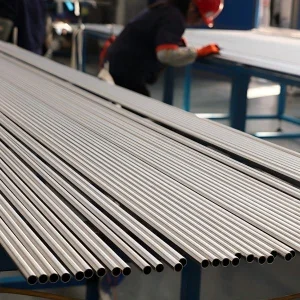
Precision Engineered Tubing Solutions
Explore our certified range of high-performance alloy tubing manufactured to strict ASME, ASTM, and EN standard specifications.




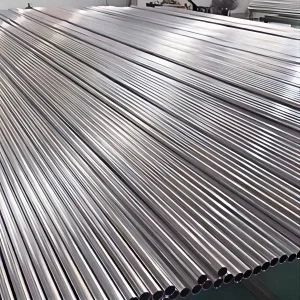
Metallurgical Foundations of Duplex Stainless Steels
An in-depth analysis of dual-phase thermodynamics, microstructural phase ratios, and corrosion kinetic enhancement.
Phase Equilibrium Dynamics
Duplex stainless steels are engineered to yield a balanced 50/50 dual-phase microstructure consisting of face-centered cubic (FCC) austenite ($\gamma$) and body-centered cubic (BCC) ferrite ($\alpha$). This precise phase balance combines the stress-corrosion cracking resistance of ferritic steels with the fracture toughness and fabrication ease of traditional austenitic grades.
Pitting Resistance Mechanics (PREN)
Resistance to localized pitting and crevice corrosion is quantified via the Pitting Resistance Equivalent Number formula: $\text{PREN} = \% \text{Cr} + 3.3(\% \text{Mo} + 0.5\% \text{W}) + 16(\% \text{N})$. Standard duplex alloys (e.g., UNS S31803 / S32205) reach PREN values of 35–38, whereas Super Duplex grades (e.g., UNS S32750) exceed PREN 42, enabling application in aggressive halide media.
Enhanced Yield Strength Profile
Unlike standard 300-series austenitic stainless steels (304L/316L) which feature yield strengths around 200–240 MPa, standard duplex grades deliver yield strengths exceeding 450–550 MPa. This twofold mechanical advantage allows structural engineers to specify thinner wall tubing without compromising pressure ratings, reducing overall vessel weight by up to 40%.
Metallurgical Insight: Precise thermal control during rapid solution annealing (1020°C to 1100°C followed by immediate water quenching) is critical. Improper heat treatment can trigger intermetallic phase precipitation (such as $\sigma$-phase and $\chi$-phase) between 600°C and 1000°C, causing severe toughness degradation and localized pitting susceptibility.
Comparative Grade Matrix: Duplex vs. Standard Stainless Alloys
| Alloy Grade | UNS / EN Standard | Microstructure | Yield Strength (0.2% Proof, MPa) | Tensile Strength (MPa) | PREN Value | Primary Industrial Utility |
|---|---|---|---|---|---|---|
| Standard Duplex 2205 | UNS S31803 / S32205 (1.4462) | 50/50 Ferrite-Austenite | ≥ 450 | 655 – 880 | 35 – 38 | Offshore O&G, Chemical Process Loops, Subsea Piping |
| Super Duplex 2507 | UNS S32750 (1.4410) | 50/50 Ferrite-Austenite | ≥ 550 | 750 – 1000 | ≥ 42 | Desalination RO Systems, Deepwater Riser Pipes, Marine Acid Lines |
| Lean Duplex 2101 | UNS S32101 (1.4162) | 50/50 Ferrite-Austenite | ≥ 400 | 650 – 850 | 26 – 28 | Civil Water Storage, Structural Architecture, Bio-fuel Tanks |
| Austenitic 316L | UNS S31603 (1.4404) | 100% Austenite | ≥ 220 | 520 – 670 | 23 – 25 | General Pharmaceutical, Sanitary Food & Beverage Processing |
| Nickel Alloy 825 | UNS N08825 (2.4858) | Nickel-Iron-Cr Matrix | ≥ 240 | 580 – 750 | 31 – 34 | Sour Gas Wells ($H_2S$), Sulfuric Acid Pickling Operations |
Macro Sector Integration & Applications
Deployment of advanced duplex steel tubing across severe operating environments, energy infrastructure, and chemical process plants worldwide.
Offshore Oil & Gas / Subsea Systems
Subsea flowlines, umbilical lines, manifold systems, and topside process equipment face combined stress from high internal pressures, hydrogen sulfide ($H_2S$), and oceanic chloride attack. Duplex UNS S32205 and Super Duplex S32750 are standard specifications compliant with NACE MR0175/ISO 15156, mitigating stress corrosion cracking in sour service environment.
Seawater Reverse Osmosis (SWRO) Desalination
High-pressure pumps, energy recovery devices, and feed manifolds operate in concentrated brine solutions with chloride concentrations exceeding 35,000 mg/L. Super Duplex UNS S32750 offers superior resistance to pitting and crevice corrosion under high velocity and high pressure conditions (60–80 bar), preventing sudden catastrophic pump casing or line rupture.
Chemical Process & Petrochemical Refining
In organic acid distillation, PTA (purified terephthalic acid) manufacturing, and chlorine production, traditional 316L tubing rapidly degrades due to crevice corrosion. Duplex grades maintain structural wall integrity under hot nitric, acetic, and phosphoric acid exposure, extending plant operational lifecycle and eliminating unbudgeted maintenance downtime.
Clean Energy & Decarbonization Ecosystems
In geothermal power extraction plants, geothermal brine contains dissolved minerals, hydrogen sulfide, and heavy chloride loads. Duplex steels provide thermal conductivity while resisting severe erosion-corrosion. Similarly, in Carbon Capture, Utilization, and Storage (CCUS) systems, high-pressure super-critical $CO_2$ streams mixed with moisture demand robust dual-phase resistance.
Factory Certification, NDT & Quality Assurance
Rigorous multi-stage verification workflows ensuring flawless mechanical performance, dimensional stability, and microstructural phase validation.
ASME & EN Standard Compliance
Our duplex seamless and welded products comply strictly with standard global engineering specifications, including ASTM A789/A790 (Standard Specification for Seamless and Welded Ferritic/Austenitic Stainless Steel Tubing for General Service), ASME SA213/SA312, and European standards EN 10217-7 / EN 10216-5.
EN 10204 3.1 & 3.2 Traceability
Every shipment is accompanied by comprehensive EN 10204 3.1 Inspection Certificates detailing chemical composition via Optical Emission Spectroscopy (OES), mechanical tension tests, micro-hardness profiles, and grain size evaluations. Independent third-party inspection (TUV, Lloyd's Register, DNV, SGS) is supported for EN 10204 3.2 certification.
Advanced Non-Destructive Testing (NDT)
Prior to warehouse dispatch, 100% of manufactured tubes undergo non-destructive examination. Testing protocols include Eddy Current Testing (ECT) for surface and sub-surface flaw detection per ASTM E426, Hydrostatic Pressure Testing up to 300 bar, Ultrasonic Testing (UT) for wall thickness verification, and Positive Material Identification (PMI).
Corrosion Testing Protocols: Intergranular corrosion resistance is verified via ASTM A262 Practice E and ASTM G48 Method A/B (Ferric Chloride Pitting and Crevice Corrosion Test). Critical Pitting Temperature (CPT) and Critical Crevice Corrosion Temperature (CCCT) metrics are routinely recorded to guarantee field performance in harsh marine environments.
Localized Applications & Technology Roadmap
Engineering real-world applications today while pioneering the next generation of hyper-duplex and green steel processing technologies.
Subsea North Sea & Gulf Flowlines
Field installations in the North Sea and Deepwater Gulf of Mexico rely on cold-drawn duplex S32205 tubing for high-pressure hydraulic control lines. The alloy resists severe pitting in localized stagnant marine crevices where marine growth builds up on external unpainted surfaces.
Geothermal Energy Heat Exchangers
Geothermal power generation in Iceland and the East African Rift utilizes U-bent duplex heat exchanger tubes. High thermal conductivity combined with immunity to chloride-induced stress corrosion cracking ensures 25+ years of continuous power grid feed without heat exchanger tube replacement.
Hyper-Duplex & Additive Manufacturing Roadmap
Future development targets Hyper-Duplex grades (PREN > 48) containing optimized tungsten and nitrogen additions for ultra-deep subsea wells exceeding 15,000 psi. Concurrently, atomized duplex powders are enabling 3D printed fluid manifold components with matched dual-phase microstructures.
Deep Metallurgical & Procurement Insights
Expert guidance addressing critical intent queries regarding duplex steel fabrication, welding procedures, and alloy selection.
Why does Duplex stainless steel exhibit superior Stress Corrosion Cracking (SCC) resistance compared to 316L?
Stress Corrosion Cracking (SCC) requires a combination of tensile stress, aggressive chloride ions, and elevated temperature (>60°C). Austenitic stainless steels like 316L possess a single-phase FCC structure that is highly vulnerable to transgranular cracking under these conditions. Duplex steels contain a 50% BCC ferritic phase matrix which acts as a physical mechanical barrier to crack propagation. Cracks initiating in the austenitic phase are arrested upon encountering the ferritic phase boundary, elevating the threshold stress required for failure.
What are the strict heat input parameters during Welding Procedure Specification (WPS) execution for Duplex 2205?
Welding duplex stainless steel requires precise control of heat input, typically maintained between 1.0 kJ/mm and 2.5 kJ/mm. Excessively low heat input causes rapid cooling rates, resulting in an overly ferritic heat-affected zone (HAZ >70% ferrite) and severe loss of impact toughness. Conversely, excessively high heat input retards cooling, promoting the precipitation of brittle intermetallic phases ($\sigma$-phase, $\chi$-phase) and chromium nitrides ($Cr_2N$). Shielding gas containing 2–3% Nitrogen ($N_2$) balanced with Argon is recommended to compensate for nitrogen loss in the weld pool.
How does the coefficient of thermal expansion of Duplex steel affect heat exchanger design?
Duplex stainless steels have a lower thermal expansion coefficient ($13.0 \times 10^{-6}/^\text{K}$ at 20–100°C) compared to standard austenitic steels ($16.5 \times 10^{-6}/^\text{K}$ for 316L), closer to that of carbon steel. In shell-and-tube heat exchangers, this reduced thermal movement minimizes differential expansion stress between the tube bundle and shell wall. This allows for simpler fixed-tubesheet designs and reduces fatigue failure risk at tube-to-tubesheet welded joints.
What is the difference between UNS S31803 and UNS S32205 standard designations?
UNS S31803 was the original specification for standard 2205 duplex steel. However, metallurgical advancements led to a tighter chemical range with higher Chromium (22.0–23.0%), Molybdenum (3.0–3.5%), and Nitrogen (0.14–0.20%), designated as UNS S32205. The dual-certified UNS S31803/S32205 material ensures higher pitting resistance and higher guaranteed mechanical strength. Today, most premium factories supply material complying with the restricted UNS S32205 composition.
When should an engineer select Super Duplex UNS S32750 over Standard Duplex UNS S32205?
Super Duplex UNS S32750 (25Cr-7Ni-4Mo-0.28N) should be specified when operating temperatures exceed 60°C in high chloride environments ($>10,000 \text{ ppm } Cl^-$), such as seawater desalination, sour oil gas systems with high $H_2S$ partial pressures, or concentrated acid streams. UNS S32750 delivers a PREN $\ge 42$ and a higher yield strength ($\ge 550 \text{ MPa}$), justifying the material cost differential in mission-critical applications.
Specialized Duplex & High-Alloy Products
Explore our complete inventory of industrial stainless, duplex, and specialized alloy tubing options.