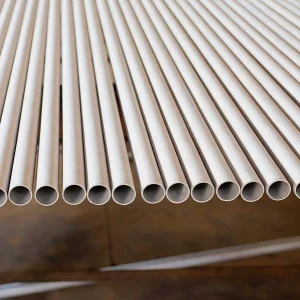
Featured Titanium & Alloy Tube Products (Series I)
Direct supply from verified factory production lines. Certified according to ASTM B338, ASTM B861, ASTM A213, ASME SB338, and EN 10204 3.1/3.2 specifications.






1. Global Commercial & Industrial Status of Titanium Tubing
As modern heavy industries push operational limits into higher temperatures, aggressive chemical media, and hyper-saline environments, selecting the appropriate structural and heat-exchange tubing becomes a critical economic and engineering decision. Titanium (Ti) and its engineered alloys have transitioned from niche aerospace materials into mainstream industrial infrastructure workhorses. Today, the global demand for titanium tubes—spanning commercially pure (CP) grades (Grades 1, 2, 3, 4) and modified alpha-beta alloys (Grade 7, Grade 9, Grade 12)—is experiencing unprecedented growth driven by global energy transitions, seawater desalination expansions, and chemical process intensification.
The global industrial titanium tubing market exceeds $2.8 Billion annually, with an estimated CAGR of 6.4% over the next decade. The primary demand sectors include coastal thermal and nuclear power station condensers, Multi-Stage Flash (MSF) and Reverse Osmosis (RO) energy recovery systems, chlor-alkali electrolysis units, offshore oil & gas platforms, and green hydrogen electrolyzers. Titanium’s exceptional strength-to-weight ratio, complete immunity to chloride-induced pitting, and self-healing titanium dioxide ($\text{TiO}_2$) passive layer make it superior to traditional copper-nickel (Cu-Ni 70/30, 90/10) alloys, super-duplex stainless steels (UNS S32750), and nickel-chromium alloys in severe marine and acidic service.
While the initial capital expenditure (CAPEX) of ASTM B338 Grade 2 titanium tubes is approximately 25% to 40% higher than super duplex stainless steel (e.g., UNS S32750), titanium's zero-corrosion rate in chloride-rich environments eliminates tube replacement cycles, biofouling-induced pinhole leaks, and emergency shutdown costs. Over a 30-year operational window in marine heat exchangers, titanium yields an estimated **42% reduction in Total Cost of Ownership (TCO)**.
2. Comprehensive Metallurgical Breakdown & Grade Specifications
Understanding the microstructural phase transformations (Alpha phase vs. Beta phase) and interstitial element limits (Nitrogen, Carbon, Hydrogen, Iron, Oxygen) is essential when specifying titanium tubes for pressure vessels and heat exchangers. Below is the technical breakdown of primary titanium grades manufactured by Spezilla and major industrial factories.
| Titanium Grade | UNS No. / Standard | Microstructure | Yield Strength (MPa) | Tensile Strength (MPa) | Key Industrial Characteristics |
|---|---|---|---|---|---|
| Grade 1 | UNS R50250 / ASTM B338 | Unalloyed Alpha ($\alpha$) | 170 – 310 | ≥ 240 | Highest formability, max ductility, optimal for cold bending, plate heat exchangers, chemical linings. |
| Grade 2 | UNS R50400 / ASTM B338 | Unalloyed Alpha ($\alpha$) | 275 – 440 | ≥ 345 | The premier industrial workhorse. Ideal balance of strength, weldability, and seawater corrosion resistance. |
| Grade 3 | UNS R50550 / ASTM B338 | Unalloyed Alpha ($\alpha$) | 380 – 550 | ≥ 450 | Higher mechanical strength; specified for pressure tubing, vessel shells, and moderate mechanical wear areas. |
| Grade 7 | UNS R52400 / ASTM B338 | Alpha + 0.12-0.25% Pd | 275 – 440 | ≥ 345 | Palladium-stabilized grade. Exceptional resistance to reducing acids (HCl, $H_2SO_4$) and crevice corrosion. |
| Grade 9 | UNS R56320 / ASTM B338 | Near-Alpha (3Al-2.5V) | ≥ 586 | ≥ 621 | High strength, medium temperature service. Widely specified in aerospace hydraulics and sports equipment. |
| Grade 12 | UNS R53400 / ASTM B338 | Alpha-Beta (0.3Mo-0.8Ni) | ≥ 345 | ≥ 485 | Elevated temperature strength up to 300°C; enhanced crevice corrosion resistance in high-temperature brine. |
Thermal Conductivity Dynamics
Although pure titanium has a thermal conductivity of ~21.9 W/m·K (lower than copper), its high strength allows for ultra-thin wall tubing designs (e.g., 0.5mm to 0.71mm WT). Consequently, overall heat transfer coefficients equal or exceed heavy-wall stainless steel tubes, with zero allowance required for corrosion scaling.
Passive $\text{TiO}_2$ Protective Layer
Upon exposure to oxygen or water, titanium instantaneously forms a dense, continuous oxide film ($\text{TiO}_2$, rutile/anatase). This film instantly self-heals if mechanically abraded, preventing pitting attack even in boiling seawater, wet chlorine gas, and nitric acid solutions.
Erosion-Corrosion Resistance
Unlike copper-nickel alloys which experience protective film breakdown at fluid velocities above 2.5 m/s, titanium tubes withstand turbulent fluid velocities in excess of **20 m/s** without suffering erosion-corrosion, cavitation damage, or impinging attacks.
3. Precision Manufacturing Routes: Seamless (B861) vs. Welded (B862/B338)
Manufacturing titanium tubes requires rigorous environmental control due to titanium’s extreme reactivity with oxygen, nitrogen, and hydrogen at elevated temperatures above 400°C. Spezilla and elite global mills deploy two primary manufacturing routes tailored to operational pressure and cost targets.
A. Seamless Titanium Tubing (ASTM B861 / ASME SB861)
Seamless tubes are produced starting from vacuum-arc remelted (VAR) titanium billets. The process involves hot extrusion followed by multi-pass cold rolling (Pilger milling) and vacuum annealing.
- Hot Extrusion: Billets are glass-lubricated and extruded at ~900°C into thick-walled hollows.
- Cold Pilgering: Cold reduction reduces outside diameter and wall thickness simultaneously, refining the grain structure.
- Vacuum Annealing: High vacuum ($10^{-4}$ Torr) at 680°C–720°C prevents oxidation while releasing cold-work stresses.
- Best For: High-pressure hydraulic lines, oilfield downhole tubing, nuclear safety systems.
B. Welded & Cold-Drawn Titanium Tubing (ASTM B338 / ASTM B862)
Welded titanium tubing starts from cold-rolled titanium strip coil. Continuous roll-forming shapes the strip into a cylindrical profile prior to automated Gas Tungsten Arc Welding (GTAW / TIG) or High-Frequency Induction welding.
- Inert Gas Trailing Shield: Argon gas (99.999% purity) protects both the molten weld pool and the cooling weld bead.
- Inline Weld Bead Reduction: Cold rolling flushes the weld seam, making the weld structure virtually indistinguishable from the base metal.
- Dimensional Precision: Superior wall uniformity ($\pm 5\%$) compared to seamless tube extrusions ($\pm 10\%$).
- Best For: Surface condensers, Multi-effect distillation (MED) heat exchangers, power plant tubing.
4. China Factory Efficiency & Supply Chain Cost Supremacy
Over the past two decades, China has developed the world's most integrated and technologically advanced titanium industrial ecosystem. Concentrated in key manufacturing hubs such as Baoji (known globally as "Titanium Valley") and Huzhou, Zhejiang, Chinese titanium manufacturers account for over 50% of the world's sponge titanium production capacity and finished tubing output.
Spezilla leverages this vertical integration to offer global procurement teams unbeatable lead times, rigorous quality assurance, and substantial cost savings without compromising international code compliance.
1. Raw Material Vertical Integration
Direct supply agreements with primary titanium sponge smelters ensure complete heat batch control. From ilmenite ore refining to VAR ingot casting and strip rolling, every step occurs within a closed-loop quality system.
2. Advanced Vacuum & Pilger Equipment
Modern Chinese factories utilize 120-meter continuous vacuum annealing furnaces, multi-strand high-speed cold pilger mills, and online 100% Eddy Current and Ultrasonic testing equipment operating under ISO 9001 and AS9100D standards.
3. High Yield Efficiency & Rapid Logistics
Optimized scrap recycling (vacuum arc remelting of clean turnings) coupled with proximity to major export ports (Shanghai / Ningbo) enables shipment lead times as short as 2 to 3 weeks for standard ASTM B338 Grade 2 sizes.
5. Industry Application Scenarios & Localized Case Studies
Titanium tubes are specified across diverse industrial sectors where equipment failure due to stress corrosion cracking (SCC) or micro-pitting is intolerable.
Coastal Power Plant Condensers
In thermal and nuclear plants using raw seawater for cooling, copper-nickel tubes suffer from sulfide attack and steam-side erosion. Replacing them with ASTM B338 Grade 2 titanium U-tubes eliminates tube leaks, protecting steam turbine condensate purity.
Desalination Plants (MED & RO)
Multi-Effect Distillation (MED) evaporators operating at high brine temperatures utilize thin-wall Grade 2 titanium tubes. Their immunity to hot sea-brine scaling guarantees stable heat rates over 25+ years of continuous municipal service.
Chlor-Alkali & Acid Processing
In wet chlorine gas lines, chlorine dioxide bleaching towers, and nitric acid reboilers, titanium outperforms 316L and 904L stainless steels. Grade 7 (Ti-Pd) or Grade 12 (Ti-Mo-Ni) tubes are specified where reducing acids are present.
6. Enterprise Procurement Specifications & Quality Assurance Protocols
International engineering, procurement, and construction (EPC) contractors require exhaustive material verification before project dispatch. At Spezilla, every titanium tubing shipment strictly adheres to the technical delivery conditions below:
Non-Destructive Testing (NDT)
100% of manufactured tubes undergo non-destructive inspection prior to hydrostatic testing:
- Eddy Current Inspection (ASTM E426): Detects surface pinholes, longitudinal cracks, and material discontinuities.
- Ultrasonic Testing (ASTM E213): Verifies wall thickness uniformity and detects sub-surface inclusions.
- Hydrostatic Testing: Tested up to 17.2 MPa (2500 psi) or pneumatic under-water testing per code.
Mill Test Certificates (EN 10204 3.1 / 3.2)
Full material traceability is provided with comprehensive documentation including:
- Chemical Analysis (Heat & Product Analysis) per ASTM B338.
- Mechanical Properties (Yield, Tensile, Elongation, Flattening, Flaring).
- Third-party inspection endorsement (SGS, TÜV, Lloyd's Register) for EN 10204 3.2 release.
Dimensional Tolerances (ASTM B338 / ASME SB338)
Tight manufacturing limits ensure flawless orbital welding and tube-to-tubesheet expansion during bundle assembly:
- Outside Diameter (OD): $\pm 0.10 \text{ mm}$ for small OD tubing.
- Wall Thickness (WT): $\pm 10\%$ standard ($\pm 5\%$ precision grade).
- Straightness: Better than $1.0 \text{ mm / m}$ over max straight lengths up to $25,000 \text{ mm}$.
7. Future Trends: Green Hydrogen, Ultra-Thin Wall Tubing & Next-Gen Power
The global transition to net-zero carbon emissions is opening new horizons for titanium tube applications:
PEM Electrolyzers for Green Hydrogen
Proton Exchange Membrane (PEM) water electrolyzers operate under acidic, highly oxidizing environments where traditional stainless steels suffer severe ion contamination. Titanium tubes serve as primary fluid manifolds and stack conduits, protecting expensive platinum-group catalysts from poisoning.
Super-Thin Wall Condenser Tubing (0.4mm WT)
Driven by energy efficiency mandates in thermal plants, titanium tube manufacturers are perfecting cold-drawing techniques for 0.4mm to 0.5mm wall thicknesses. This reduces raw material weight while boosting thermal conductivity by over 15%.
Small Modular Reactors (SMRs) & Offshore Wind
Compact nuclear SMRs and floating offshore wind hydrogen units demand compact heat exchangers with 40+ years maintenance-free operational windows. Titanium's mechanical reliability ensures complete zero-leak performance under cyclic wave loading.
8. Frequently Asked Questions (Technical & Procurement Q&A)
Full Specialty Alloy & Stainless Tube Product Portfolio (Series II)
Explore our complete inventory of corrosion-resistant austenitic, nickel alloy, and custom titanium tubing engineered for critical industrial applications.