
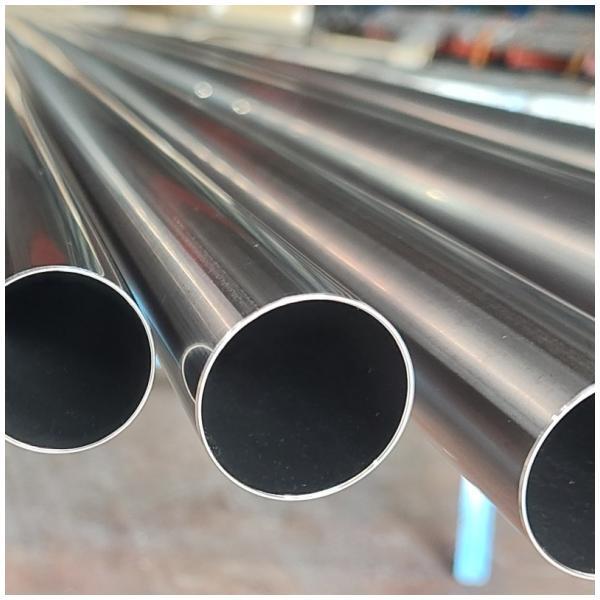
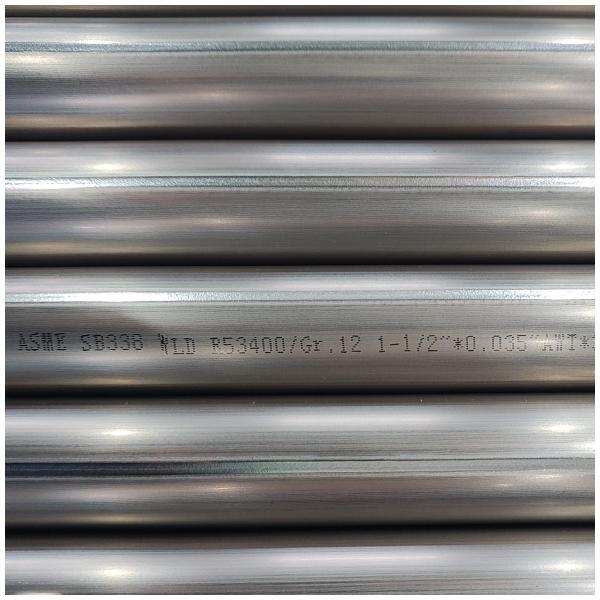
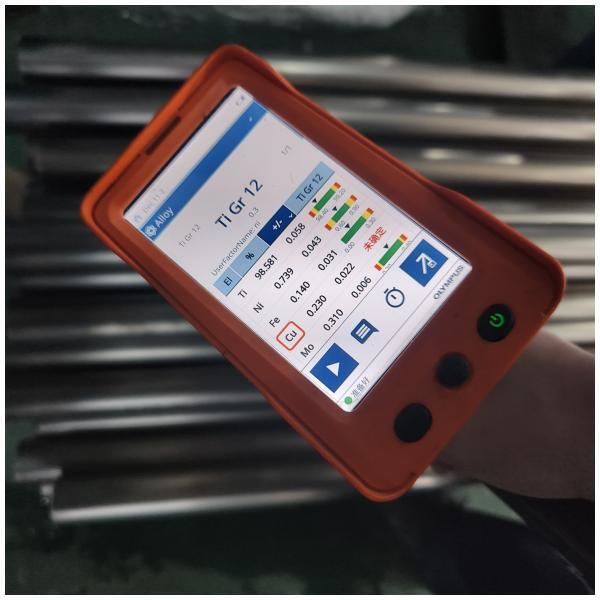
Custom Titanium Tubes • Grade 12 • UNS R53400 Manufacturers, Product
Product Description
Titanium Tubes • Grade 12 • UNS R53400
|
Supported Grades
|
Grade 1, Grade 2, Grade 3, Grade 4, Grade 5, Grade 7, Grade 9, Grade 12, Grade 23, Grade 24, Grade 26, Grade 29 |
|---|---|
|
Supported GOST/BT
|
ВТ1-00, ВТ1-0, ВТ1-2, ВТ1-1, ВТ6, ПТ-7М, ВТ3-1, ПТ-3В, ВТ6С, ВТ6, ПТ-3В, ВТ6С |
|
Manufacturing Standard
|
AMS 4941/4942, ВТ1-0 (VT1-0), ASTM B861 (Seamless), ASTM B862 (Welded), ASTM B338 |
|
Outside Diameter (OD)
|
12.7 – 330 mm (Seamless Tube), 15.88 – 209 mm (Welded Tube) |
|
Wall Thickness (WT)
|
0.4 – 10 mm (Seamless Tube), 0.5 mm – 8 mm (Welded Tube) |
|
Length
|
As customer's request |
|
Quality Control
|
100% NDT (UT/ET), Hydrostatic Test, MTC 3.1 (Mill Test Certificate) |
|
Customization
|
Custom sizes, special lengths, and end finishes (PE/BE) available |
Chemical Composition (in % by mass)
| Grade | Ti | Oxygen (O) | Fe | C | N | Mo | Ni | H | Others |
|---|---|---|---|---|---|---|---|---|---|
| Max. | Max. | Max. | Max. | Max. | |||||
| Gr.12 | Remainder | 0.25 | 0.3 | 0.08 | 0.03 | 0.2-0.4 | 0.6-0.9 | 0.015 | - |
Mechanical Property & Heat Treatment
| Grade | Rp 0.2 Mpa | Rp 1.0 Mpa | Rm Mpa | A (%) | Hardness (HRB) | Heat Treatment |
|---|---|---|---|---|---|---|
| Min. | Min. | Min. - Max. | Min. | Max. | ||
| Gr.12 | 345 | - | 483 | 18 | - | Annealed |
Tube Size Commonly Used
| OD | Thickness (mm) | |||||||||||||
|---|---|---|---|---|---|---|---|---|---|---|---|---|---|---|
| (mm) | 0.50 | 0.70 | 0.80 | 0.89 | 1.00 | 1.20 | 1.24 | 1.50 | 1.65 | 2.00 | 2.11 | 2.50 | 2.77 | 3.05 |
| 6.00 | x | x | x | x | x | x | x | x | ||||||
| 6.35 | x | x | x | x | x | x | x | x | x | |||||
| 7.00 | x | x | x | x | x | x | x | x | ||||||
| 7.50 | x | x | x | x | x | x | x | x | ||||||
| 8.00 | x | x | x | x | x | x | x | x | ||||||
| 9.00 | x | x | x | x | x | x | x | x | ||||||
| 9.53 | x | x | x | x | x | x | x | x | x | |||||
| 10.00 | x | x | x | x | x | x | x | x | ||||||
| 11.00 | x | x | x | x | x | x | x | x | ||||||
| 12.00 | x | x | x | x | x | x | x | x | x | |||||
| 12.70 | x | x | x | x | x | x | x | x | x | x | x | |||
| 13.00 | x | x | x | x | x | x | x | x | ||||||
| 14.00 | x | x | x | x | x | x | x | x | ||||||
| 15.00 | x | x | x | x | x | x | x | x | ||||||
| 15.88 | x | x | x | x | x | x | x | x | x | x | x | |||
| 16.00 | x | x | x | x | x | x | x | x | x | x | ||||
| 17.15 | x | x | x | x | x | x | x | x | x | x | x | |||
| 18.00 | x | x | x | x | x | x | x | x | x | x | ||||
| 19.00 | x | x | x | x | x | x | x | x | x | x | ||||
| 19.05 | x | x | x | x | x | x | x | x | x | x | x | x | x | |
| 20.00 | x | x | x | x | x | x | x | x | x | x | x | x | x | |
| 21.34 | x | x | x | x | x | x | x | x | x | x | x | x | x | |
| 22.00 | x | x | x | x | x | x | x | x | x | x | x | x | x | |
| 22.23 | x | x | x | x | x | x | x | x | x | x | x | x | x | |
| 23.00 | x | x | x | x | x | x | x | x | x | x | x | x | x | |
| 24.00 | x | x | x | x | x | x | x | x | x | x | x | x | x | |
| 25.00 | x | x | x | x | x | x | x | x | x | x | x | x | x | x |
| 25.40 | x | x | x | x | x | x | x | x | x | x | x | x | x | x |
| 26.00 | x | x | x | x | x | x | x | x | x | x | x | x | x | x |
| 26.67 | x | x | x | x | x | x | x | x | x | x | x | x | x | x |
| 26.90 | x | x | x | x | x | x | x | x | x | x | x | x | x | x |
| 28.00 | x | x | x | x | x | x | x | x | x | x | x | x | x | x |
| 28.58 | x | x | x | x | x | x | x | x | x | x | x | x | x | x |
| 30.00 | x | x | x | x | x | x | x | x | x | x | x | x | x | x |
| 31.75 | x | x | x | x | x | x | x | x | x | x | x | x | x | x |
| 32.00 | x | x | x | x | x | x | x | x | x | x | x | x | x | x |
| 33.40 | x | x | x | x | x | x | x | x | x | x | x | x | x | x |
| 35.00 | x | x | x | x | x | x | x | x | x | x | x | x | x | x |
| 36.00 | x | x | x | x | x | x | x | x | x | x | x | x | x | x |
| 38.10 | x | x | x | x | x | x | x | x | x | x | x | x | x | x |
| 42.00 | x | x | x | x | x | x | x | x | x | x | ||||
| 44.50 | x | x | x | x | x | x | x | x | x | |||||
| 48.26 | x | x | x | x | x | x | x | |||||||
| 50.80 | x | x | x | x | x | x | x | x | x | x | x | |||
Frequently Asked Questions (FAQ)
What are the primary applications of Grade 12 Titanium Tubes?
Grade 12 Titanium (UNS R53400) contains small additions of Molybdenum and Nickel, providing high strength and superior corrosion resistance, especially in crevice corrosion environments. It is extensively used in chemical processing, marine heat exchangers, power generation plants, and desalinization equipment.
What is the difference between seamless and welded Titanium Grade 12 tubes?
Seamless titanium tubes (ASTM B861) are manufactured from hollow billets without any weld seams, making them suitable for high-pressure and critical applications. Welded tubes (ASTM B862) are produced from flat-rolled strip or sheet through an automated welding process, offering economical solutions for standard pressure systems and heat exchangers.
How does Titanium Grade 12 compare with commercially pure Grade 2 Titanium?
Grade 12 offers higher elevated-temperature strength than Grade 2 due to its Mo and Ni alloying elements. Furthermore, Grade 12 exhibits superior resistance to crevice corrosion in acidic chloride solutions compared to Grade 2.
What quality control and testing procedures are included with these tubes?
All titanium tubes undergo 100% Non-Destructive Testing (NDT), including Ultrasonic Testing (UT) or Eddy Current Testing (ET), along with Hydrostatic Testing. Every shipment is supplied with EN 10204 3.1 Mill Test Certificates (MTC) detailing complete chemical analysis and mechanical testing records.
Can custom sizes, lengths, and end preparations be specified?
Yes, custom outside diameters, non-standard wall thicknesses, fixed lengths, and special pipe end preparations such as Plain Ends (PE) or Beveled Ends (BE) can be produced upon request.




