
Featured Super Austenitic & High-Alloy Tubing Solutions (Part I)
Explore our certified mill inventory of premium super austenitic steels, heat exchanger tubes, and corrosion-resistant alloys built to stringent ASTM, ASME, and EN international standards.





Understanding Super Austenitic Steels: Metallurgical Whitepaper & Engineering Fundamentals
In modern industrial process environments—where localized pitting, crevice corrosion, and chloride-induced stress corrosion cracking (SCC) rapidly destroy standard 304L or 316L stainless steels—Super Austenitic Steels serve as the definitive material boundary between conventional stainless alloys and high-cost nickel-base alloys.
Super austenitic stainless steels are defined metallurgically by their high chromium (19%–25%), high nickel (17%–26%), and elevated molybdenum (4.5%–7.5%) content, intentionally fortified with nitrogen alloying (0.15%–0.50%). This specific chemical synergy elevates the material's Pitting Resistance Equivalent Number (PREN) beyond 42–56, enabling flawless operational reliability in aggressive halide solutions, brackish fluids, and acidic media.
Role of Nitrogen Alloying
Nitrogen increases yield strength without impairing ductility or toughness. Metallurgically, nitrogen retards the precipitation of intermetallic inter-phase compounds (such as Sigma σ and Chi χ phases) during hot working and bright annealing operations.
Pitting & Crevice Corrosion Mechanics
The combination of 6% Molybdenum and Nitrogen forms a highly stable passive chromium-molybdenum-oxide film on the tube ID and OD surfaces. This film prevents halide ion penetration under severe thermal and mechanical stresses.
Microstructural Phase Stability
Maintaining a 100% stable fully austenitic microstructure requires precise control of Nickel equivalent ($Ni_{eq}$) vs. Chromium equivalent ($Cr_{eq}$). Modern VOD/AOD refining ensures ultra-low carbon levels ($C \le 0.020\%$).
Material Selection Matrix: Super Austenitic Steel Grade Specifications
Compare mechanical benchmarks, UNS/EN standards, chemistry breakdowns, and typical corrosion resistance metrics across standard commercial super austenitic alloys.
| Steel Grade | UNS / EN Standard | Nominal Composition | PREN Rating | CPT / CCT (°C) | Primary Industrial Application |
|---|---|---|---|---|---|
| 904L | UNS N08904 / 1.4539 | 20Cr - 25Ni - 4.5Mo - 1.5Cu | 34.0 - 36.0 | 35°C / 20°C | Sulfuric & Phosphoric Acid lines, Fertilizer plants |
| 254SMO (6Mo) | UNS S31254 / 1.4547 | 20Cr - 18Ni - 6.1Mo - 0.20N | 42.5 - 45.0 | 65°C / 35°C | Seawater Desalination (RO), FGD Scrubbers, Pulp Bleaching |
| Alloy 926 (1925hMo) | UNS N08926 / 1.4529 | 20Cr - 25Ni - 6.5Mo - 0.20N | 45.0 - 47.0 | 70°C / 40°C | Offshore Oil & Gas sour gas piping, Chemical synthesis |
| AL-6XN | UNS N08367 / 1.4501 | 20.5Cr - 24Ni - 6.3Mo - 0.22N | 44.0 - 46.5 | 68°C / 38°C | Marine condensers, Pharmaceutical pure water systems |
| 654SMO (7Mo) | UNS S32654 / 1.4652 | 24Cr - 22Ni - 7.3Mo - 0.50N | 54.0 - 56.0 | 85°C / 50°C | Ultra-aggressive marine environments, Hot concentrated acids |
Note: PREN is calculated via equation: $\text{PREN} = \% \text{Cr} + 3.3 \times \% \text{Mo} + 16 \times \% \text{N}$. Critical Pitting Temperature (CPT) and Critical Crevice Temperature (CCT) values are determined per ASTM G48 testing protocol.
Strategic Value: Super Austenitic Steels China Factory & Manufacturing Excellence
sourcing super austenitic steel products from advanced Chinese mill facilities yields unmatched economic efficiencies, modern metallurgical equipment, and end-to-end supply chain resiliency.
Optimized Total Cost of Ownership (TCO)
Chinese factories leverage fully integrated domestic supply chains for high-purity Nickel, Molybdenum, and Chromium raw materials. Combined with automated cold-drawing lines, this yields a 20% to 35% cost reduction compared to Western European alternatives without compromising alloy performance.
State-of-the-Art Cold Working & Pilgering
Our modern factory floors utilize high-precision multi-roll Cold Pilger mills and automatic hydraulic cold drawing benches capable of producing seamless and welded & drawn (W&D) tubes with tight outer diameter (OD) tolerances down to ±0.05 mm and smooth inner surface finish ($R_a < 0.4 \mu m$).
Continuous Hydrogen Bright Annealing
To ensure complete solution annealing of 6% Mo grades without precipitating brittle intermetallic phases, our facilities use continuous roller-hearth bright annealing furnaces filled with 100% high-purity hydrogen gas at temperatures up to 1170°C, followed by rapid water quench.
Rigorous Quality Control & EN 10204 3.1 / 3.2
Every single batch of tubes undergoes mandatory hydrostatic testing, eddy current inspection (ET per ASTM E426), ultrasonic testing (UT), mechanical yield/tensile checks, and intergranular corrosion testing (ASTM A262 Practice E) verified with full EN 10204 3.1 mill certificates.
Macro Industry Solutions & High-Performance Application Scenarios
Engineering teams across critical global industries specify super austenitic steels for environments where material failure means catastrophic downtime or safety risks.
Seawater Reverse Osmosis (SWRO) & Desalination
High-pressure piping manifolds, heat exchanger U-tubes, and brine recirculating systems in coastal desalination plants face chloride concentrations exceeding 20,000 ppm at elevated pressures. 254SMO (UNS S31254) and Alloy 926 provide total immunity to crevice corrosion under tight gasket fittings.
Flue Gas Desulfurization (FGD) Scrubbers
Coal-fired power stations and marine vessel scrubbers utilize super austenitic tubing in gas reheaters, spray headers, and slurry pumps where condensate mixes with sulfur dioxide ($SO_2$) and chlorides, creating extremely corrosive low-pH acidic slurries.
Phosphoric & Sulfuric Acid Processing
In wet-process phosphoric acid production and fertilizer manufacturing, trace fluorides, chlorides, and free sulfuric acid destroy standard alloys. 904L (UNS N08904) with its 1.5% copper addition delivers exceptional passivity across all acid concentration curves.
Offshore Oil & Gas Sour Gas Handling
Subsea umbilical lines, flowlines, and hydraulic control tubing operating under NACE MR0175/ISO 15156 conditions demand high resistance to sulfide stress cracking (SSC) and hydrogen embrittlement caused by $H_2S$-laden sour gas environments.
Semiconductor & Ultra-Pure Gas Piping
Advanced microchip fabrication plants specify electropolished (EP) super austenitic tubing for carrying ultra-pure chemicals, aggressive cleaning acids, and corrosive precursor gases without metallic ion contamination.
Global Procurement Guide: Evaluating Manufacturers & Quality Assurance
When sourcing super austenitic steel tubing globally, procurement managers and EPC engineers must execute rigorous factory audits and technical validation to avoid high-risk material substitution.
1. Raw Material Heat Verification
Ensure raw hollows or coils originate exclusively from premier VOD/AOD stainless steel melt shops. Review incoming chemical analysis certificates to verify Nitrogen and Molybdenum fractions meet minimum tolerance thresholds.
2. Welded vs. Seamless Tube Selection
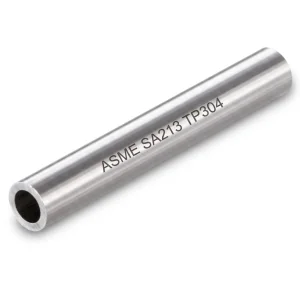
Determine whether your design code allows autogenously welded and cold-drawn tubing (ASTM A249 / ASTM B675) or mandates seamless tubing (ASTM A213 / ASTM B676). Cold-drawn welded tubes offer tighter wall concentricity at reduced costs.
3. Third-Party Inspection (TPI) Protocols
Require independent third-party inspection (TUV, SGS, BV, DNV) for critical orders. Inspection plans should include dimensional verification, PMI (Positive Material Identification), NDT flaw detection, and hydrostatic holding pressure checks.
4. Packaging & Overseas Logistics Protection
Super austenitic tubes must be packaged in ISPM-15 compliant wooden cases, with ends plugged using heavy-duty plastic caps, wrapped in vapor-corrosion-inhibitor (VCI) plastic film to prevent marine atmosphere surface contamination during transit.
High-Performance Austenitic & Nickel Alloy Tubing Portfolio (Part II)
Discover our comprehensive range of specialized stainless steel pipes, titanium tubes, and heat exchanger components tailored for industrial piping installations.







Frequently Asked Questions: Technical Engineering & Factory Sourcing Guide
Get immediate answers to engineering, metallurgical, and supply chain queries from our technical specialist team.
What is the primary technical difference between 316L and 254SMO (UNS S31254)?
While 316L contains 2%–3% Molybdenum with a PREN of approximately 24, 254SMO is a 6% Molybdenum super austenitic steel alloyed with 0.20% Nitrogen, yielding a PREN ≥ 42.5. 254SMO provides nearly double the yield strength of 316L and offers absolute resistance to chloride pitting and crevice corrosion in seawater and aggressive acidic environments where 316L rapidly fails due to stress corrosion cracking.
Why is Nitrogen intentionally added to 6% Molybdenum super austenitic stainless steels?
Nitrogen acts as a potent interstitial solid-solution strengthener and austenite stabilizer. It increases mechanical yield strength without reducing ductility. Metallurgically, nitrogen impedes the precipitation of harmful intermetallic phases (σ-phase and χ-phase) during high-temperature processing and welding, preserving high critical pitting temperatures (CPT).
What heat treatment temperature is required for super austenitic tubes after cold drawing?
Super austenitic tubes must undergo continuous solution bright annealing at elevated temperatures between 1120°C and 1170°C (2050°F to 2140°F) in a 100% dry hydrogen atmosphere, followed by rapid water cooling or forced gas quenching. This high-temperature regime redissolves any chromium-molybdenum precipitates back into the austenitic matrix.
Can super austenitic steel tubes be welded using standard TIG or MIG procedures?
Yes, but proper filler metals must be selected. Because autogenous welding without filler metal can cause molybdenum segregation in the weld metal microstructure (reducing local PREN), matching or over-alloyed nickel-base filler metals (such as Alloy 625 / ERNiCrMo-3) are recommended to maintain full corrosion resistance across the weld zone.
How do China super austenitic steel factory prices compare to European suppliers?
Sourcing super austenitic tubing directly from certified Chinese factories provides a cost reduction of 20% to 35% on average. This cost advantage stems from localized raw material refining scale, streamlined manufacturing automation, and integrated cold-pilgering infrastructure, all while adhering to identical ASTM/EN testing norms.
What non-destructive testing (NDT) certifications accompany factory shipments?
Standard production includes 100% Hydrostatic testing (up to 300 Bar), Eddy Current testing (per ASTM E426), Air-under-water testing for U-bent tubes, dimensional wall verification, microstructural grain size analysis, and intergranular corrosion test reports certified under EN 10204 3.1 or 3.2 TPI documentation.
When should an engineer specify Super Duplex (e.g. 2507) versus Super Austenitic (e.g. 254SMO)?
Super Duplex (UNS S32750) provides higher yield strength and lower cost, making it ideal for high-pressure subsea pipelines. However, Super Austenitic (254SMO) should be specified when service temperatures exceed 250°C, when forming complex tight-radius bends, or in aggressive acid media (such as pure sulfuric acid) where duplex two-phase microstructures can suffer selective phase attack.
What custom dimensions and surface finishes can be ordered from the factory?
Factory production covers outer diameters (OD) from 4.00 mm to 114.30 mm, wall thickness (WT) from 0.40 mm to 3.05 mm, and straight lengths up to 25 meters (or continuous coiled tubing up to 1000m). Available surface finishes include Bright Annealed (BA), Annealed & Pickled (AP), Mechanical Polished (Grit 180–600), and Electropolished (EP).
