1 / 1
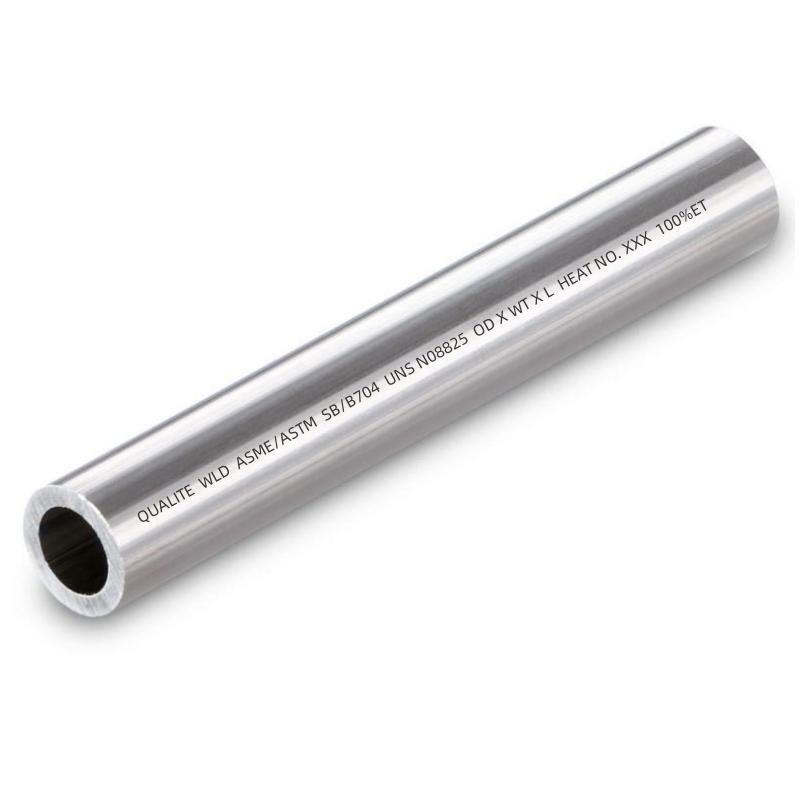
High-Quality Nickel Alloy Tubes 825 • UNS N08825 • 2.4858 Manufacturers, Products
Product Description
Alloy 825 Nickel Alloy Tubes, 2.4858 Nickel Alloy Tubes
Chemical Composition (in % by mass)
| Grade | C | Si | Mn | P | S | Cr | Ni | Mo | Fe | Co | W | Ti | Cu | Others |
|---|---|---|---|---|---|---|---|---|---|---|---|---|---|---|
| Max. | Max. | Max. | Max. | Max. | Max. | |||||||||
| N08825 | 0.05 | 1.0 | 19.5-23.5 | 38.0-46.0 | 2.5-3.5 | 6.0 - 10.0 | 0.6-1.2 | 1.5-3.0 | ||||||
| 2.4858 | 0.05 | 1.0 | 19.5-23.5 | 38.0-46.0 | 2.5-3.5 | 6.0 - 10.0 | 0.6-1.2 | 1.5-3.0 |
Mechanical Property & Heat Treatment
| Grade | Rp 0.2 Mpa | Rp 1.0 Mpa | Rm Mpa | A (%) | Hardness (HRB) | Heat Treatment |
|---|---|---|---|---|---|---|
| Min. | Min. | Min. - Max. | Min. | Max. | ||
| N08825 | 241 | 585 | 30 | Solution Annealed | ||
| 2.4858 | 241 | 585 | 30 | Solution Annealed |
Tube Size Commonly Used
| OD | Thickness (mm) | |||||||||||||
|---|---|---|---|---|---|---|---|---|---|---|---|---|---|---|
| (mm) | 0.50 | 0.70 | 0.80 | 0.89 | 1.00 | 1.20 | 1.24 | 1.50 | 1.65 | 2.00 | 2.11 | 2.50 | 2.77 | 3.05 |
| 6.00 | x | x | x | x | x | x | x | x | ||||||
| 6.35 | x | x | x | x | x | x | x | x | x | |||||
| 7.00 | x | x | x | x | x | x | x | x | ||||||
| 7.50 | x | x | x | x | x | x | x | x | ||||||
| 8.00 | x | x | x | x | x | x | x | x | ||||||
| 9.00 | x | x | x | x | x | x | x | x | ||||||
| 9.53 | x | x | x | x | x | x | x | x | x | |||||
| 10.00 | x | x | x | x | x | x | x | x | ||||||
| 11.00 | x | x | x | x | x | x | x | x | ||||||
| 12.00 | x | x | x | x | x | x | x | x | x | |||||
| 12.70 | x | x | x | x | x | x | x | x | x | x | x | |||
| 13.00 | x | x | x | x | x | x | x | x | ||||||
| 14.00 | x | x | x | x | x | x | x | x | ||||||
| 15.00 | x | x | x | x | x | x | x | x | ||||||
| 15.88 | x | x | x | x | x | x | x | x | x | x | x | |||
| 16.00 | x | x | x | x | x | x | x | x | x | x | ||||
| 17.15 | x | x | x | x | x | x | x | x | x | x | x | |||
| 18.00 | x | x | x | x | x | x | x | x | x | x | ||||
| 19.00 | x | x | x | x | x | x | x | x | x | x | ||||
| 19.05 | x | x | x | x | x | x | x | x | x | x | x | x | x | |
| 20.00 | x | x | x | x | x | x | x | x | x | x | x | x | x | |
| 21.34 | x | x | x | x | x | x | x | x | x | x | x | x | x | |
| 22.00 | x | x | x | x | x | x | x | x | x | x | x | x | x | |
| 22.23 | x | x | x | x | x | x | x | x | x | x | x | x | x | |
| 23.00 | x | x | x | x | x | x | x | x | x | x | x | x | x | |
| 24.00 | x | x | x | x | x | x | x | x | x | x | x | x | x | |
| 25.00 | x | x | x | x | x | x | x | x | x | x | x | x | x | x |
| 25.40 | x | x | x | x | x | x | x | x | x | x | x | x | x | x |
| 26.00 | x | x | x | x | x | x | x | x | x | x | x | x | x | x |
| 26.67 | x | x | x | x | x | x | x | x | x | x | x | x | x | x |
| 26.90 | x | x | x | x | x | x | x | x | x | x | x | x | x | x |
| 28.00 | x | x | x | x | x | x | x | x | x | x | x | x | x | x |
| 28.58 | x | x | x | x | x | x | x | x | x | x | x | x | x | x |
| 30.00 | x | x | x | x | x | x | x | x | x | x | x | x | x | x |
| 31.75 | x | x | x | x | x | x | x | x | x | x | x | x | x | x |
| 32.00 | x | x | x | x | x | x | x | x | x | x | x | x | x | x |
| 33.40 | x | x | x | x | x | x | x | x | x | x | x | x | x | x |
| 35.00 | x | x | x | x | x | x | x | x | x | x | x | x | x | x |
| 36.00 | x | x | x | x | x | x | x | x | x | x | x | x | x | x |
| 38.10 | x | x | x | x | x | x | x | x | x | x | x | x | x | x |
| 42.00 | x | x | x | x | x | x | x | x | x | x | ||||
| 44.50 | x | x | x | x | x | x | x | x | x | |||||
| 48.26 | x | x | x | x | x | x | x | |||||||
| 50.80 | x | x | x | x | x | x | x | x | x | x | x | |||
Frequently Asked Questions (FAQ)
Q
What is Alloy 825 (UNS N08825 / 2.4858)?
Alloy 825 (UNS N08825 / 2.4858) is a nickel-iron-chromium alloy with additions of molybdenum, copper, and titanium. It is engineered to provide exceptional resistance to both reducing and oxidizing acids, stress-corrosion cracking, and localized pitting.
Q
What is the chemical composition of UNS N08825 / 2.4858 alloy?
The chemical composition primarily includes 38.0%–46.0% Nickel (Ni), 19.5%–23.5% Chromium (Cr), 2.5%–3.5% Molybdenum (Mo), 1.5%–3.0% Copper (Cu), 0.6%–1.2% Titanium (Ti), and 6.0%–10.0% Iron (Fe), with a maximum carbon content of 0.05%.
Q
What are the mechanical properties of Alloy 825 nickel alloy tubes?
Under the Solution Annealed heat treatment condition, Alloy 825 tubes feature a minimum yield strength (Rp 0.2) of 241 MPa, a minimum tensile strength (Rm) of 585 MPa, and a minimum elongation (A) of 30%.
Q
What heat treatment process is used for Alloy 825 tubes?
Alloy 825 / 2.4858 nickel alloy tubes are typically supplied in the Solution Annealed condition to optimize corrosion resistance and mechanical ductility.
Q
What outer diameters (OD) and wall thicknesses are available for Alloy 825 tubes?
Commonly available outer diameters (OD) range from 6.00 mm to 50.80 mm, with wall thicknesses ranging from 0.50 mm up to 3.05 mm depending on specific dimensional requirements.
Q
Why is Titanium added to Alloy 825 / 2.4858 material?
Titanium (0.6%–1.2%) is added to stabilize the alloy against sensitization to intergranular corrosion during thermal treatment or welding processes.