
Precision Alloy Tubing Showcase
Verified ASTM / ASME / EN Standard Compliant Stock



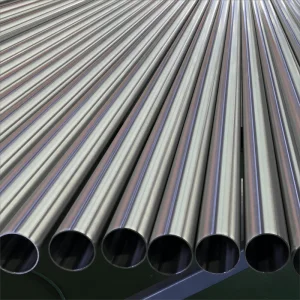




Metallurgical Precision & Manufacturing Route of Stainless Steel Capillary Tubing
Stainless steel capillary tubing represents the pinnacle of micro-dimensional cold-drawing engineering. Defined typically by an outside diameter (OD) spanning from 0.20 mm to 6.35 mm (0.008 to 0.250 inches) and wall thicknesses (WT) ranging from 0.05 mm to 1.00 mm, capillary tubes require exceptional structural integrity, tight dimensional tolerances, and ultra-smooth inner surface roughness ($Ra$) to eliminate flow turbulence and fluid stagnation.
Cold Drawing: Plug Drawing vs. Sink Drawing
The fabrication of high-performance capillary tubing relies on advanced multi-pass cold drawing techniques. The choice of drawing methodology dictates internal geometry and mechanical strength:
- Floating Plug Drawing: Utilizes an internal stationary or floating mandrel during drawing. This guarantees precise inner diameter (ID) control, uniform wall thickness, and an exceptionally smooth internal bore, vital for Chromatography (HPLC) and medical dosing lines.
- Cold Sink Drawing (Tube Sinking): Draws the tube through a die without internal mandrel support. While efficient for reducing outer diameter, it requires post-process electropolishing to maintain stringent internal surface smoothness standards.
Atmospheric Bright Annealing & Grain Boundary Control
Cold working severely strains the austenitic crystal lattice, increasing hardness but decreasing ductility and corrosion resistance.
Our continuous inline Bright Annealing (BA) processes take place under a pure hydrogen or hydrogen-nitrogen reducing atmosphere at temperatures up to 1050°C – 1150°C. This prevents oxide scale formation, stress-relieves the material, dissolves chromium carbides back into the austenitic matrix, and restores maximum resistance to intergranular stress corrosion cracking (SCC).
Comprehensive Material Grade Selection Matrix
Selecting the correct capillary tubing alloy requires evaluating mechanical yield strength, thermal expansion, chemical compatibility, and Pitting Resistance Equivalent Number (PREN).
| Alloy Grade | UNS / EN Designation | PREN Value | Tensile / Yield (MPa) | Max Temp (°C) | Primary Industrial Application |
|---|---|---|---|---|---|
| 304 / 304L | UNS S30400 / 1.4301 UNS S30403 / 1.4307 |
18.0 - 20.0 | ≥ 515 / ≥ 205 | 800°C | General HVAC, medical needles, sensors, food processing lines. |
| 316 / 316L | UNS S31600 / 1.4401 UNS S31603 / 1.4404 |
23.0 - 25.0 | ≥ 515 / ≥ 220 | 870°C | HPLC chromatography, marine sensors, petrochemical instrumentation. |
| 316Ti / 321 | UNS S31635 / 1.4571 UNS S32100 / 1.4541 |
23.0 - 25.0 | ≥ 520 / ≥ 210 | 900°C | High-temperature exhaust sensors, aerospace hydraulic impulse tubes. |
| Super Austenitic 904L | UNS N08904 / 1.4539 | ≥ 34.0 | ≥ 490 / ≥ 220 | 400°C (Acid) | Sulfuric & phosphoric acid dosing, brackish water micro-coolers. |
| Super Duplex 2507 | UNS S32750 / 1.4410 | ≥ 42.0 | ≥ 750 / ≥ 550 | 300°C | Subsea control lines, offshore oil & gas injection, desalination micro-jets. |
| Nickel Alloy C276 | UNS N10276 / 2.4819 | ≥ 68.0 | ≥ 690 / ≥ 283 | 1040°C | Severe sour gas ($H_2S$), wet chlorine gas, pharmaceutical reactors. |
| Titanium Grade 1 / 2 | UNS R50250 / 3.7025 UNS R50400 / 3.7035 |
N/A (Passive Film) | ≥ 345 / ≥ 275 | 600°C | Biomedical implants, aerospace weight-critical fluid systems, marine heat exchangers. |
Macro Industry Solutions & Application Engineering
Capillary tubing acts as the nervous system of modern automated industrial equipment. Our custom-engineered micro-tubes deliver targeted performance across high-stakes sectors.
Analytical Chemistry & HPLC Systems
High-Performance Liquid Chromatography (HPLC) and Gas Chromatography (GC) require zero-dead-volume capillary connections. Our 316L and 904L electropolished tubes withstand pressures up to 15,000 PSI while maintaining precise flow rates without sample contamination or peak broadening.
Medical & Biomedical Micro-Dosing
Compliant with ISO 10993 biocompatibility standards, our medical-grade 304L, 316L, and Titanium Grade 2 capillary tubes are used for surgical needles, endoscopic cannulas, diagnostic probes, and micro-fluidic delivery mechanisms requiring flawless surface cleanliness.
Semiconductor Cleanroom Gas Distribution
Ultra-High Purity (UHP) gas lines in semiconductor fab facilities mandate ultra-low outgassing. Our bright annealed and electropolished capillary tubes feature internal surface finishes down to $Ra \le 0.15\,\mu\text{m}$, packaged in ISO Class 5 cleanroom conditions.
Aerospace & Defense Hydraulic Control Lines
Engineered to endure severe vibration, rapid thermal cycling, and high dynamic pressure surges, titanium and 316Ti capillary tubing feeds critical pitot-static systems, flight control actuators, and jet engine fuel injection nozzles.
Energy, Subsea & Downhole Control Lines
Continuous long-length coiled capillary tubing in Super Duplex 2507 or Nickel Alloy 825 provides downhole chemical injection capabilities in deep-sea oil wells, resisting harsh hydrogen sulfide ($H_2S$) sour service environments.
China Factory 4.0: Supply Chain Resilience & Efficiency Advantages
Leveraging advanced automation, digital twin quality monitoring, and integrated regional raw material supply chains, our Huzhou and Shanghai facilities redefine global cost-efficiency without compromising metallurgical standards.
Raw Material Traceability
Sourced exclusively from premium heat-certified master heats (Baosteel, Tsingshan) with complete EN 10204 3.1 chemical re-verification.
Automated Cold Drawing
Precision multi-pass draw benches equipped with real-time laser micrometer dimensional feedback ensuring ±0.01mm concentricity.
Inline NDT Inspection
Continuous 100% Eddy Current Testing (ECT) and ultrasonic flaw detection integrated directly onto bright annealing lines.
Global Logistics Execution
Streamlined export packaging, customs clearing, and express air/ocean freight coordination direct from Shanghai logistics hubs.
Technology Roadmap & Future Outlook (2025–2035)
As industrial applications shrink in physical footprint while increasing in thermal density and operating pressures, capillary tube engineering is undergoing a technological revolution.
Atomic Layer Deposition (ALD) Coatings
Future capillary lines are integrating nano-scale ceramic coatings (such as $Al_2O_3$ or $TiO_2$) on internal walls via ALD. This technology achieves complete chemical inertness for ultra-sensitive bio-analysis while preventing ion leaching in high-purity water circuits.
Cryogenic Liquid Hydrogen Lines
With the growth of the green hydrogen economy, micro-capillary tubes must maintain fracture toughness at cryogenic temperatures (-253°C). Specialized 316LN and austenitic-ferritic micro-tubing routes are being optimized for zero-leakage hydrogen transport.
Additive-Manufactured Micro-Joints
Combining cold-drawn seamless capillary tubes with 3D-printed transition manifolds via orbital laser welding eliminates mechanical fitting leakage in high-g aerospace and satellite cooling loops.
Localization Support & Compliance Assurance
Procuring specialty alloy tubing across international borders demands total compliance with global pressure vessel codes and regional engineering standards.
Certified Quality Frameworks
Every production batch undergoes exhaustive destructive and non-destructive testing certified in accordance with standard international requirements:
- Material Test Certificates: EN 10204 3.1 as standard; independent 3.2 inspection (TÜV, SGS, Lloyd's Register) upon request.
- Design Standards: ASTM A632 (Small-Diameter Stainless Tubing), ASTM A269, ASTM A213, ASME SA249, EN 10217-7, EN 10216-5.
- Pressure Directives: PED 2014/68/EU compliance for European pressure equipment integration.
Global Enterprise Procurement Support
We accommodate diverse international purchasing requirements through tailored commercial and supply chain services:
- Custom Form Factors: Straight cut lengths (up to 25 meters), continuous orbital-welded coils, or custom-bent U-tubes.
- Vendor Managed Inventory (VMI): Dedicated buffer stock maintenance in Shanghai warehouses for OEM contracted customers.
- Secure Packaging: Wooden crate encapsulation, plastic end-capping, and vapor-corrosion inhibitor (VCI) shrink wrapping for sea export.
Engineering Q&A: Capillary Tube Procurement & Technical Specifications
Direct technical answers to common questions raised by procurement leads and system design engineers.
How do you calculate the maximum working pressure for stainless steel capillary tubing?
Maximum internal working pressure is calculated using Barlow’s Formula: $P = \frac{2 \cdot S \cdot t}{D \cdot SF}$, where $P$ is pressure, $S$ is allowable stress value of the alloy grade, $t$ is nominal wall thickness, $D$ is outer diameter, and $SF$ is the engineering safety factor (typically 1.5 to 3.0 depending on design code). Because capillary tubes feature a very small $D$ relative to wall thickness $t$, they can safely sustain extremely high operating pressures (e.g., 10,000 to 20,000 PSI).
What is the difference between Bright Annealed (BA) and Electropolished (EP) capillary tubing?
Bright Annealed (BA) tubing is heat treated in a controlled inert atmosphere (pure hydrogen/argon), yielding a mirror-like bright surface without scaling while maintaining standard inner surface roughness ($Ra \approx 0.4 - 0.8\,\mu\text{m}$). Electropolished (EP) tubing undergoes a secondary electrochemical process that selectively dissolves surface peaks, achieving ultra-smooth micro-finishes ($Ra \le 0.15\,\mu\text{m}$), removing iron contaminants, and building an ultra-pure chromium oxide passive layer essential for semiconductor UHP gas lines.
What dimensional tolerances can be guaranteed for micro-capillary orders?
Our standard production lines adhere strictly to ASTM A632 specifications. For special instrumentation and medical applications, we provide custom tight-tolerance cold drawing capable of holding Outer Diameter (OD) tolerances within $\pm 0.01\,\text{mm}$ ($\pm 0.0004\,\text{in}$) and Wall Thickness (WT) variation within $\pm 5\%$.
How do you prevent capillary tube clogging or internal residue during transit?
All capillary tubes undergo multi-stage ultrasonic solvent degreasing and high-pressure nitrogen purging post-drawing. Ends are immediately fitted with tight elastomeric dust caps or heat-sealed plastic plugs before outer vacuum poly-bagging to prevent moisture ingress or atmospheric oxidation.
Can capillary tubing be supplied in continuous coiled lengths?
Yes. Depending on outer diameter and wall thickness, we supply seamless and welded capillary tubes in continuous coil reels up to 500 meters (1,640 feet) long without orbital welds, or longer lengths with certified micro-orbital welds to support automated continuous line installations.
Specialty Alloy & Titanium Tube Products
High Temperature, Nickel Alloy & Titanium Solutions







Request Technical Datasheet & Custom Quote
Our metallurgists and technical sales specialists are available to review your custom drawing, chemical compatibility requirements, and dimension specs. Receive detailed quotes within 24 business hours.
