
High-Performance Alloy & Specialty Tube Coils
Explore our certified corrosion-resistant tube portfolio produced under stringent ISO 9001:2015 quality controls and ASTM/ASME standards.







Global Demand Dynamics for Custom Titanium Tube Coils in Extreme Environments
In the modern industrial processing ecosystem, fluid dynamics and thermal management equipment operate under increasingly aggressive thermal, mechanical, and corrosive regimes. Custom titanium tube coils represent the zenith of corrosion-resistant thermal engineering, offering an unprecedented strength-to-weight ratio, total immunity to chloride-induced pitting, and resistance to erosion-corrosion in high-velocity media.
Desalination & Marine Industry
With global water scarcity driving massive adoption of Multi-Stage Flash (MSF), Multiple-Effect Distillation (MED), and Reverse Osmosis (RO) energy recovery units, titanium tube coils provide non-degrading performance against concentrated brine and hypochlorite dosing.
Chemical & Petrochemical Processing
In aggressive chemical synthesis involving wet chlorine gas, nitric acid, organic acids, and oxidizing metal chlorides, titanium tube coils eliminate catastrophic equipment failure and expensive un-scheduled turnarounds.
Green Hydrogen & Renewable Energy
Next-generation PEM (Proton Exchange Membrane) electrolyzers and geothermal heat pumps leverage custom continuous titanium tube coils to handle ultra-pure water loops, corrosive geothermal condensates, and high-pressure hydrogen chilling.
Titanium Grade Selection Matrix & Microstructural Engineering
Selecting the optimal titanium alloy grade for coiled tube heat exchangers requires a deep evaluation of mechanical tensile constraints, operating temperature thresholds, and chemical passivity kinetics.
| Grade / Alloy | UNS Standard | Yield Strength (Min) | Tensile Strength (Min) | Chemical Resistance Specialty | Primary Industrial Application |
|---|---|---|---|---|---|
| Titanium Grade 1 | UNS R50250 | 170 MPa (25 ksi) | 240 MPa (35 ksi) | Maximum ductileness, cold formability & passivity | Deep-drawn pancake coils, complex bending, plate frame coils |
| Titanium Grade 2 | UNS R50400 | 275 MPa (40 ksi) | 345 MPa (50 ksi) | Optimum balance of strength, formability, & oxidation resistance | Standard shell-and-tube heat exchangers, ocean heating coils |
| Titanium Grade 7 (Ti-Pd) | UNS R52400 | 275 MPa (40 ksi) | 345 MPa (50 ksi) | 0.12-0.25% Palladium added; ultimate crevice corrosion defense | Reducing acid environments, HCl/H2SO4 media processing |
| Titanium Grade 12 (Ti-Mo-Ni) | UNS R53400 | 345 MPa (50 ksi) | 483 MPa (70 ksi) | 0.3% Mo + 0.8% Ni; high-temperature creep & brine stability | High-temp geothermal heat exchangers, severe chloride evaporators |
| Titanium Grade 9 (Ti-3Al-2.5V) | UNS R56320 | 483 MPa (70 ksi) | 621 MPa (90 ksi) | Near-alpha alloy; extreme hydraulic burst strength rating | Subsea hydraulic control coils, aerospace fluid conduits |
Passive Oxide Film Dynamics
The exceptional corrosion immunity of titanium coils stems from the instantaneous formation of a dense, tenacious, self-healing Titanium Dioxide (TiO₂) passive film. Even when mechanically damaged, oxygen trace quantities in the fluid reform this film within nanoseconds.
Erosion-Corrosion Thresholds
Unlike copper-nickel (Cu-Ni) alloys limited to fluid velocities below 2.5 m/s, custom titanium tube coils withstand flow velocities exceeding 20 m/s without experiencing protective layer shear failure or localized pitting.
Chlorides & Stress Corrosion Cracking
Austenitic stainless steels (304, 316) suffer severe chloride stress corrosion cracking (SCC) at temperatures above 60°C. Commercially pure titanium tube coils exhibit total immunity to SCC in boiling seawater up to 260°C.
Cold Forming, CNC Mandrel Bending & Heat Treatment Procedures
Manufacturing high-integrity custom titanium tube coils requires specialized cold forming equipment, proprietary lubricants, controlled bending mechanics, and inert gas shielding to avoid work-hardening micro-cracks and oxygen embrittlement.
Continuous Seamless Tube Draw
Seamless titanium tubes (ASTM B338 / ASME SB338) are cold-pilgered and precision-drawn to yield joint-free single coils extending up to 1,200 meters, eliminating weld seam vulnerability.
Vacuum Bright Annealing
Post-coiling stress relief is executed in ultra-high vacuum furnaces (10⁻⁵ Torr) at 650°C to 720°C, restoring ductility and removing residual tensile stress without surface discoloration or alpha-case contamination.
CNC Helical & Serpentine Bending
Automated multi-axis CNC bending machines maintain tight wall-thinning control (less than 8% wall reduction) and ovality ratios below 5%, ensuring optimal fluid dynamics inside the coiled circuit.
Orbital Inert-Gas Welding
For extended coil assemblies requiring tie-in joints, closed-chamber orbital TIG welding is performed with Grade 99.999% pure Argon trailing gas shields to prevent interstitial hydrogen/oxygen pickup.
Heat Transfer Efficiency & Pressure Drop Optimization
While thermal conductivity of Commercially Pure Titanium (21.9 W/m·K) is lower than carbon steel, its superior mechanical strength allows design engineers to specify ultra-thin wall tubing (e.g., 0.5mm to 0.89mm WT). This dramatically minimizes conductive wall resistance and maximizes overall heat transfer coefficients (U-values).
Secondary Flow & Dean Vortices
Curved helical tube coils induce centrifugal forces that generate dual counter-rotating fluid flows known as Dean Vortices. This secondary flow disrupts the thermal boundary layer, increasing inner-tube heat transfer efficiency by 150% to 280% compared to straight tube bundles.
Fouling Factor Reduction
Titanium's smooth surface profile (Ra < 0.4 µm) combined with continuous high fluid shear stress dramatically inhibits biological biofouling, scale deposition, and crystal nucleation, keeping thermal efficiency constant over decades of operation.
Compact Footprint Engineering
By utilizing coiled configurations (pancake, double-helical, or concentric multi-layer coils), thermal processing equipment achieves up to 70% volumetric footprint reduction compared to traditional straight tube-and-shell heat exchangers.
Regional Field Applications & International Quality Compliance
Our custom titanium tube coils are specified by global EPC engineering firms, OEM equipment fabricators, and chemical plant operators across North America, Europe, the Middle East, and the Asia-Pacific region.
Gulf Coast Subsea & Offshore
Deepwater oil fields require continuous titanium Grade 9 coils for umbilical lines, chemical injection conduit lines, and subsea hydraulic control loops rated up to 15,000 PSI operating pressures per ASME B31.3.
Desalination & Petrochem
Major SWRO and MED desalination complexes in Saudi Arabia and the UAE rely on Titanium Grade 2 coils for high-temperature brine heaters, acid-dosing heat recovery units, and hypochlorite chlorination lines.
Green Energy & PED Compliance
European chemical plants and green hydrogen plants require full compliance with the Pressure Equipment Directive (PED 2014/68/EU), EN 13445, and material traceability to EN 10204 3.1/3.2 certification.
Nuclear & Power Generation
Coastal nuclear reactors and steam turbine plants deploy titanium tube coils inside surface condensers and feedwater preheaters to withstand aggressive bio-fouling and high silt seawater dynamics.
Rigorous Quality Protocol for Pressure Containment
Every custom titanium tube coil leaving our facility undergoes 100% non-destructive testing (NDT) to ensure absolute structural integrity, pressure tightness, and dimensional precision under severe working conditions.
| Inspection Protocol | Governing Specification | Testing Parameters | Quality Objective |
|---|---|---|---|
| Eddy Current Testing (ET) | ASTM E426 / ASTM B338 | 100% full-circumference electromagnetic scan | Detect longitudinal and transverse subsurface flaws |
| Hydrostatic Pressure Test | ASTM A1047 / ASME SA338 | Pressures up to 300 Bar (4,350 PSI) sustained for 60s | Verify mechanical yield margin and leak tightness |
| Pneumatic Air-Under-Water Test | Factory Standard Inspection | Submerged testing at 10 to 25 Bar compressed nitrogen | Detect micro-porosity and bubble leaks in coiled bends |
| Positive Material Identification (PMI) | ASTM E1476 | X-Ray Fluorescence (XRF) alloy verification | Guarantee exact titanium grade chemical compliance |
| Dimensional & Ovality Check | ISO 2768-m / Client Drawing | Laser micrometry across outer diameter & bend radius | Maintain tight outer diameter tolerances within ±0.05 mm |
Next-Generation Coiling Technologies & Future Outlook
As industrial processes shift toward carbon-neutral goals, our engineering laboratory continuously advances titanium coiling technology to meet demanding future operating limits.
Micro-Finned Inner Diameter Coils
Development of internally ribbed continuous titanium coils to increase internal surface area by 40%, enhancing refrigerant condensation in heat pump systems.
Ultra-High Pressure Grade 9 Coils
Expansion of seamless Ti-3Al-2.5V continuous spooling capacities for offshore hydrogen storage and subsea gas reinjection loops up to 20,000 PSI.
Additive Metal Hybrid Junctions
Integrating 3D-printed titanium manifold headers directly onto continuous coils to eliminate mechanical flange joints and reduce fluid friction losses.
Cryogenic Titanium Coils
Optimization of low-interstitial Grade 1 (Ti-ELI) coils for liquid hydrogen (LH2) thermal exchangers operating at cryogenic temperatures down to -253°C.
Complementary Stainless Steel, Duplex & Titanium Tubing
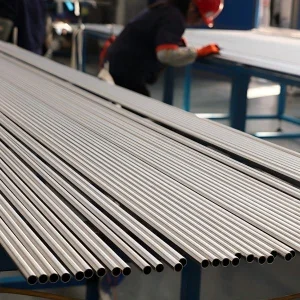
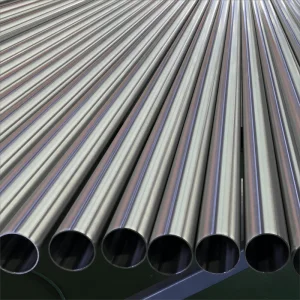
Browse our full range of specialty tubing manufactured to exact industrial dimensions and heat-treated conditions.






Engineering Q&A: Titanium Coiled Tube Procurement & Design
Direct technical answers provided by our senior metallurgical and mechanical engineering specialists.
What is the minimum bend radius (R/D ratio) achievable for Titanium Grade 2 tube coils without wall collapse?
For standard cold rotary hydraulic bending of Titanium Grade 2 tubing, the recommended minimum centerline bend radius (R) is 2.0 to 2.5 times the tube outside diameter (D) using internal mandrel support. With custom internal hydraulic counter-pressure toolings, an R/D ratio of 1.5D can be achieved while maintaining wall thinning under 10% and ovality below 5%.
Should I select Seamless (ASTM B338) or Welded & Drawn Titanium Tubing for coiled heat exchangers?
Continuous Seamless Titanium Tubing (ASTM B338) is preferred for ultra-high pressure applications (>150 Bar), subsea umbilical lines, and critical nuclear service where longitudinal welds are restricted by code. Welded and Cold-Drawn Titanium Tubing (ASTM B338 / B862) undergoes full cold-reduction of the weld seam, yielding identical burst strength and dimensional tolerances to seamless tubing at a 15% to 25% cost reduction.
How does Titanium Grade 7 compare with Titanium Grade 2 in acidic media?
Titanium Grade 7 contains 0.12% to 0.25% Palladium (Pd). This minor precious metal addition dramatically shifts the cathodic polarization curve, lowering corrosion rates in reducing acids (such as Hydrochloric, Sulfuric, and Phosphoric acids) by up to 100-fold compared to unalloyed Grade 2, especially in tight crevice gaps where oxygen replenishment is starved.
What inspection certificates accompany custom titanium tube coil orders?
Every shipment includes an inspection certificate according to EN 10204 3.1 detailing chemical composition (XRF/ICP), mechanical tensile/yield tests, flattening/flaring tests, 100% Eddy Current results, and hydrostatic test charts. Third-party inspection (TPI) by DNV, Lloyd's Register, TUV, or BV for EN 10204 3.2 certification is supplied upon specification.
