
High-Grade Austenitic & Specialty Tubing Solutions
Engineered to precise ASTM, ASME, and EN specifications. Inspected with full EN 10204 3.1/3.2 traceability for critical industrial environments.







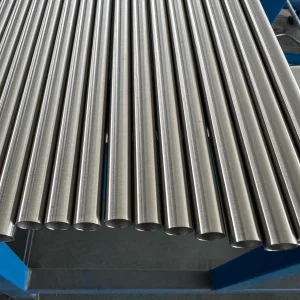
Executive Technical Analysis: The Strategic Role of Stainless Steel 304 Tubing
In modern industrial infrastructure, Austenitic Stainless Steel Grade 304 (UNS S30400 / EN 1.4301) remains the fundamental baseline material for fluid transport, thermal processing, and structural tubing systems. Defined by its nominal chemical synthesis of 18% Chromium and 8% Nickel, AISI 304 presents an optimal thermodynamic balance between intergranular corrosion resistance, deep-drawing formability, and structural yield strength.
As global procurement mandates shift toward life-cycle optimization and zero-defect compliance, relying on standard off-the-shelf commercial tubing introduces operational friction. Custom tube fabrication—engineered around explicit wall thickness tolerances ($TOL \le \pm 5\%$), tailored surface roughness ($Ra < 0.4\ \mu\text{m}$ for sanitary applications), and specific mechanical temper states—is now the standard requirement for Tier-1 OEMs, EPC contractors, and system integrators worldwide.
Metallurgical Properties & Structural Dynamics of 304 vs. 304L vs. 304H
Selecting the correct sub-variant of Grade 304 is critical for preventing in-service catastrophic failures such as Stress Corrosion Cracking (SCC) or Sensitization during welding.
| Alloy Grade | UNS / EN Standard | Carbon Limits (%) | Key Metallurgical Trait | Optimal Industry Application |
|---|---|---|---|---|
| Standard 304 | UNS S30400 / 1.4301 | ≤ 0.08% | General purpose corrosion resistance & high ductility. | Structural framing, general fluid lines, decorative. |
| Low Carbon 304L | UNS S30403 / 1.4307 | ≤ 0.03% | Prevents Chromium Carbide precipitation during welding. | Heavy-wall welded piping, heat exchangers, chemical tanks. |
| High Carbon 304H | UNS S30409 / 1.4948 | 0.04% - 0.10% | Enhanced creep strength at elevated temperatures (>525°C). | Boiler tubes, superheaters, refinery crackers. |
Global Macro Trends & Emerging Enterprise Procurement Demands
The international market for custom stainless steel tubing is experiencing structural transformation driven by four global dynamics:
Decarbonization & Green Hydrogen
Transition to hydrogen economies requires ultra-clean, high-pressure 304/304L tubing capable of sustaining mechanical integrity under severe gas permeability standards without hydrogen embrittlement risks in ambient temperature conditions.
Strict Sanitary Standards
Biopharmaceutical, food processing, and semiconductor manufacturing demand high-purity internal bore quality. Electro-polished (EP) and Bright Annealed (BA) custom 304 tubes with $Ra \le 0.25\ \mu\text{m}$ prevent bacterial biofilm adhesion.
Near-Shoring & Cost Resilience
Procurement directors face volatile raw material indices. Enterprises require manufacturing partners who offer transparent mill pricing, flexible order volumes (MOQ flexibility), and integrated forward-stocking logistics hubs.
Tight Dimensional Tolerances
Automated orbital welding systems require exceptional outer diameter (OD) and wall thickness consistency. Standard ASTM tolerances are often tightened by 50% in custom procurement specifications to ensure perfect fit-up.
China Industry 4.0: Modern Manufacturing & Supply Chain Advantage
As a premier China-based factory and supplier hub (with operations centered in Shanghai and state-of-the-art production facilities in Huzhou, Zhejiang), our manufacturing eco-system integrates Industry 4.0 automation with rigorous European quality assurance practices.
Automated Laser & TIG Welding lines
Our continuous automated forming lines combine high-frequency TIG, Plasma, and Laser welding. Real-time seam monitoring ensures 100% autogenous weld fusion without filler metals, maintaining chemical homogeneity.
Precision Cold Drawing & Pilgering
For seamless and welded-and-drawn (W&D) requirements, multi-pass cold drawing reduces wall thickness and grain structure, resulting in refined microstructures, superior tensile strength, and exact dimensional control.
Hydrogen Bright Annealing (BA)
Thermal treatment conducted in a 100% pure dry hydrogen atmosphere at temperatures exceeding 1050°C. This eliminates internal stresses, dissolves precipitates, and maintains a mirror-like scale-free surface finish.
Vertical Integration & Raw Material Buffer
Direct partnership with primary steel mills (e.g., Tsingshan, Baosteel) grants immediate access to verified mother coils and billet stock, insulating global clients from regional raw material shortages.
Custom Stainless Steel 304 Tubing: Localized Industry Application Scenarios
Understanding exact working conditions allows our engineering team to recommend specific manufacturing processes—such as bright annealing, polished OD/ID, coiled tubing, or precise U-bending.
HVAC, Shell & Tube Heat Exchangers
Requirements: ASTM A249 / ASME SA249, ASTM A688 U-bent tubing.
Custom 304 heat exchanger tubes feature precise wall uniformity to maximize heat transfer efficiency and withstand high shell-side vibration. Stress-relief annealing on U-bend legs prevents localized pitting in cooling water systems.
Food, Beverage & Dairy Processing
Requirements: ASTM A270 / EN 10357 Sanitary Standard.
Smooth, non-contaminating surfaces polished up to 400 grit (Ra < 0.4 µm) ensure Clean-In-Place (CIP) efficiency. Used in milk pasteurization loops, brewery lines, and syrup dosing manifolds.
Automotive Exhaust & EGR Systems
Requirements: ASTM A554 / Custom Bending & Flaring.
Thin-wall custom 304 structural and exhaust tubing engineered for high thermal fatigue resistance, high ductility during hydroforming, and weight reduction in modern internal combustion and hybrid powertrains.
Hydraulic Lines & Instrumentation
Requirements: ASTM A269 / EN 10216-5 Seamless.
High-pressure seamless 304 coiled and straight tubing designed for leak-free compression fitting connections in chemical plant instrumentation, off-shore platforms, and hydraulic power units.
Nickel Alloys, Super Duplex & Specialty Austenitics
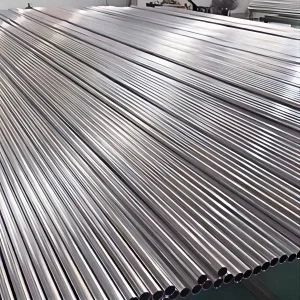
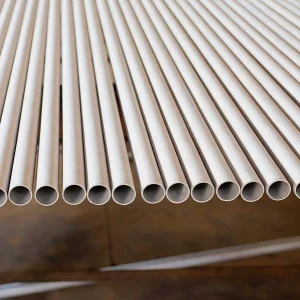
Complementary tubing alloys fabricated to strict international standards for corrosive, ultra-high temperature, and marine environments.






Quality Assurance Rigor: Zero-Defect Testing Protocols
In accordance with Google E-E-A-T principles and stringent global engineering codes, Spezilla enforces a multi-stage non-destructive testing (NDT) regime for every batch of custom 304 tubing produced.
1. Hydrostatic & Pneumatic Test
Every tube is subjected to internal pressure testing up to 20 MPa (or per calculated ASTM formula) to verify structural hoop-stress resistance without microscopic leakage.
2. Eddy Current Testing (ECT)
Inline automated Eddy Current inspection per ASTM E426 detects surface anomalies, pinholes, or weld seam discontinuities at 100% line speed.
3. Destructive Mechanical Testing
Batch samples undergo flaring, flattening, reverse-bending, and tensile tests to verify micro-structural ductility and weld seam integrity.
4. Intergranular Corrosion Test
Performed strictly in compliance with ASTM A262 Practice E (Copper-Copper Sulfate-Sulfuric Acid Test) to guarantee zero susceptibility to sensitization.
Frequently Asked Technical & Procurement Questions (FAQ)
Request a Technical Consultation & Custom Quotation Today
Speak directly with our metallurgical engineers and international procurement team. Submit your specification sheet or drawing to receive a verified mill quote within 24 hours.
