
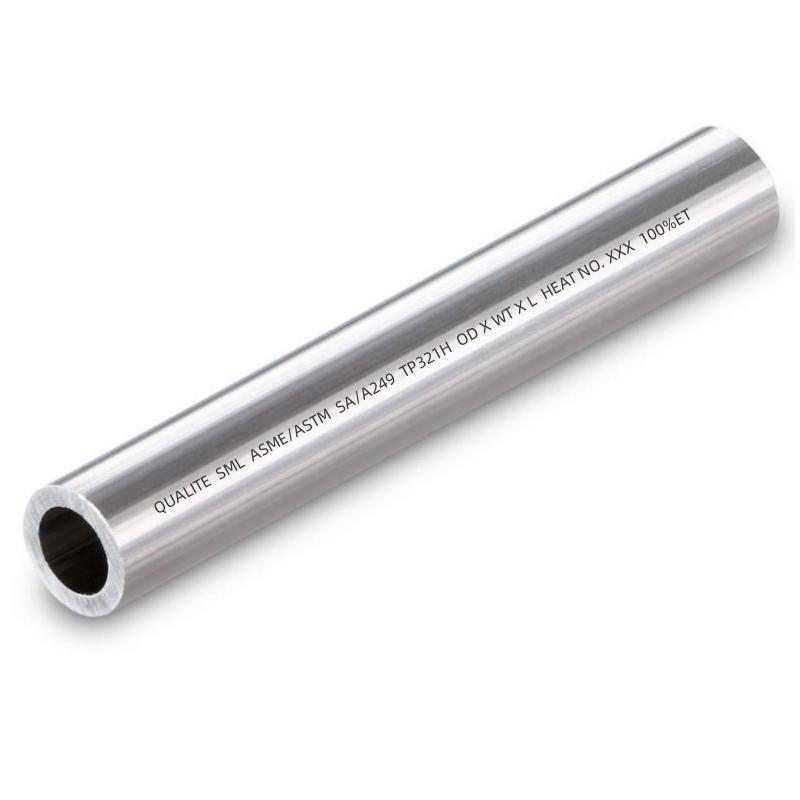
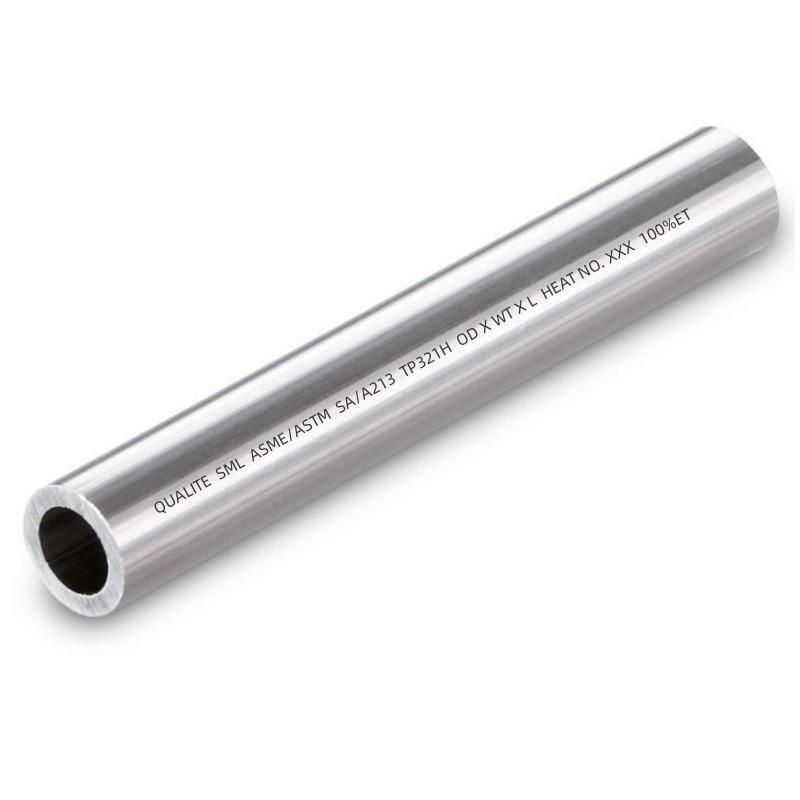
Custom Austenitic Steels 321H • UNS S32109 • 1.4878 Manufacturer, Products
Product Description
| Grade | C | Si | Mn | P | S | Cr | Ni | Mo | Ti | N | Others |
|---|---|---|---|---|---|---|---|---|---|---|---|
| Min. - Max. | Max. | Max. | Max. | Max. | - | - | - | - | - | - | |
| 321H | 0.04 - 0.10 | 1.00 | 2.00 | 0.045 | 0.030 | 17.0 - 19.0 | 9.0 - 12.0 | - | 5 X (C+N) - 0.70 | 0.10 | - |
| 1.4878 | 0.10 | 1.00 | 2.00 | 0.045 | 0.015 | 17.0 - 19.0 | 9.0 - 12.0 | - | 5 X C - 0.80 | - | - |
| Grade | Rp 0.2 (MPa) | Rp 1.0 (MPa) | Rm (MPa) | A (%) | Hardness (HRB) | Heat Treatment |
|---|---|---|---|---|---|---|
| Min. | Min. | Min. - Max. | Min. | Max. | ||
| 321H | 205 | - | 515 | 35 | 90 | Solution Annealed |
| 1.4878 | 190 | 230 | 500 | 40 | - | Solution Annealed |
| OD | Thickness (mm) | |||||||||||||
|---|---|---|---|---|---|---|---|---|---|---|---|---|---|---|
| (mm) | 0.50 | 0.70 | 0.80 | 0.89 | 1.00 | 1.20 | 1.24 | 1.50 | 1.65 | 2.00 | 2.11 | 2.50 | 2.77 | 3.05 |
| 6.00 | x | x | x | x | x | x | x | x | ||||||
| 6.35 | x | x | x | x | x | x | x | x | x | |||||
| 7.00 | x | x | x | x | x | x | x | x | ||||||
| 7.50 | x | x | x | x | x | x | x | x | ||||||
| 8.00 | x | x | x | x | x | x | x | x | ||||||
| 9.00 | x | x | x | x | x | x | x | x | ||||||
| 9.53 | x | x | x | x | x | x | x | x | x | |||||
| 10.00 | x | x | x | x | x | x | x | x | ||||||
| 11.00 | x | x | x | x | x | x | x | x | ||||||
| 12.00 | x | x | x | x | x | x | x | x | x | |||||
| 12.70 | x | x | x | x | x | x | x | x | x | x | x | |||
| 13.00 | x | x | x | x | x | x | x | x | ||||||
| 14.00 | x | x | x | x | x | x | x | x | ||||||
| 15.00 | x | x | x | x | x | x | x | x | ||||||
| 15.88 | x | x | x | x | x | x | x | x | x | x | x | |||
| 16.00 | x | x | x | x | x | x | x | x | x | x | ||||
| 17.15 | x | x | x | x | x | x | x | x | x | x | x | |||
| 18.00 | x | x | x | x | x | x | x | x | x | x | ||||
| 19.00 | x | x | x | x | x | x | x | x | x | x | ||||
| 19.05 | x | x | x | x | x | x | x | x | x | x | x | x | x | |
| 20.00 | x | x | x | x | x | x | x | x | x | x | x | x | x | |
| 21.34 | x | x | x | x | x | x | x | x | x | x | x | x | x | |
| 22.00 | x | x | x | x | x | x | x | x | x | x | x | x | x | |
| 22.23 | x | x | x | x | x | x | x | x | x | x | x | x | x | |
| 23.00 | x | x | x | x | x | x | x | x | x | x | x | x | x | |
| 24.00 | x | x | x | x | x | x | x | x | x | x | x | x | x | |
| 25.00 | x | x | x | x | x | x | x | x | x | x | x | x | x | x |
| 25.40 | x | x | x | x | x | x | x | x | x | x | x | x | x | x |
| 26.00 | x | x | x | x | x | x | x | x | x | x | x | x | x | x |
| 26.67 | x | x | x | x | x | x | x | x | x | x | x | x | x | x |
| 26.90 | x | x | x | x | x | x | x | x | x | x | x | x | x | x |
| 28.00 | x | x | x | x | x | x | x | x | x | x | x | x | x | x |
| 28.58 | x | x | x | x | x | x | x | x | x | x | x | x | x | x |
| 30.00 | x | x | x | x | x | x | x | x | x | x | x | x | x | x |
| 31.75 | x | x | x | x | x | x | x | x | x | x | x | x | x | x |
| 32.00 | x | x | x | x | x | x | x | x | x | x | x | x | x | x |
| 33.40 | x | x | x | x | x | x | x | x | x | x | x | x | x | x |
| 35.00 | x | x | x | x | x | x | x | x | x | x | x | x | x | x |
| 36.00 | x | x | x | x | x | x | x | x | x | x | x | x | x | x |
| 38.10 | x | x | x | x | x | x | x | x | x | x | x | x | x | x |
| 42.00 | x | x | x | x | x | x | x | x | x | x | ||||
| 44.50 | x | x | x | x | x | x | x | x | x | |||||
| 48.26 | x | x | x | x | x | x | x | |||||||
| 50.80 | x | x | x | x | x | x | x | x | x | x | x | |||
321H is an ASTM/AISI standard designation, while 1.4878 is the EN/DIN equivalent standard grade. Both are titanium-stabilized austenitic stainless steels designed for high-temperature service, with slight variations in carbon and titanium content limits per their respective specifications.
Titanium is added as a stabilizing element to prevent chromium carbide precipitation during welding or exposure to high temperatures (427°C - 816°C), thereby significantly enhancing resistance to intergranular corrosion.
321H and 1.4878 stainless steel tubes offer higher carbon content than standard 321, providing improved creep strength and higher tensile strength at operating temperatures above 537°C (1000°F).
These tubes typically undergo solution annealing, heating to a temperature range between 1040°C to 1120°C followed by rapid quenching to optimize corrosion resistance and mechanical properties.
Common applications include chemical processing equipment, petroleum refinery heat exchangers, high-temperature steam boiler tubes, superheaters, exhaust manifolds, and thermal processing pipe systems.










