
High-Performance Corrosion-Resistant Tubing Products
Directly sourced mill inventory and precision-drawn tubes compliant with ASME, ASTM, and EN standard specifications for critical industrial systems.

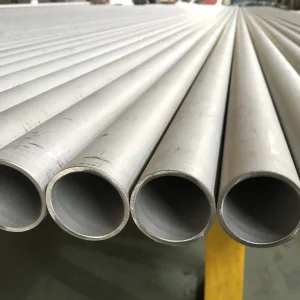

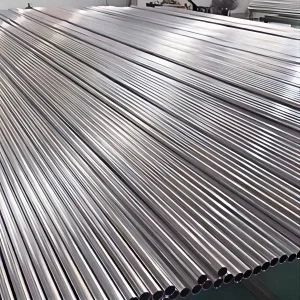



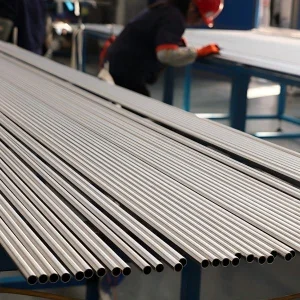
Comprehensive Metallurgy of 304 Seamless Stainless Steel Tubing
An engineering analysis of UNS S30400 / EN 1.4401 chemical stability, phase transformation, passivity kinetics, and structural integrity under cyclic thermal and pressure loads.
Chemical Composition Equilibrium
Grade 304 (18Cr-8Ni) seamless tubing relies on a tightly controlled austenitic crystal lattice (FCC structure). The balanced addition of Chromium ($\ge 18.0\%$) forms an impermeable, self-healing Chromium Oxide ($\text{Cr}_2\text{O}_3$) passive layer. Nickel ($\ge 8.0\%$) stabilizes the austenitic phase, preventing martensitic transformation during severe cold working (pilgering) and ensuring non-magnetic characteristics in annealed states.
Seamless Cold Pilgering vs. Drawing
Unlike welded tubing, seamless 304 tubing produced via cold pilgering (rocking mill) undergoes triaxial compressive stress state deformation. This refines grain size down to ASTM Grade 7–9 while achieving ultra-tight wall thickness tolerances ($\pm 5\%$) and smooth internal surface roughness ($Ra < 0.4\,\mu\text{m}$). Cold drawing subsequently ensures exact dimensional accuracy for critical instrumentation ferrule fittings.
Intergranular Corrosion Protection
Sensitization occurs when chromium carbide ($\text{Cr}_{23}\text{C}_6$) precipitates at grain boundaries between $450^\circ\text{C}$ and $850^\circ\text{C}$, depleting adjacent zones of chromium. As a premier 304 seamless tubing supplier, our stock undergoes high-temperature solution annealing at $1040^\circ\text{C} - 1150^\circ\text{C}$ followed by rapid water quenching, preserving 100% austenitic microstructure free of grain boundary carbide networks per ASTM A262 Practice E.
| Specification Parameter | ASTM A213 / ASME SA213 TP304 | EN 10216-5 (1.4301 Seamless) | Performance & Inspection Advantage |
|---|---|---|---|
| Chemical Composition | Cr: 18.0 - 20.0%, Ni: 8.0 - 11.0%, C: $\le 0.08\%$ | Cr: 17.5 - 19.5%, Ni: 8.0 - 10.5%, C: $\le 0.07\%$ | Optimized PREN ($\sim 19.0$) for resistance to atmospheric pitting & mild chemicals. |
| Tensile Strength ($\text{R}_m$) | $\ge 515\,\text{MPa}\ (75\,\text{ksi})$ | $500 - 700\,\text{MPa}$ | High safety margin under hydraulic pulse loading and structural pressure spikes. |
| Yield Strength ($\text{R}_{p0.2}$) | $\ge 205\,\text{MPa}\ (30\,\text{ksi})$ | $\ge 210\,\text{MPa}$ | Superior burst pressure capabilities compared to welded alternative tubing. |
| Elongation ($A_5$) | $\ge 35\%$ | $\ge 40\%$ (Longitudinal) | Exceptional ductility for tight-radius U-bending and expansion into tubesheets. |
| Nondestructive Testing | Hydrostatic Test or Eddy Current per ASTM A450 | EN 10246-2 / EN ISO 10893-1 Eddy Current | 100% pinhole & subsurface flaw verification guaranteeing zero leakage. |
China Smart Factory 4.0: Supply Chain Resilience & Efficiency
How modern digitalized manufacturing infrastructure in China yields unprecedented quality control, rapid throughput, and total trace-ability for global engineering projects.
Real-Time IoT Quality Tracking
Every step of our 304 seamless tubing manufacturing route—from mother hollow piercing to cold pilgering, degreasing, bright annealing, and final hydrostatic testing—is monitored by automated IoT sensors. Raw heat numbers are embedded into matrix QR codes on each tube bundle, granting procurement teams full digital MTC transparency.
Cost-Efficiency & Raw Material Scale
By leveraging China's integrated stainless steel industry clusters—combining high-purity nickel pig iron (NPI) refining, continuous billet casting, and localized logistics hubs—our smart mills minimize material waste, lower power consumption per ton, and provide global buyers with highly competitive pricing without compromising E-E-A-T standard metrics.
Hydrogen Bright Annealing Technology
To eliminate surface oxidation and pickling acid residues, our production lines utilize continuous pure hydrogen ($\text{H}_2$) atmosphere bright annealing furnaces. This results in a mirror-like finish on both inside diameter (ID) and outside diameter (OD), essential for high-purity biopharmaceutical and semiconductor applications.
Macro Industry Solutions for Extreme Engineering Challenges
Deploying high-integrity 304 seamless tubing across global energy, chemical, cryogenic, and high-purity process infrastructures.
Oil & Gas / Offshore Heat Exchangers
304 seamless heat exchanger tubes serve as vital heat transfer conduits in shell-and-tube heat exchangers, condensers, and feed water heaters. The absence of a longitudinal weld seam eliminates stress corrosion cracking (SCC) initiation sites under high-pressure thermal cycling.
Cryogenic LNG & Aerospace Systems
At ultra-low cryogenic temperatures down to $-196^\circ\text{C}$ ($77\,\text{K}$), grade 304 seamless tubing exhibits zero ductile-to-brittle transition. It retains exceptional Charpy V-notch impact energy values ($> 100\,\text{J}$), making it indispensable for liquid nitrogen and LNG transport lines.
Hydrogen Fuel & High-Pressure Instrumentation
For compressed hydrogen storage systems up to $35\,\text{MPa} - 70\,\text{MPa}$, seamless 304 lines provide superior resistance to hydrogen embrittlement compared to high-carbon alternatives. Their smooth bore prevents gas turbulence and micro-particle generation.
High-Purity Food, Beverage & Pharma
Clean-in-place (CIP) and Sterilize-in-place (SIP) sanitary piping systems require inner surface smoothness down to $Ra \le 0.4\,\mu\text{m}$. Bright annealed 304 seamless tubes prevent bacterial bio-film adhesion and chemical product contamination.
Nuclear Power & Thermal Energy Generation
In steam generator U-tubes and feedwater systems, strict wall tolerance and zero surface defects are non-negotiable. Our 304 seamless tubing undergoes ultrasonic thickness testing to prevent flow-accelerated corrosion (FAC).
Semiconductor & Specialty Chemical Lines
Precision instrument lines handling aggressive organic solvents, nitric acid, and specialty gases rely on high-purity 304 seamless tube manifolds to maintain toxic gas containment under severe vacuum and positive pressure conditions.
Localization Support, Quality Assurance & Regulatory Compliance
Meeting global engineering standards with complete auditability, international certifications, and localized logistics support.
EN 10204 3.1 & 3.2 Certification
Every shipment of 304 seamless tubing is accompanied by an authenticated EN 10204 Type 3.1 Mill Test Certificate detailing actual heat chemical analysis, mechanical property test results, flattening/flaring tests, micro-structure ratings, and NDT records. Independent Type 3.2 inspection (TÜV, SGS, Lloyd's Register, DNV) is available upon request.
Pressure Equipment Directive (PED)
Our manufacturing infrastructure is fully certified under PED 2014/68/EU and AD 2000-W0 for pressure vessel equipment used across the European Union. Procurement officers can integrate our seamless tubes directly into CE-marked assemblies without secondary material validation.
NACE MR0175 / ISO 15156 Sour Service
For upstream energy operations, special heat-treated 304 seamless tubing orders comply with NACE MR0175 hardness limits ($\le 22\,\text{HRC}$), ensuring safety against sulfide stress cracking (SSC) in environments containing hydrogen sulfide ($\text{H}_2\text{S}$).
Technical Roadmap & Future Outlook: 2025–2035
Pioneering next-generation seamless stainless steel tubing technologies for green hydrogen energy, ultra-clean semiconductor fabrication, and carbon-neutral mill operations.
Zero-Carbon Green Steel Manufacturing
In response to global CBAM (Carbon Border Adjustment Mechanism) regulations, our forward-looking mills are transitioning to 100% Electric Arc Furnace (EAF) melting powered by renewable solar/wind energy, utilizing Direct Reduced Iron (DRI) to shrink the embodied carbon footprint per meter of 304 seamless tubing by up to $65\%$.
Nano-Grain Surface Modifications
Future development focuses on severe plastic deformation (SPD) techniques during pilgering to induce ultra-fine nano-scale austenitic grain structure ($< 1\,\mu\text{m}$). This enhances yield strength by $> 40\%$ without sacrificing ductility or corrosion resistance, permitting thinner tube wall designs and weight reduction.
AI-Driven Predictive Quality Control
Integrating real-time machine vision eddy-current fusion sensors directly onto high-speed drawing benches. Neural networks analyze surface micro-topography instantly, automatically rejecting anomalies and guaranteeing flawless 100% yield rates for nuclear and aerospace clients.
Complete Alloy & Stainless Tubing Solutions
Explore our full line of specialized stainless steel, titanium, and nickel alloy tubing manufactured for heat transfer and structural precision.








Frequently Asked Procurement & Engineering Questions
Expert answers regarding 304 seamless tubing selection, manufacturing tolerances, material verification, and international ordering logistics.
Q1: What is the fundamental operational difference between 304 seamless tubing and 304 welded tubing?
Seamless 304 tubing is manufactured from solid round billets via hot extrusion or rotary piercing followed by cold pilgering or drawing, containing absolutely no longitudinal weld seam. Welded 304 tubing is formed from flat rolled strip and autogenously welded. Seamless tubing provides uniform mechanical strength around the entire circumference, higher hydrostatic burst pressure ratings, and eliminates weld-zone intergranular corrosion risks, making it mandatory for high-pressure, thermal-cycling heat exchangers (ASTM A213).
Q2: Why choose 304 seamless tubing over 316L for my industrial process system?
304 stainless steel tubing (18% Cr, 8% Ni) provides exceptional cost-effective corrosion resistance in clean water, steam, atmospheric, and mild chemical environments. While 316L contains 2-3% Molybdenum for high chloride/pitting environments, 304 seamless tubing offers higher economic value for non-saline applications, cryogenic liquid transport, structural hydraulics, and high-temperature heat recovery systems where chloride concentration is minimal.
Q3: Which dimensional tolerances can your China Smart Mill achieve for 304 seamless tubing?
Our cold-pilgered and bright annealed 304 seamless tubing strictly adheres to ASTM A213 / ASTM A269 and EN 10216-5 specifications. Outside Diameters (OD) range from 4.00 mm up to 114.30 mm with tolerances as tight as $\pm 0.05\,\text{mm}$. Wall Thickness (WT) ranges from 0.40 mm to 3.05 mm with a variance of $\le \pm 7.5\%$. Precision instrument tubes can be custom-drawn to meet EN 10305-1 class tolerances.
Q4: How does your facility ensure surface roughness requirements for high-purity applications?
We utilize hydrogen atmosphere bright annealing furnaces operating at dew points below $-50^\circ\text{C}$ to eliminate oxidation scaling. Inner diameter (ID) roughness achieved through cold pilgering reaches $Ra \le 0.4\,\mu\text{m}$. For ultra-pure gas or biopharmaceutical service, mechanical polishing (MP) and electropolishing (EP) options can further refine internal roughness down to $Ra \le 0.25\,\mu\text{m}$ ($10\,\mu\text{in}$).
Q5: What non-destructive inspection methods (NDT) are performed prior to export dispatch?
Every single length of 304 seamless tube undergoes 100% Eddy Current Testing (ECT) per ASTM E426 or EN ISO 10893-2 to detect surface and internal longitudinal flaws. Additionally, tubes undergo hydrostatic pressure testing (up to 300 Bar / 4350 PSI) or pneumatic underwater bubble testing. Ultrasonic Testing (UT) and Positive Material Identification (PMI) chemical verification are conducted on 100% of heat batches.
Q6: What mill documentation accompanies your 304 seamless tubing orders?
All orders ship with complete EN 10204 Type 3.1 Mill Test Certificates (MTC) detailing heat numbers, raw billet origin, chemical analysis (C, Mn, P, S, Si, Cr, Ni, N), mechanical tensile/yield/elongation data, hardness tests (HRB/HV), grain size, intergranular corrosion test results (ASTM A262 Pr. E), and non-destructive examination reports. Third-party EN 10204 3.2 inspection reports (SGS, TÜV, Lloyd's) are routinely provided upon contract request.
Partner with a Premier 304 Seamless Tubing Supplier
Submit your engineering datasheets, dimensional tolerances, and material grade specifications. Our metallurgical team delivers fast technical quotes within 24 hours.
Request Technical Quotation & Datasheet