
Featured Heat-Resistant & Austenitic Tubing Products
High-precision stainless steel, nickel alloy, and titanium pipes fabricated to strict ASTM, ASME, and EN specifications.

High-Quality Austenitic Steels 347 • UNS S34700 • 1.4550 Suppliers, Product
View Product Details
High-Quality Austenitic Steels 321 • UNS S32100 • 1.4541 Manufacturers, Factories
View Product Details
Custom Austenitic Steels 309S • UNS S30908 • 1.4833 Factories, Products
View Product Details
Custom Austenitic Steels 304 • UNS S30400 • 1.4301 Manufacturer, Factories
View Product Details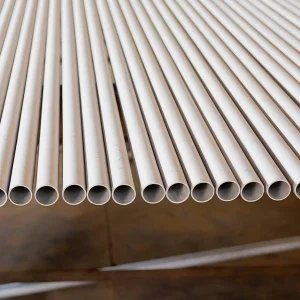
High-Quality Austenitic steel ASME SA269 · TP304 Factories, Products
View Product Details
Custom Austenitic steel ASME SA213 · TP304 Seamless Tube Manufacturer, Supplier
View Product Details
High-Quality Austenitic Steels 304H • UNS S30409 • 1.4948 Manufacturer, Supplier
View Product Details
Custom Nickel Alloy Tubes 800H • UNS N08810 • 1.4958 Factory, Products
View Product DetailsMastering 321 Stainless Steel: Titanium Stabilization Metallurgy
An engineering evaluation of UNS S32100 (1.4541) and UNS S32109 (321H) alloy performance under thermal stress and intergranular corrosion regimes.
Titanium Carbide Precipitation Mechanism
Grade 321 is an austenitic chromium-nickel stainless steel containing a titanium addition ($Ti \ge 5 \times C$). Titanium possesses a far stronger chemical affinity for carbon than chromium. At temperatures between 427°C and 816°C (800°F–1500°F), titanium carbides ($TiC$) precipitate preferentially throughout the matrix rather than chromium carbides ($Cr_{23}C_6$). This prevents chromium depletion at grain boundaries, eliminating susceptibility to intergranular corrosion (sensitization).
Creep & Stress-Rupture Integrity
For high-temperature structural installations operating above 537°C (1000°F), Grade 321H (UNS S32109) specifies a controlled carbon content of 0.04% to 0.10% and a minimum final heat treatment temperature of 1040°C (1900°F). This optimized grain chemistry and thermal history provide superior creep strength, higher stress-rupture capability, and long-term microstructural stability compared to Standard 304/304L or non-stabilized alloys.
Polythionic Acid SCC Resistance
In refining and petrochemical hydrodesulfurization (HDS) units, equipment exposed to sulfurous environments during shutdowns can develop polythionic acid ($H_2S_xO_6$), triggering rapid stress corrosion cracking (SCC) in sensitized standard austenitic steels. Stabilized Grade 321 custom pipes, processed with a thermal stabilization heat treatment at 870°C–900°C (1600°F–1650°F), neutralize this risk entirely.
| Material Specification | UNS Designation | EN Standard / W.Nr. | Chemical Composition Key Elements (%) | Thermal Operating Ceiling | Primary Technical Advantage |
|---|---|---|---|---|---|
| AISI 321 / TP321 | UNS S32100 | 1.4541 / X6CrNiTi18-10 | Cr: 17.0–19.0 | Ni: 9.0–12.0 | Ti: 5×(C+N) min 0.70 max | 816°C (1500°F) | Eliminates grain boundary chromium depletion during welding. |
| AISI 321H / TP321H | UNS S32109 | 1.4878 / X12CrNiTi18-10 | Cr: 17.0–19.0 | Ni: 9.0–12.0 | C: 0.04–0.10 | Ti: 4×(C+N) min | 900°C (1650°F) | Enhanced creep strength and high-temperature rupture resistance. |
| AISI 347 / TP347 | UNS S34700 | 1.4550 / X6CrNiNb18-10 | Cr: 17.0–19.0 | Ni: 9.0–13.0 | Nb: 10×C min 1.0 max | 816°C (1500°F) | Niobium-stabilized alternative for severe oxidizing environments. |
| AISI 316Ti | UNS S31635 | 1.4571 / X6CrNiMoTi17-12-2 | Cr: 16.5–18.5 | Ni: 10.5–13.5 | Mo: 2.0–2.5 | Ti: 5×(C+N) | 850°C (1560°F) | Titanium stabilization combined with Molybdenum chloride pitting resistance. |
To achieve maximum resistance to intergranular corrosion and stress corrosion cracking in extreme thermal environments, Spezilla applies a specialized Stabilization Heat Treatment at $870^\circ C \text{ to } 900^\circ C$ ($1600^\circ F \text{ to } 1650^\circ F$) following standard solution annealing ($1040^\circ C - 1120^\circ C$). This process precipitates virtually all remaining carbon as stable Titanium Carbides ($TiC$), ensuring zero free carbon is available to react with chromium during elevated-temperature service.
China Factory 4.0: Supply Chain Resilience & Manufacturing Efficiency
Integrated manufacturing excellence from our Huzhou production facility and Shanghai operations center delivering international quality at optimized cost structures.
Automated Pilgering & Cold Drawing
Our facility operates multi-roll cold pilger mills and high-tonnage precision hydraulic cold-drawing benches. This ensures dimensional tolerances finer than standard ASTM A269/A213 requirements, delivering precise wall concentricity down to $\pm 5\%$ and surface roughness down to $Ra < 0.4 \mu m$.
In-Line Digital Quality NDT Inspection
100% of custom 321 SS pipes undergo real-time non-destructive testing (NDT), including integrated Eddy Current testing (ET) per ASTM E426, Hydrostatic testing up to 300 bar, and full Ultrasonic testing (UT) per ASTM E213. Digital quality records are bound to heat lot numbers.
Direct Mill Raw Material Traceability
We source raw mother hollows and forged billets directly from tier-1 steelmakers including Tsingshan, Yongxing Special Steel, and TISCO. Every heat batch undergoes Optical Emission Spectrometry (OES) verification prior to hot extrusion or tube forming, guaranteeing 100% chemical purity.
Macro Industry Solutions for Severe Environments
Custom 321 Stainless Steel piping engineered to solve high-temperature oxidation, thermal fatigue, and corrosive media challenges across key industrial sectors.
Aerospace & Jet Engine Exhaust Systems
Aerospace exhaust manifolds, engine afterburners, cabin heating exchangers, and fuel lines experience aggressive cyclic heating and extreme vibration. 321 stainless steel provides unmatched thermal fatigue strength up to 800°C without risk of embrittlement, protecting structural skin integrity.
Chemical & Petrochemical Refining
Deploying UNS S32100 pipes in hydro-cracking furnace tubes, thermal crackers, flare stacks, and organic acid synthesis lines prevents intergranular failure caused by polythionic acid and wet $H_2S$. Spezilla's bright annealed 321 tubing extends maintenance cycles by over 40%.
Thermal Power Generation & Superheaters
ASME SA213 TP321 / TP321H seamless tubing forms the core of steam superheater elements, reheater coils, and high-pressure steam headers. Designed to resist steam oxidation up to 650°C, these custom U-bend pipes withstand severe pressure dynamics under continuous baseline loads.
Automotive Exhaust Manifolds & Turbo Chargers
Modern high-efficiency diesel and gas engines generate exhaust gas temperatures exceeding 750°C. Custom thin-wall 321 SS welded and drawn tubes offer superior formability for intricate tube bending while resisting high-frequency thermal shock and sulfur oxidation.
Next-Generation Metallurgy: 321 SS Technical Roadmap
Innovations in grain refinement, green hydrogen transport, and hybrid additive tube manufacturing for 2030 and beyond.
Nano-Scale TiC Dispersion Control
Future high-temperature requirements demand finer grain boundaries. Spezilla is pioneering thermo-mechanical processing (TMP) that produces nano-scale titanium carbide dispersions ($<50 nm$). This refinement doubles the creep-fatigue life of 321H pipes operating above 600°C in next-gen concentrated solar power (CSP) receivers.
Green Hydrogen & Reformer Systems
As energy markets shift to hydrogen, 321 SS pipes demonstrate superior resistance to high-temperature hydrogen attack (HTHA) and hydrogen embrittlement compared to conventional 300-series alloys. Optimized 321 tubing is being qualified for high-pressure steam methane reforming (SMR) and solid oxide electrolyzer cells (SOEC).
Ultra-Smooth Electropolished (EP) ID Surfaces
To support ultra-high purity (UHP) chemical transport and semiconductor exhaust gases, Spezilla's tech roadmap integrates inner-diameter electropolishing down to $Ra < 0.15 \mu m$ ($6 \mu in$), combined with high-purity bright annealing under 100% pure hydrogen atmosphere.
Global Enterprise Procurement & Risk Mitigation Matrix
Addressing Total Cost of Ownership (TCO), vendor verification, and quality assurance for international EPC contractors and OEM buyers.
Total Cost of Ownership (TCO) Optimization
Selecting the correct titanium-stabilized grade avoids premature piping failure. While Grade 321 carries a slight alloy surcharge over Grade 304, it eliminates the need for expensive post-weld heat treatment (PWHT) and avoids catastrophic shutdown costs associated with intergranular cracking.
- Zero post-weld annealing required in field installations.
- Extended service life under thermal cycling up to 816°C.
- Lower risk of unplanned plant maintenance stops.
Quality Verification Protocol (QVP)
Every shipment from Spezilla is accompanied by fully transparent, mill-validated inspection paperwork compliance matching global engineering contracts.
- EN 10204 3.1 & 3.2: Independent third-party inspection (TUV, SGS, BV, Lloyd's Register).
- Intergranular Corrosion Test: Mandatory ASTM A262 Practice E (Strauss Test) or Practice A.
- Grain Size Evaluation: ASTM E112 verification ensuring grain size #7 or finer for TP321, or #6 to #3 for TP321H.
Localized Support, Compliance & Engineering Standards
Certified alignment with pressure equipment directives, international building codes, and regional engineering criteria.
PED 2014/68/EU & AD2000
Full compliance with the European Pressure Equipment Directive (PED) for pressurized piping components. Qualified under AD 2000-W0 for German and EU power boiler installations.
ASME / ASTM Boiler Codes
Manufactured strictly to ASME Boiler & Pressure Vessel Code (BPVC) Section II Part A, supporting ASTM A213 (Seamless Boiler Tubes), A312 (Pipe), A249 (Welded Heat Exchanger Tubes), and A269 (General Tubing).
Export Logistics & Packaging Protection
Heavy-duty wooden crate packaging, end plastic caps, Vapor Corrosion Inhibitor (VCI) paper wrapping, and custom steel-strapped bundles ensure 100% damage-free ocean and air freight delivery globally.
Extended Specialty Alloys & High-Temp Piping Catalog
Explore our complementary range of high-temperature austenitic, nickel alloy, ferritic, and titanium tubing products.

Custom Austenitic Steels 310S • UNS S31008 • 1.4845 Supplier, Suppliers
View Product Details
High-Quality Super Austenitic Steels 904L • UNS N08904 • 1.4539 Suppliers, Factory
View Product Details
Custom Austenitic steel ASME SA213 · TP317 Manufacturers, Products
View Product Details
High-Quality Ferritic & Martensitic Steels 410 • UNS S41000• 1.4512 Suppliers, Factories
View Product Details
Custom Austenitic Steels 310H • UNS S31009 Manufacturers, Products
View Product Details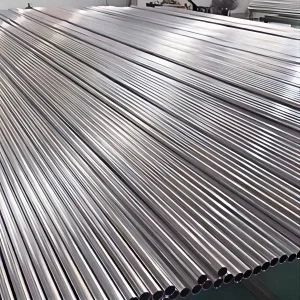
Custom Austenitic steel ASME SA213 · TP310S Manufacturer, Products
View Product Details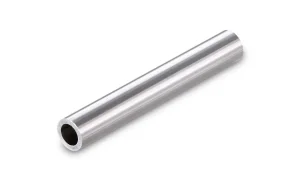
High-Quality Titanium Tubes • Grade 2 • UNS R50400 Factories, Products
View Product Details
High-Quality Nickel Alloy Tubes 800HT • UNS N08811 • 1.4959 Manufacturer, Product
View Product DetailsFrequently Asked Questions (FAQ)
In-depth technical answers addressing material selection, welding parameters, standards compliance, and manufacturing tolerances.
Request a Custom 321 SS Pipe Technical Quote
Connect directly with Spezilla’s metallurgical sales engineering team. Submit your drawing, target grade (321 / 321H / 347), wall tolerance, and testing specifications for rapid 24-hour quotation support.
