
High-Precision Seamless & High-Alloy Tubing Solutions
Explore our core range of EN 10216-5 compliant and equivalent ASTM/ASME precision tubing, manufactured under rigid quality controls for chemical, petrochemical, and power generation environments.


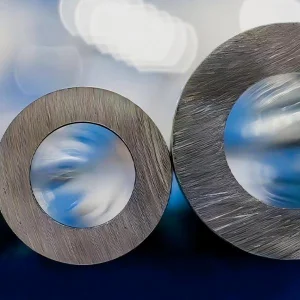

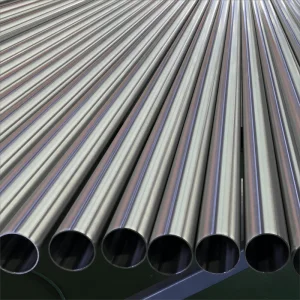

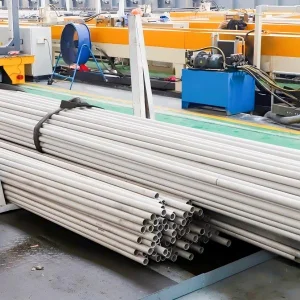

EN 10216-5: Precision Seamless Stainless Steel Tubes for Pressure Purposes
A comprehensive analysis of technical delivery conditions, metallurgical classifications, dimensional tolerances, and non-destructive testing requirements under European Standard EN 10216-5.
The standard EN 10216-5 specifies the technical delivery conditions for seamless tubes of circular cross-section, made of austenitic, austenitic-ferritic (duplex), and super duplex stainless steels, intended for pressure and corrosion-resisting purposes at room temperature, low temperatures, or elevated temperatures. In high-integrity thermal, chemical, and nuclear energy engineering, EN 10216-5 represents one of the world's most rigorous benchmarks for seamless pressure piping and heat exchanger tubing.
1. Technical Delivery Categories: TC1 vs. TC2
Understanding the distinction between Test Category 1 (TC1) and Test Category 2 (TC2) is essential for EPC contractors and procurement managers when specifying EN 10216-5 seamless tubes for critical installations:
Test Category 1 (TC1)
Designed for standard pressure systems and industrial heat exchange circuits where moderate operating parameters apply. Requires 100% hydrostatic testing or equivalent electromagnetic (eddy current) non-destructive testing (NDT), room-temperature tensile testing, and basic visual/dimensional verification.
- Standard hydraulic & fluid transportation
- Basic heat exchangers and steam coils
- Tensile & flattening / ring expansion tests
- Mill Test Certificate EN 10204 3.1
Test Category 2 (TC2) — Severe Service
Mandatory for high-pressure, severe-corrosion, cryogenic, or high-temperature environments (e.g., nuclear loops, offshore platforms, high-pressure hydrogen). Requires comprehensive longitudinal and transverse ultrasonic NDT for longitudinal and transverse defects, impact testing down to -196°C, and grain size determination.
- 100% Ultrasonic Testing (UT) for inner/outer flaws
- Charpy V-notch impact test at sub-zero temperatures
- Intergranular Corrosion (IGC) test per EN ISO 3651-2
- Mandatory EN 10204 3.2 Third-Party Inspection available
2. Metallurgical Classifications & Chemical Matrix
Precision seamless tubes manufactured under EN 10216-5 span three distinct stainless steel material families. Below is a technical summary of standard European steel designations (Material Number / Steel Name) compared with equivalent ASTM/UNS grades and their chemical/mechanical performance traits:
| EN Steel Name | EN Material No. | US / ASTM Equivalent | Structure | Tensile Rm (MPa) | Yield Rp0.2 (MPa) | Key Performance Attribute |
|---|---|---|---|---|---|---|
| X2CrNi19-11 | 1.4306 | TP304L / UNS S30403 | Austenitic | 450 – 680 | ≥ 180 | Low carbon content prevents intergranular precipitation during welding. |
| X2CrNiMo17-12-2 | 1.4404 | TP316L / UNS S31603 | Austenitic | 490 – 690 | ≥ 190 | Molybdenum additions provide pitting resistance in chloride media. |
| X6CrNiTi18-10 | 1.4541 | TP321 / UNS S32100 | Austenitic (Ti-Stab) | 500 – 730 | ≥ 200 | Titanium stabilized for continuous service at 400°C–800°C temperature ranges. |
| X6CrNiMoTi17-12-2 | 1.4571 | TP316Ti / UNS S31635 | Austenitic (Ti-Stab) | 500 – 730 | ≥ 210 | Titanium-stabilized 316 with superior high-temperature creep strength. |
| X2CrNiMoN22-5-3 | 1.4462 | 2205 / UNS S31803 / S32205 | Duplex | 650 – 880 | ≥ 450 | High yield strength combined with extreme resistance to Stress Corrosion Cracking (SCC). |
| X2CrNiMoN25-7-4 | 1.4410 | 2507 / UNS S32750 | Super Duplex | 730 – 930 | ≥ 550 | PREN ≥ 42; optimized for aggressive offshore marine and acidic halide processing. |
| X1NiCrMoCu25-20-5 | 1.4539 | 904L / UNS N08904 | Super Austenitic | 500 – 700 | ≥ 220 | High copper content imparts resistance to warm sulfuric and phosphoric acids. |
3. Dimensional Tolerances & Surface Finish Precision (ISO 1127 Standard)
Precision seamless tubes under EN 10216-5 are usually supplied cold-finished (cold drawn or cold pilgered) to achieve tight dimensional control conforming to EN ISO 1127 tolerance classes:
Outside Diameter (OD) Tolerances
Class D3: ±0.75% or ±0.3 mm (whichever is greater). Standard industrial grade.
Class D4: ±0.50% or ±0.1 mm (whichever is greater). Precision grade for orbital welding and instrumentation manifolds.
Wall Thickness (WT) Tolerances
Class T3: ±10% or ±0.2 mm. Applied for standard pressure vessel tubes.
Class T4: ±7.5% or ±0.15 mm. High-precision cold-pilgered wall thickness for tight heat exchanger bundle packing.
Heat Treatment & Delivery Condition
+D (Cold Drawn): Hardened profile requiring final heat treatment.
+AT (Solution Annealed): Fully austenitic state achieved by rapid quenching from 1040°C–1150°C, ensuring complete carbide dissolution and maximum corrosion resistance.
Industry Trends Shaping EN 10216-5 Precision Tubing Demand
Analyzing macro-industrial shifts, technical evolutions, and decarbonization drivers across European, North American, and Asia-Pacific industrial sectors.
1. Clean Energy & High-Pressure Hydrogen
The acceleration of global green hydrogen infrastructures has triggered strict requirement profiles for seamless tube bore integrity. Hydrogen compression systems operating at 350 bar to 700 bar require EN 10216-5 1.4404 / 1.4435 cold-drawn tubes with zero internal micro-fissures to prevent hydrogen embrittlement and catastrophic pressure loss.
2. Supercritical & Ultra-Supercritical Power
Modern coal-fired retrofit and biomass thermal power plants operate at steam temperatures exceeding 600°C and pressures above 25 MPa. Metallurgists favor titanium-stabilized and high-nickel austenitic grades like EN 10216-5 1.4541 (TP321) and 1.4571 (TP316Ti) for superheater and reheater tubing coils due to superior creep rupture strength.
3. Semiconductor & High-Purity Gas Systems
Microchip mega-fab expansion across Western Europe and East Asia demands Ultra-High Purity (UHP) seamless stainless steel tubes. Factory cold-drawing techniques are paired with electropolishing (EP) to reach internal roughness values of Ra ≤ 0.15 µm, eliminating micro-particulate entrapment in toxic gas lines.
China Industry 4.0: Modernizing Seamless Tube Production
How Chinese precision tube manufacturers integrate automated cold-pilgering, real-time ultrasonic NDT, and smart supply chains to deliver global cost efficiency without compromising quality.
Smart Manufacturing & Quality Control
Over the past decade, premier Chinese tube mills have overhauled traditional cold drawing shops into digital Industry 4.0 smart facilities. By installing multi-roll cold-pilger mills with automated feed systems, dimensional deviations are controlled within micrometers.
Raw materials are strictly selected from top-tier stainless steel melt shops (such as Tsingshan and Yongxing Special Stainless), guaranteeing pristine heat chemistry with minimal slag inclusions and ultra-low sulfur levels (≤0.005%).
Fully Automated Inline NDT Inspection
Integrates combined Eddy Current (ET) and Ultrasonic Testing (UT) rotators directly behind bright annealing lines. Every single meter of EN 10216-5 TC2 tube undergoes continuous digital flaw logging with automated sorting of out-of-spec products.
Supply Chain Resilience & Strategic Sourcing
Global EPCs face constant challenges regarding lead time volatility and raw material price surges. Chinese precision tube factories mitigate these risks through centralized industrial clusters located in Zhejiang and Jiangsu provinces.
-
01
Integrated Raw Billet Stockpiling
Maintains a permanent inventory of solution-annealed hollow billets across standard EN 1.4301, 1.4404, 1.4541, and 1.4462 grades, enabling short turnaround times for custom sizes.
-
02
In-House Special Processing Capabilities
Equipped with long-length continuous bright annealing furnaces capable of processing straight tubes up to 25 meters, as well as automatic U-bending equipment with post-bend stress relief annealing.
-
03
Independent Third-Party Verification
Seamless coordination with international inspection agencies including TÜV Rheinland, Bureau Veritas, DNV GL, and Lloyd's Register for EN 10204 3.2 certificate sign-offs.
Precision Manufacturing Steps for EN 10216-5 Seamless Tubes
From solid round bar to final non-destructive inspection, every step is rigorously monitored under ISO 9001 quality management systems.
Billet Piercing
Hot rotary piercing transforms solid steel round bars into heavy-walled hollow tubes at controlled forging temperatures.
Cold Pilgering / Drawing
Multi-pass cold reducers or draw benches precisely refine both Outside Diameter and Wall Thickness to ISO 1127 tolerances.
Bright Annealing
Solution heat treatment in a 100% pure Hydrogen atmosphere furnace at 1080°C restores corrosion properties with zero surface oxidation.
Straightening & Cut
Multi-roll precision vertical straighteners correct tube ovality and straightness to < 1.0 mm/m, followed by precise cut-to-length end squaring.
100% NDT & Hydrotest
Tubes undergo continuous ET/UT inspection and hydrostatic testing up to 30 MPa to confirm structural wall integrity.
Marking & Packing
Continuous inkjet laser stenciling of heat number, EN grade, size, and TC category prior to plastic end capping and wooden box packing.
Field Deployment & Industry Integration Case Scenarios
Specific examples of how EN 10216-5 precision seamless tubes serve critical engineering sub-sectors worldwide.
Scenario A: Marine & Offshore FPSO Desalination Modules
Material Specified: EN 10216-5 1.4462 (Duplex 2205) / 1.4410 (Super Duplex 2507)
Operating Environment: High-velocity raw seawater feed lines, reverse osmosis (RO) high-pressure manifolds up to 80 bar.
Engineering Challenge: Standard 316L tubes suffer rapid pitting and crevice corrosion under marine bio-fouling and high chloride conditions.
Solution Advantage: Seamless Duplex 2205 delivers a PREN (Pitting Resistance Equivalent Number) ≥ 35, doubling the mechanical yield strength of 316L, allowing thinner wall design and significant weight reduction on offshore topside structures.
Scenario B: Nitric Acid & Fertilizer Processing Coils
Material Specified: EN 10216-5 1.4306 (304L) / 1.4541 (321)
Operating Environment: Concentrated nitric acid boiler loops operating at elevated temperatures.
Engineering Challenge: Intergranular attack at the heat-affected zone (HAZ) caused by chromium carbide precipitation.
Solution Advantage: Solution annealed (+AT) ultra-low carbon 1.4306 or stabilized 1.4541 seamless tubes prevent intergranular corrosion per EN ISO 3651-2 Method A testing, assuring long operational lifespans without unscheduled shutdowns.
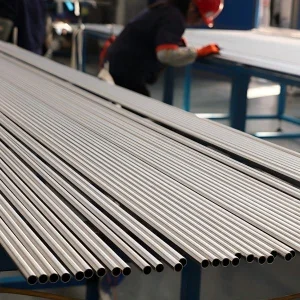
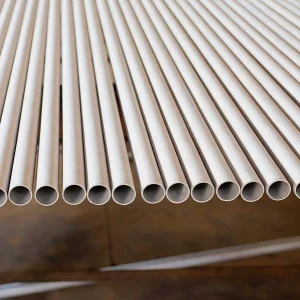
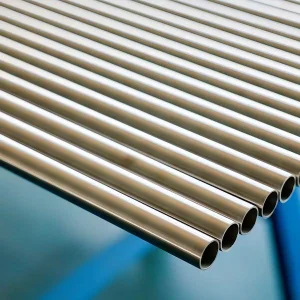
High-Alloy, Duplex & Nickel Tube Product Showcase
Discover our specialized corrosion-resistant and high-temperature seamless tubing portfolio engineered for demanding industrial procurement specifications.





Frequently Asked Questions (FAQ)
In-depth responses to critical technical queries raised by piping engineers, QA/QC inspectors, and global procurement professionals.
