
Featured Austenitic, Duplex & High-Alloy Pressure Tubing
Direct factory manufacturing compliant with ASME SA213, SA312, SA249, and EN 10216-5 standards. Verified for extreme pressure and aggressive chloride/acid environments.


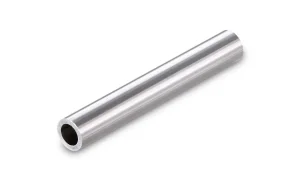

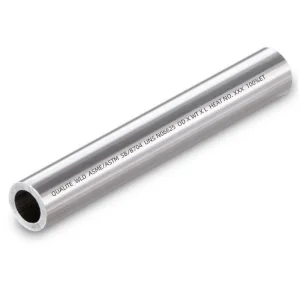
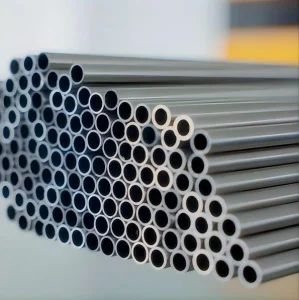
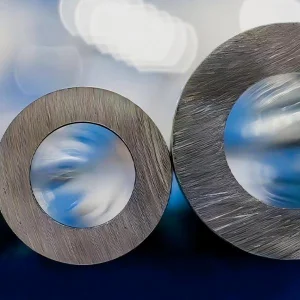

Executive Summary: The Evolution of Heavy Wall Seamless Duplex Steel in Extreme Pressure Service
In modern energy production, chemical synthesis, subsea exploration, and high-pressure hydraulic infrastructure, piping materials operate at the extreme boundaries of thermodynamic and mechanical tolerance. Global industrial assets are increasingly pushed into High-Pressure High-Temperature (HPHT) regimes, offshore deepwater environments exceeding 3,000 meters, and chemical processing media saturated with chlorides, hydrogen sulfide ($\text{H}_2\text{S}$), and concentrated acids.
Historically, engineering designers addressed pressure containment by specifying standard austenitic stainless steels (such as 316L or 317L) with exceptionally thick wall profiles, or by utilizing carbon steel piping lined with internal corrosion-resistant alloys (CRA cladding). However, both legacy approaches present severe engineering limitations:
Austenitic Stress Corrosion Fatigue
Standard 300-series austenitic stainless steels exhibit relatively low yield strength ($\approx 200 - 240 \text{ MPa}$), requiring excessive wall thicknesses under ASME pressure vessel codes. Furthermore, they suffer catastrophic Chloride Stress Corrosion Cracking (CSCC) at temperatures above $60^\circ\text{C}$.
CRA Cladding Interface Risks
Lined or clad carbon steel piping suffers from thermal expansion mismatch, localized disbonding at weld margins, high non-destructive examination (NDE) complexity, and catastrophic galvanic corrosion if the CRA cladding layer experiences micro-perforation.
The Duplex Advantage
Heavy Wall Seamless Duplex Steel (UNS S31803 / S32205) and Super Duplex Steel (UNS S32750 / S32760) deliver a biphasic microstructural solution. Offering double the yield strength ($\ge 450 - 550 \text{ MPa}$) of conventional austenitic steels, Duplex enables up to 40% wall thickness reduction while guaranteeing immunity to CSCC.
Microstructural Thermodynamics & Mechanical Integrity
Understanding the 50:50 Ferrite-Austenite balance, Pitting Resistance Equivalent Number (PREN), and heavy wall hoop stress containment equations under ASME BPVC.
1. Phase Balance & Intermetallic Kinetics
The performance of custom heavy wall seamless duplex tubes depends on maintaining a balanced microstructure composed of approximately equal volume fractions of delta-ferrite ($\alpha$) and austenite ($\gamma$).
- Chromium & Molybdenum Partitioning: Ferrite phases are enriched in Cr and Mo, providing exceptional resistance to localized pitting.
- Nickel & Nitrogen Partitioning: Austenite phases retain Ni and N, ensuring microstructural toughness down to $-50^\circ\text{C}$.
- Precipitation Avoidance: Heavy wall seamless manufacturing requires precise cooling controls. Slow cooling between $600^\circ\text{C}$ and $1000^\circ\text{C}$ triggers the nucleation of embrittling intermetallic phases:
• Sigma ($\sigma$) Phase: Cr-Mo rich, causes severe impact toughness loss.
• Chi ($\chi$) Phase & Chromium Nitrides ($\text{Cr}_2\text{N}$): Depletes adjacent zones of Chromium, leading to intergranular attack.
2. PREN Mechanics & Hoop Stress Equations
Pitting Resistance Equivalent Number (PREN) mathematically quantifies resistance to localized chloride breakdown:
For heavy wall thick-cylinder pressure calculations, standard thin-wall approximations fail. Factories must apply Lamé's hoop stress ($\sigma_\theta$) formulation to ensure safety under internal pressure ($P$):
Where $r_i$ is inner radius, $r_o$ is outer radius, and $r$ is the radius across the wall thickness. Heavy wall duplex seamless tubing distributes high radial and hoop stresses far more effectively than low-yield austenitic grades.
Custom Factory Process Routes & Advanced NDT Quality Controls
Producing heavy wall seamless duplex steel pressure tubes requires specialized high-tonnage hot extrusion, precision cold pilgering, and full-spectrum non-destructive evaluation.
1. Hot Extrusion & Piercing
Refined duplex solid round billets are heated in induction furnaces to $1150^\circ\text{C} - 1250^\circ\text{C}$. High-tonnage hydraulic extrusion presses transform the billet into a heavy-walled seamless hollow tube with uniform concentricity and minimal grain flow distortion.
2. Precision Cold Pilgering
Heavy wall tubes undergo cold pilgering (cold rolling over a tapered stationary mandrel). Cold reduction increases yield and tensile strength while achieving strict dimensional tolerances (OD $\pm 0.5\%$, WT $\pm 7.5\%$) and smooth internal bore surface finishes ($\text{Ra} \le 0.4\,\mu\text{m}$).
3. Rapid Solution Annealing
To dissolve precipitations and restore the 50:50 phase balance, tubes are heat-treated in continuous roller hearth furnaces at $1040^\circ\text{C} - 1120^\circ\text{C}$ (for 2205) or $1080^\circ\text{C} - 1160^\circ\text{C}$ (for 2507), followed by high-pressure water quenching ($> 100^\circ\text{C}/\text{sec}$).
Mandatory NDT & Quality Inspection Protocols (EN 10204 3.1 / 3.2)
- Ultrasonic Testing (UT): 100% full-body wall thickness scan & longitudinal/transverse flaw detection per ASTM E213 / ISO 10893-10.
- Hydrostatic Testing: High-pressure hold up to 1000 bar to verify structural containment under ASME SA790 requirements.
- Eddy Current Testing (ECT): Surface micro-crack inspection per ASTM E426 / ISO 10893-2.
- Ferrite Content Quantification: Microstructural analysis via magnetic induction (Feritscope) and metallographic point counting per ASTM E562 (35%–55% range).
- Pitting Corrosion Test: Ferric Chloride test per ASTM G48 Method A (24 hours at $25^\circ\text{C}$ or $50^\circ\text{C}$) to guarantee zero pitting weight loss.
- Positive Material Identification (PMI): 100% XRF / OES chemical composition confirmation on all factory heat lots.
Technical Specifications & Mechanical Comparison
Comprehensive specification guide for engineering procurement teams. Compare UNS designations, chemical composition ranges, PREN values, and mechanical properties.
| Steel Grade | UNS / EN Designation | PREN | Yield Strength ($R_{p0.2}$, Min) | Tensile Strength ($R_m$, Min) | Standard Specifications | Primary Industrial Application |
|---|---|---|---|---|---|---|
| Standard Duplex 2205 | UNS S31803 / S32205 1.4462 |
35 – 38 | ≥ 450 MPa | 655 – 880 MPa | ASTM A789 / A790 ASME SA789 / SA790 EN 10216-5 |
Oil & gas manifolds, sour gas lines, chemical tankers, heat exchangers. |
| Super Duplex 2507 | UNS S32750 1.4410 |
42 – 45 | ≥ 550 MPa | 750 – 1000 MPa | ASTM A789 / A790 ASME SA789 / SA790 NORSOK M-630 |
Offshore subsea umbilicals, SWRO high-pressure piping, FPSO process units. |
| Super Duplex 2507+Cu/W | UNS S32760 (Zeron 100) 1.4501 |
42 – 45 | ≥ 550 MPa | 750 – 1000 MPa | ASTM A789 / A790 NACE MR0175 / ISO 15156 |
Flue gas desulfurization (FGD), aggressive acidic chloride media, downhole tubing. |
| Lean Duplex 2101 / 2304 | UNS S32101 / S32304 1.4162 / 1.4362 |
24 – 28 | ≥ 400 MPa | 600 – 820 MPa | ASTM A789 / A790 EN 10216-5 |
Civil pressure vessels, structural high-strength tubes, storage tanks. |
| Conventional Austenitic 316L (For Benchmark) |
UNS S31603 1.4404 |
23 – 25 | ≥ 205 MPa | 515 MPa | ASTM A213 / A312 ASME SA213 / SA312 |
Low-pressure chemical transport, general fluid piping (Limited CSCC resistance). |
Global Operating Environments & Critical Field Use-Cases
How custom heavy wall seamless duplex steel pressure tubes resolve localized operational bottlenecks across harsh global infrastructure projects.
Subsea Flowlines & Umbilicals (North Sea & Gulf of Mexico)
In deepwater oil fields operating at depths exceeding 2,500 meters, subsea hydraulic lines face internal pressure up to 15,000 psi combined with external hydrostatic pressure and aggressive sour fluid ($\text{H}_2\text{S} / \text{CO}_2$). Custom heavy wall seamless Super Duplex UNS S32750 tubing offers the extreme yield strength needed to prevent collapse while satisfying NACE MR0175 / ISO 15156 sour service resistance standards.
SWRO High-Pressure Desalination (Middle East Region)
Sea Water Reverse Osmosis (SWRO) facilities across Saudi Arabia, UAE, and Qatar process high-salinity Arabian Gulf water (TDS $> 45,000 \text{ mg/L}$) at working pressures between 70 bar and 100 bar. Heavy wall duplex tubes configured in feed water pump discharge headers eliminate localized pitting and crevice attack without the high cost of titanium.
Petrochemical Synthesis & Nitric Acid Coolers
In modern chemical synthesis plants processing concentrated nitric acid, urea, or organic chlorides at elevated temperatures, heavy wall seamless duplex tubes (UNS S31803 / S32205) act as high-efficiency heat exchanger tube bundles. The high thermal conductivity of duplex relative to austenitic grades improves heat transfer rates by 12–15%.
Nuclear & Geothermal Steam Power Piping
Geothermal steam extraction piping encounters superheated brines laden with silica, chlorides, and hydrogen sulfide. Heavy wall seamless duplex tubing handles combined erosion-corrosion and high mechanical vibration fatigue under continuous cyclic thermal loadings.
Localization Support, Regulatory Codes & Certified Supply Assurance
Delivering fully certified heavy wall seamless duplex products compliant with international engineering frameworks and backed by localized technical support.
ASME / ASTM Certification
Full compliance with ASME Boiler and Pressure Vessel Code Section II, Section III (Nuclear), and Section VIII Div 1 & 2. Material test reports (MTR) provided according to ASTM A789, A790, and A923.
European PED 2014/68/EU
Pressure Equipment Directive (PED) compliance for European installations. TÜV certified manufacturing routes with EN 10204 Type 3.1 and independent third-party 3.2 inspection capabilities (Lloyd's, DNV, Bureau Veritas).
NORSOK M-650 / M-630
Pre-qualified factory routes for Scandinavian and global offshore oil platform projects. Qualification includes microstructural verification, corrosion testing, and mechanical impact testing down to $-46^\circ\text{C}$.
Technology Roadmap: Hyper-Duplex & Smart Structural Sensing
Next-generation innovations shaping the future of high-pressure seamless tubing manufacturing over the coming decade.
1. Commercialization of Hyper Duplex (PREN > 48)
Emerging Hyper Duplex grades (such as UNS S33207) incorporate elevated concentrations of Nitrogen ($0.40\% - 0.50\%$) and Chromium ($29\% - 30\%$). These alloys achieve yield strengths exceeding $800 \text{ MPa}$ and PREN $> 48-50$, allowing seamless tubing to withstand ultra-deep offshore wells exceeding 10,000 meters depth and working pressures beyond 20,000 psi.
2. Digital Twin Metallurgical Monitoring & Fiber Integration
Advanced heavy wall seamless tube manufacturing is incorporating real-time digital twin monitoring during cold pilgering and thermal quenching. Furthermore, subsea pressure lines are integrating embedded fiber-optic distributed acoustic/temperature sensors (DAS/DTS) along tube grooves to track internal wall erosion and micro-strain in real-time.
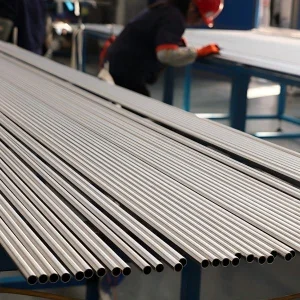
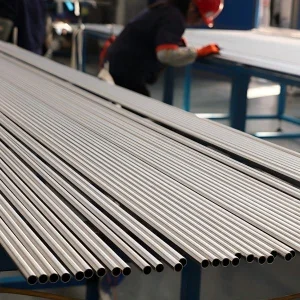
Additional Austenitic & Titanium Tubing Products
Explore our certified tube and pipe inventory engineered for chemical, power generation, and marine heat transfer systems.






Frequently Asked Technical Questions (FAQ)
Direct engineering answers addressing search intent surrounding heavy wall seamless duplex steel selection, testing, and field fabrication.
Seamless duplex tubes eliminate the longitudinal weld seam, which represents a potential localized site for micro-segregation, heat-affected zone (HAZ) phase imbalance, and preferential corrosion attack under high pressure. Seamless tubes offer uniform 360-degree radial strength, critical for ASME pressure vessel compliance and extreme fatigue resistance under pressure pulsation.
Our specialized hot extrusion and cold pilgering lines can manufacture heavy wall seamless duplex tubes with outside diameters (OD) up to 323.8 mm (12 inch) and wall thicknesses (WT) up to 40 mm, maintaining tight wall tolerances within $\pm 7.5\%$ across full 12-meter straight lengths.
Heavy wall duplex tubing requires accelerated cooling due to thermal mass retention. We employ solution annealing at $1040^\circ\text{C}-1120^\circ\text{C}$ followed by immediate high-velocity water quenching ($> 100^\circ\text{C}/\text{sec}$) to bypass the critical $600^\circ\text{C}-1000^\circ\text{C}$ precipitation window, ensuring zero Sigma phase per ASTM A923 Method C.
When welding UNS S31803 / S32205 seamless tubes, an over-alloyed nickel filler metal such as ER2209 (22% Cr, 9% Ni, 3% Mo, 0.15% N) is mandatory. The extra nickel promotes austenite formation during rapid weld pool solidification, guaranteeing the required 50:50 phase balance in the weld metal.
Yes. All our heavy wall duplex (S31803 / S32205) and super duplex (S32750 / S32760) seamless tubes are manufactured in accordance with NACE MR0175 / ISO 15156. Maximum hardness is strictly controlled below 28 HRC (for 2205) or 32 HRC (for 2507) to guarantee immunity to sulfide stress cracking (SSC).
Every export shipment is delivered with comprehensive EN 10204 Type 3.1 Mill Test Certificates (MTC). Type 3.2 MTC with third-party witnessing by Lloyd's Register, DNV, ABS, or SGS is available upon project request, including raw heat chemistry, mechanical results, NDT charts, and corrosion test reports.
