
High-Precision Small Diameter & Specialty Alloy Tubing
Explore our certified precision tubing inventory, engineered to exact ASME, ASTM, and EN specifications for demanding industrial environments.








Executive Technical Overview: Small Diameter Stainless Steel Tubing
Defining ultra-precision capillary, micro-bore, and thin-wall tubing benchmarks across critical process industries.
In modern industrial manufacturing, small diameter stainless steel tubing—typically classified as tubing with an outer diameter (OD) ranging from 0.20 mm up to 19.05 mm (0.75 inches) and wall thicknesses starting at 0.05 mm—serves as the indispensable vascular system of advanced engineering. Whether operating within high-pressure liquid chromatography (HPLC) columns, subsea chemical injection lines, aerospace hydraulic control systems, or medical hypodermic devices, small-diameter tubing must deliver flawless surface finishes, tight dimensional tolerances, and exceptional resistance to localized corrosion mechanisms such as pitting, crevice corrosion, and stress corrosion cracking (SCC).
Material Selection & Alloy Categorization Matrix
Selecting the optimal stainless steel or high-performance alloy grade depends on the chemical exposure, thermal envelope, and mechanical stress profile of the target application:
| Alloy Category | Common Technical Grades | UNS / EN Standard | PREN Value | Primary Performance Characteristics |
|---|---|---|---|---|
| Standard Austenitic | 304 / 304L / 316L | UNS S30403 / S31603 (1.4307 / 1.4404) | 19 - 25 | Excellent weldability, high ductility, ideal for general sanitary, food & beverage, and low-pressure hydraulic lines. |
| Stabilized Austenitic | 321 / 347H / 316Ti | UNS S32100 / S34709 (1.4541 / 1.4550) | 20 - 26 | Titanium/Niobium stabilized to prevent intergranular carbide precipitation during high-temperature service (400°C - 800°C). |
| Super Austenitic | 904L / 254 SMO | UNS N08904 / S31254 (1.4539 / 1.4547) | 35 - 43 | High molybdenum (4.5–6.0%) content offering supreme resistance to pitting and crevice corrosion in severe chloride and acidic media. |
| Duplex & Super Duplex | 2205 / 2507 | UNS S32205 / S32750 (1.4462 / 1.4410) | 35 - 42+ | Dual-phase ferritic-austenitic microstructure providing double the yield strength of 316L alongside superior stress corrosion cracking resistance. |
| Nickel Superalloys | Alloy 600 / 800H / C276 | UNS N06600 / N08810 / N10276 | 50+ | Extreme temperature resistance (>1000°C), immune to chloride-induced SCC, tailored for aggressive chemical reactors and nuclear systems. |
Global Commercial & Industrial Demand Analysis
Evaluating macro-economic growth drivers, regional consumption trends, and evolving precision engineering mandates.
Medical & Life Sciences Expansion
Surging global investments in minimally invasive surgical devices, robotic biopsy needles, and analytical lab automation are propelling double-digit demand for ultra-smooth capillary tubes (OD < 1.5mm) with zero internal inclusions.
Energy Transition & Hydrogen Infrastructure
High-pressure hydrogen refueling stations operating at 70 MPa (700 bar) require micro-bore seamless 316L and Duplex 2205 tubing capable of mitigating hydrogen embrittlement while retaining structural fatigue life.
Semiconductor Fab Construction
Next-generation 2nm and 3nm semiconductor fabrication plants mandate Ultra-High Purity (UHP) electro-polished stainless steel lines (316L VIM/VAR) to convey toxic, corrosive, and pyrophoric process gases without particle contamination.
Localized High-Tech Application Scenarios
Real-world integration parameters across critical industrial, aerospace, and medical engineering sectors.
1. High-Performance Liquid Chromatography (HPLC)
Analytical chemistry demands zero dead-volume flow paths. Custom 1/16-inch OD capillary tubing with an inner diameter down to 0.1mm requires mirror-like internal bore micro-finishing to eliminate sample peak broadening and carryover contamination during high-pressure fluid separation.
2. Subsea Umbilicals & Downhole Chemical Lines
Offshore oil & gas platforms utilize continuous long-length coiled small diameter tubing (UNS S32205 / UNS N06625) running up to 10,000 meters without orbital welds. These lines inject scale inhibitors and methanol directly into deepwater wells under extreme hydrostatic pressures.
3. Aerospace Sensor & Pitot-Static Systems
Aircraft speed and altitude sensors rely on thin-wall 316L and Inconel 600 micro-tubing. High vibration tolerance, resistance to thermal cycling (-55°C to 650°C), and stringent concentricity controls ensure accurate air pressure transmission to flight avionics.
4. Automotive Common Rail Fuel Injection Systems
Modern high-efficiency diesel and GDI engines demand heavy-wall small diameter alloy tubing capable of enduring cyclic pulse pressures exceeding 2,500 bar. Cold-drawn seamless processing eliminates internal seam stress risers.
5. Medical Surgical Cannulas & Endoscopes
Biocompatible 304L and 316L micro-tubing subjected to precision burr-free electrochemical cutting, swaging, and tip flaring. Full compliance with ISO 10993 cytotoxicity and biocompatibility standards is mandatory.
6. Nuclear Reactor Instrumentation & Control Rod Sleeves
High-purity stabilized austenitic (347H, 321) and Nickel 800H small tubing used for core temperature monitoring thermowells, engineered for low neutron absorption and immunity to radiation-induced embrittlement.
Advanced Manufacturing Roadmap & Future Outlook
Pioneering cold-drawing precision, smart inline quality control, and sustainable metallurgical processing.
Precision Cold-Drawing Mechanics (Plug vs. Floating Mandrel)
Next-generation micro-drawing technology utilizes multi-pass floating tungsten carbide plug drawing combined with ultrasonic-assisted dies. This process minimizes frictional heat generation, achieving cross-sectional wall uniformity variations under 2.5% across lengths up to 25 meters.
Pure Hydrogen Bright Annealing Atmosphere
To eliminate surface oxidation without mechanical pickling, high-speed inline bright annealing furnaces operate under a 100% dry hydrogen gas atmosphere with a dew point below -60°C. This yields a pristine, chromium-rich passive surface layer directly out of the heat treatment furnace.
AI-Powered Multi-Channel Inline Defect Detection
Integrating real-time laser micrometer arrays with high-frequency encircling Eddy Current testing coils allows 100% scanning of the tube geometry. Deep-learning algorithms filter out surface noise to detect micro-cracks and inclusions down to 10 microns in real time.
Sustainable Metallurgical Processing & Low-Carbon Steels
Transitioning toward scrap-based electric arc furnace (EAF) raw materials melted with renewable energy reduces the embedded carbon footprint per ton of finished stainless steel tubing by up to 65%, meeting stringent EU CBAM regulations.
China Factory Ecosystem: Supply Chain Resilience & Efficiency
Unlocking competitive total cost of ownership (TCO) through integrated manufacturing clusters and rapid logistics execution.
The global industrial procurement landscape demands more than just material quality; it requires absolute operational agility, lead time certainty, and scalable capacity. China's specialized stainless steel tubing clusters—most notably centered in Zhejiang (Huzhou) and Shanghai operational hubs—represent the world's most densely integrated manufacturing ecosystem for small diameter precision tubing.
Vertical Raw Material Integration
Direct partnerships with primary master-alloy melters ensure immediate access to fully certified, vacuum-degassed (VOD/AOD) round billets and cold-rolled master coils, shortening raw material lead times from months to days.
Rapid Tooling & Micro-Draw Flexibility
In-house CNC die grinding and specialized drawing fixture fabrication enable rapid prototyping of non-standard fractional or metric sizes within 7 to 10 days, supporting small-batch R&D through to high-volume commercial runs.
Strategic Global Shipping Logistics
Proximity to Shanghai and Ningbo maritime mega-ports, coupled with automated customs clearing interfaces, guarantees seamless FOB, CIF, or DDP delivery routes to North American, European, and Asia-Pacific industrial hubs.
Quality Control, Testing & International Compliance
Rigorous metallurgical verification protocols guaranteeing 100% compliance with international standards.
In high-pressure, cryogenic, or aggressive chemical environments, a single tube defect can trigger catastrophic operational downtime. Modern quality assurance protocols enforce comprehensive destructive and non-destructive testing (NDT) regimes verified by EN 10204 Type 3.1 or independent Type 3.2 inspection certificates.
Mandatory Testing & Inspection Protocol
Eddy Current Testing (ECT)
Conforms to ASTM E426 / EN 10246-2. 100% inline non-destructive electromagnetic inspection detecting longitudinal pinholes and surface discontinuities.
Hydrostatic & Pneumatic Test
Each tube length is subjected to internal pressure testing up to 100 MPa or submerged pneumatic testing under demineralized water to verify pressure boundary integrity.
Mechanical & Flare Testing
Mandatory drift expanding (flaring), flattening, reverse flattening, and tensile/yield testing per ASTM A450/A1016 to confirm wall ductility and weld integrity.
Microstructural & Intergranular Corrosion
Metallographic grain size examination (ASTM E112) and intergranular corrosion testing per ASTM A262 Practice E (Strauss Test) ensure zero sensitization.
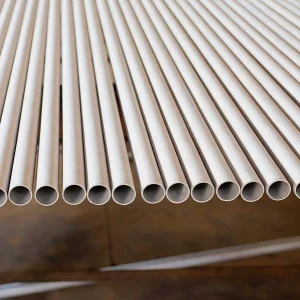
Precision Tube Offerings & Special Alloy Inventory
Review our extended catalog of high-performance austenitic, super austenitic, titanium, and nickel alloy tubing options.







Frequently Asked Questions (FAQ)
Addressing key engineering, manufacturing tolerance, and procurement inquiries from international buyers.
