
High-Performance Tubular Products Showcase
Explore precision-engineered heat exchanger, pressure vessel, and chemical process piping components manufactured to stringent global specifications.
-

High-Quality Austenitic steel ASME SA213 · TP310H Supplier, Suppliers
-

Custom Austenitic Steels 310S • UNS S31008 • 1.4845 Supplier, Suppliers
-
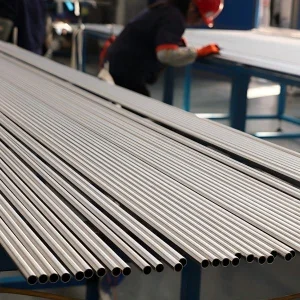
Custom Austenitic steel ASME SA213 · TP321H Manufacturer, Supplier
-

Custom Titanium Tubes • Grade 1•UNS R50250 Product, Products
-

Custom Austenitic steel ASME SA213 · TP347H Product, Products
-

High-Quality Austenitic steel ASME SA269 · TP304 Factories, Products
-

High-Quality Nickel Alloy Tubes 600 • UNS N06600 • 2.4816 Manufacturer, Manufacturers
-

High-Quality Nickel Alloy Tubes 625 • UNS N06625 • 2.4856 Suppliers, Product
Global Industrial Landscape & Advanced Tubular Material Engineering
In modern high-efficiency process engineering, custom stainless steel pipes and specialty alloy tubes represent critical failure-proof arteries across thermal, chemical, and energy systems.
The Evolving Demand for Custom Stainless & Specialty Alloy Tubing
The global industrial sector is undergoing a profound structural shift driven by decarbonization, operational intensification, and extreme fluid containment requirements. Custom stainless steel (SS) pipes and tubing systems are no longer selected solely based on bulk dimensions; they are specified down to exact microstructural grain boundaries, PREN (Pitting Resistance Equivalent Number) values, and tight wall thickness tolerances.
From high-pressure steam superheaters governed by ASME SA213 to cryogenic LNG transport lines certified under EN 10216-5, selecting the optimal metallurgical grade and manufacturing route (seamless vs. welded & drawn) directly dictates plant uptime, safety, and life-cycle economics.
Spezilla Tube Co., Ltd.: Metallurgical Excellence Since 2007
Founded in 2007 with operational headquarters in Shanghai and state-of-the-art manufacturing facilities in Huzhou, Zhejiang, Spezilla Tube Co., Ltd. has established itself as an authoritative global manufacturer of precision tubular solutions. Operating across an outside diameter (OD) spectrum of 4.00 mm to 114.30 mm and wall thicknesses from 0.40 mm to 3.05 mm (with straight lengths up to 25,000 mm), Spezilla bridges the gap between mass-scale production and custom engineering customization.
Every tube is produced under rigorous Quality Management Systems complying with ASTM, ASME, EN, and ISO standards, fully certified with EN 10204 3.1 and 3.2 inspection documentation.
Comprehensive Alloy Classification & Performance Metrics
A rigorous engineering comparison of stainless steel families, nickel superalloys, and titanium grades manufactured for severe industrial environments.
| Alloy Category | Representative Grades | Standard Specifications | PREN Rating | Primary Mechanical Property | Target Industrial Application |
|---|---|---|---|---|---|
| Standard Austenitic | 304 / 304L (1.4301/1.4307) 316 / 316L (1.4401/1.4404) |
ASTM A213 / A249 / A269 / A312 EN 10217-7 / EN 10216-5 |
19.0 – 25.0 | Yield Strength: >205 MPa Elongation: >35% |
General chemical handling, sanitary food/beverage, hydraulic control lines. |
| High-Temp Austenitic | 310S / 310H (1.4845/1.4841) 321 / 321H (1.4878) 347 / 347H (UNS S34709) |
ASME SA213 / SA312 / SA249 EN 10296-2 |
23.0 – 27.0 | High Creep Rupture Strength Stabilized against IC Corrosion |
Power plant superheaters, petrochemical reformers, radiant tube heaters. |
| Super Austenitic | 904L (UNS N08904 / 1.4539) 6Mo / UNS S31254 (1.4547) |
ASTM B676 / B515 / A269 EN 10217-7 |
34.0 – 43.0 | Pitting & Crevice Resistance Sulfuric/Phosphoric Acid Proof |
Flue gas desulfurization (FGD), pulp bleaching plants, phosphoric acid production. |
| Duplex & Super Duplex | 2205 (UNS S32205 / 1.4462) 2507 (UNS S32750 / 1.4410) |
ASTM A789 / A790 EN 10216-5 |
35.0 – 43.0+ | Yield Strength: >450–550 MPa High Resistance to Chloride SCC |
Offshore oil & gas, seawater desalination, subsea umbilical flowlines. |
| High-Nickel Superalloys | Alloy 600 (N06600 / 2.4816) Alloy 625 (N06625 / 2.4856) Alloy 825 (N08825 / 2.4858) |
ASTM B704 / B516 / B163 ASME SB515 / SB704 |
45.0 – 68.0+ | Extreme Oxidation Resistance Cryogenic to 1093°C stability |
Nuclear steam generators, sour gas (H2S) extraction, aerospace manifolds. |
| Titanium Tubing | Grade 1 (UNS R50250) Grade 2 (UNS R50400) |
ASTM B338 / ASME SB338 | N/A (Passive TiO2) | Density: 4.51 g/cm³ Immunity to Marine Corrosion |
Coastal power plant surface condensers, chemical evaporators, marine heat exchangers. |
Pitting Resistance (PREN)
The Pitting Resistance Equivalent Number (PREN) is calculated via formula: PREN = %Cr + 3.3(%Mo + 0.5%W) + 16(%N). Super austenitic 6Mo and Super Duplex 2507 achieve PREN > 40, ensuring virtual immunity to pitting corrosion in hyper-saline and acidic media.
High-Temperature Stability
Austenitic grades titanium-stabilized (321H) or niobium-stabilized (347H) prevent intergranular chromium carbide precipitation in the critical 450°C–850°C sensitization range, guaranteeing elevated thermal creep-rupture strength.
Stress Corrosion Cracking (SCC)
Standard 304/316 alloys are susceptible to chloride-induced stress corrosion cracking above 60°C. Upgrading to Duplex 2205, Nickel Alloy 825, or Titanium completely eliminates SCC failure vectors in industrial cooling circuits.
Precision Tube Drawing, Bright Annealing & NDT Infrastructure
Combining automated cold-drawing technology, controlled atmosphere heat treatment, and 100% non-destructive testing for zero-defect tube delivery.
1. Precision Cold Drawing & Reductions
For demanding heat exchanger applications, raw welded or seamless hollows undergo cold drawing over a precision die and plug (plug drawing or floating mandrel drawing). This cold-working process homogenizes the weld seam in welded & drawn (W&D) tubes, refines crystal grain alignment, and achieves dimensional tolerances down to ±0.05 mm on OD and wall thickness.
2. Bright Annealing (BA) & Solution Heat Treatment
To eliminate cold-working stresses and restore maximum corrosion resistance, tubes are processed through continuous bright annealing furnaces in a pure hydrogen or dissociated ammonia protective atmosphere at temperatures up to 1150°C. This prevents surface oxidation, delivering a mirror-like Ra < 0.4 µm internal and external surface finish without requiring pickling.
3. Comprehensive Non-Destructive Testing (NDT)
Spezilla enforces multi-stage testing prior to certification:
- Eddy Current Testing (ECT): 100% volumetric inline inspection per ASTM E426 to detect longitudinal and transverse surface discontinuities.
- Hydrostatic Testing: Pressure testing up to 30 MPa (4350 PSI) confirming structural integrity under ASME SA450 parameters.
- Ultrasonic Testing (UT): Wall thickness profiling and subsurface flaw identification per ASTM E213.
- Intergranular Corrosion (IGC) Test: Chemical immersion verification per ASTM A262 Practice E (Monypenny Strauss Test).
Next-Generation Trends in Custom SS & Alloy Piping Systems
Analyzing key technology vectors transforming global industrial infrastructure over the next decade.
1. Hydrogen Economy & High-Pressure Containment
The global transition toward green hydrogen requires specialty stainless steel tubing capable of resisting Hydrogen Embrittlement (HE). High-nickel austenitic grades (such as 316L with enhanced Ni content >12%) and Nickel Alloys (Inconel 625) are becoming industry benchmarks for 70 MPa to 100 MPa ultra-high pressure hydrogen refueling stations and electrolyzer manifolds.
2. Carbon Capture, Utilization & Storage (CCUS)
Supercritical CO2 transport streams in CCUS facilities contain high concentrations of moisture, H2S, and impurities that form highly aggressive carbonic acid. Super Duplex 2507 and Super Austenitic 6Mo tubing provide essential corrosion protection against localized crevice degradation in dense-phase CO2 compressors.
3. Ultra-High Purity (UHP) Biopharma & Semiconductor
Modern biopharmaceutical reactors and microchip fabrication plants require stainless tubing with electropolished inner surfaces (EP) reaching surface roughness Ra < 0.25 µm (10 µin). Spezilla’s precision drawing and cleanroom packaging protocols meet these stringent ASME BPE sanitary tubing standards.
Macro-Sector Industrial Application Scenarios
Custom piping and tubing systems tailored for extreme mechanical, thermal, and chemical environments.
Petrochemical Refineries & High-Temp Steam Generation
In power plants and crude oil hydrocrackers, tubing components are subjected to aggressive cyclic creep and high-temperature oxidation. Spezilla supplies specialized seamless austenitic tubes certified under ASME SA213 TP310H, TP321H, and TP347H.
- TP310H (25Cr-20Ni): High carbon variant optimizing creep resistance up to 1100°C in thermal reformers.
- TP347H (Nb-Stabilized): Prevents intergranular corrosion in high-pressure steam boilers operating between 540°C and 650°C.
Marine, Subsea & Desalination Engineering
Seawater cooling systems, Reverse Osmosis (RO) high-pressure manifolds, and offshore platform piping face continuous chloride exposure and biofouling. Spezilla engineered solutions combine Titanium Grade 2 (ASTM B338) and Nickel Alloy 625 / 825.
- Titanium Grade 2: Delivers complete immunity to seawater pitting and erosion-corrosion at light weight.
- Nickel Alloy 625 (UNS N06625): Solves severe pitting and SCC in sour (H2S-rich) crude environments.
Frequently Asked Questions on Custom SS Pipes & Tubes
Authoritative technical answers to common procurement, engineering, and metallurgy inquiries.
ASME SA213 covers seamless stainless steel and alloy tubes designed for high-temperature service like boilers, superheaters, and heat exchangers. ASME SA249 specifically governs welded stainless steel tubes intended for heat exchangers, condensers, and feed water heaters, where tight wall uniformity is paramount. ASME SA312 applies to seamless, straight-seam welded, and heavily cold worked austenitic stainless steel pipes intended for general high-temperature and corrosive fluid conveyance.
Welded & Drawn (W&D) tubing is created by cold drawing a welded tube over a plug or mandrel. This cold work completely recrystallizes the weld zone, matching its mechanical properties to the base metal. Engineers specify W&D tubing for shell-and-tube heat exchangers because it offers significantly tighter concentricity, uniform wall thickness, and superior internal surface smoothness compared to seamless tubing, often at a 20%–30% cost savings.
The "H" suffix designates a high-carbon alloy variant (typically 0.04%–0.10% carbon content) combined with controlled solution annealing temperatures. This higher carbon chemistry increases high-temperature creep strength and stress-rupture resistance for continuous service above 538°C (1000°F).
Titanium Grade 2 forms an instantaneous, self-healing passive TiO2 oxide film that renders it completely immune to chloride pitting, crevice corrosion, and microbiologically influenced corrosion (MIC) in seawater up to 300°C. Super Duplex 2507 (PREN > 42) offers much higher mechanical yield strength (>550 MPa vs >275 MPa for Ti Gr 2), making 2507 preferred for high-pressure subsea lines where structural strength is required alongside marine corrosion resistance.
Every order is shipped with standard EN 10204 3.1 Mill Test Certificates (MTC) detailing original melt heat numbers, chemical composition (Ladle analysis), mechanical test results (Tensile, Yield, Elongation, Hardness), NDT inspection logs (Eddy Current/Hydrostatic), and grain size analysis. EN 10204 3.2 certificates verified by independent third-party inspection agencies (such as TÜV, DNV, SGS, or Lloyd's Register) are available upon project request.
Custom SS & Specialty Alloy Product Catalogue
Precision-drawn stainless steel, super austenitic, and high-nickel tubing ready for global distribution.
-

Custom Austenitic Steels 304 • UNS S30400 • 1.4301 Manufacturer, Factories
-

Custom Austenitic steel ASME SA312 · TP304 Stainless Steel Pipe Manufacturers, Supplier
-

Custom Nickel Alloy Tubes 825 • UNS N08825 • 2.4858 Suppliers, Product
-

Custom Austenitic Steels 321H • UNS S32109 • 1.4878 Manufacturer, Products
-

Custom Austenitic steel ASME SA312 · TP321 Suppliers, Product
-

High-Quality Super Austenitic Steels 904L • UNS N08904 • 1.4539 Suppliers, Factory
-

Custom Austenitic Steels 310H • UNS S31009 Manufacturers, Products
-

High-Quality Austenitic steel ASME SA213 · TP347 Manufacturers, Supplier
Engineered Tubular Solutions for High-Stakes Applications
Whether your project requires straight lengths up to 25 meters, precision U-bent heat exchanger bundles, or bright annealed instrument tubing, Spezilla delivers fully certified materials engineered to your exact chemical and mechanical specifications.
