
Featured Corrosion-Resistant Alloy Products
Explore our global catalog of high-performance austenitic, nickel alloy, and specialized metallic tubing built to rigorous ASTM, ASME, and EN standards.


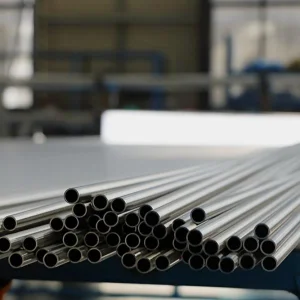


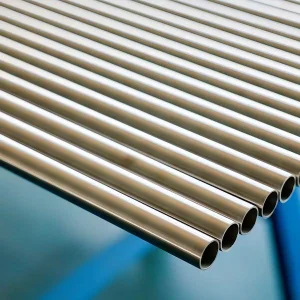


"Copper-nickel alloys possess a unique metallurgical synergy: the inherent biofouling resistance of copper coupled with the mechanical strength and velocity resistance imparted by nickel and micro-alloyed iron/manganese additions. Choosing the right alloy grade and seamless manufacturing process directly prevents premature microbiologically influenced corrosion (MIC) and pitting failures in marine heat exchangers."
Metallurgical Foundations & Corrosion Resistance Mechanisms
A rigorous examination of CuNi 90/10 and CuNi 70/30 behavior in aggressive saline, brackish, and industrial fluid environments.
CuNi 90/10 (UNS C70600 / EN CW352H)
CuNi 90/10 is the most widely specified copper-nickel alloy for marine seawater piping systems. The chemical composition is engineered with 10% nickel, 1.0–1.8% iron (Fe), and 0.5–1.0% manganese (Mn) balanced with pure copper.
- Protective Surface Oxide Film: Develops a stable, adherent cuprous oxide ($Cu_2O$) surface layer within hours of exposure to oxygenated seawater. Over weeks, this layer transitions into a protective $Cu_2(OH)_3Cl$ top surface that stifles further ionic migration.
- Inherent Anti-Biofouling: Continuous release of copper ions at the surface lattice inhibits the settlement of macro-organisms such as barnacles, mussels, and macro-algae without requiring chemical biocide dosing.
- Thermal Efficiency: Retains high thermal conductivity ($45\ W/m\cdot K$ at $20^\circ C$), making it ideal for shell-and-tube heat exchangers and condenser tube bundles.
CuNi 70/30 (UNS C71500 / EN CW354H)
Where fluid shear forces, higher operating pressures, and elevated temperatures exceed the capabilities of 90/10 alloys, CuNi 70/30 provides superior structural and mechanical durability.
- Enhanced Impingement & Erosion Resistance: With a 30% nickel content and controlled iron additions (0.4–1.0%), CuNi 70/30 tolerates design fluid velocities up to $4.5\ m/s$ in seawater piping networks without suffering protective film strip-off.
- Resistance to Stress Corrosion Cracking (SCC): Highly resistant to chloride-induced stress corrosion cracking and ammonia-assisted cracking compared to traditional brasses or lower-grade copper tubing.
- High-Temperature Performance: Maintains mechanical yield strength and creep resistance at elevated temperatures up to $300^\circ C$, suitable for high-pressure feedwater heaters and boiler feedwater lines.
Engineering Specification & Standard Comparison Matrix
Direct technical mapping across international manufacturing standards, chemical compositions, and mechanical pressure boundaries.
| Parameter / Specification | CuNi 90/10 (UNS C70600) | CuNi 70/30 (UNS C71500) | Testing & Compliance Standards |
|---|---|---|---|
| Nominal Composition | Cu Rem, Ni 10.0-11.0%, Fe 1.0-1.8%, Mn 0.5-1.0% | Cu Rem, Ni 29.0-33.0%, Fe 0.4-1.0%, Mn 0.5-1.0% | ASTM B111 / B466 / EN 12451 |
| Tensile Strength (min) | $275\ MPa\ (40\ ksi)$ | $360\ MPa\ (52\ ksi)$ | ASTM B111 Tensile Testing |
| Yield Strength 0.2% (min) | $105\ MPa\ (15\ ksi)$ | $125\ MPa\ (18\ ksi)$ | ISO 6892-1 / ASTM E8 |
| Max Flow Velocity (Seawater) | $2.5 - 3.0\ m/s\ (8.2 - 9.8\ ft/s)$ | $4.0 - 4.5\ m/s\ (13.1 - 14.7\ ft/s)$ | EEMUA Publication 144 / 234 |
| Thermal Conductivity | $45\ W/m\cdot K$ | $29\ W/m\cdot K$ | DIN 52612 |
| Manufacturing Routes | Seamless Cold Drawn EFW Welded | Seamless Cold Drawn | ASTM B466 / ASTM B467 |
| Key Standards Compliance | DIN 86019, EEMUA 144, BS 2871, MIL-T-16420K, EN 12449, PED 2014/68/EU | EN 10204 3.1 / 3.2 Certified | |
China Factory Supply Chain Superiority & Advanced Manufacturing
Why leading global EPC contractors and OEMs rely on China’s integrated manufacturing bases for seamless copper-nickel tubing.
Vertical Upstream Integration
China's premier copper-nickel mills utilize fully integrated production lines, starting from high-purity electrolytic copper ($99.99\%$) and Grade-1 refined nickel cathode. In-house horizontal continuous casting and heavy extrusion presses (up to 6,000 tons) guarantee exceptional billet density and zero void formation prior to cold piercing and drawing.
Cost Efficiency & Scalability
Through optimized thermal annealing cycles, automated triple-strand cold pilger mills, and localized energy infrastructure, Chinese factories deliver up to $20-30\%$ lower total cost of procurement compared to Western European mills, without compromising geometric tolerances or metallurgical purity.
Rapid Delivery & Custom Fabrication
Equipped with ultra-long bright annealing furnaces, Chinese manufacturing hubs can supply continuous straight lengths up to $25\ meters$ and precision U-bent tubes with tight radius tolerances. Vast stock reserves of raw hollows enable rapid lead times (as short as 2-3 weeks for urgent offshore repair projects).
Global Enterprise Procurement & Compliance Guarantees
Mitigating supply chain risks through total quality control, international certifications, and transparent traceability.
Total Cost of Ownership (TCO) Optimization
Procurement directors in international marine and chemical engineering firms evaluate copper-nickel tubing beyond initial material unit costs. Premature piping failure due to micro-pitting or poor weldability leads to catastrophic drydock expenses or plant shutdowns.
Our quality assurance framework mitigates TCO risks through:
- Strict Iron Solution Control: Iron must remain fully dissolved in the alpha solid-solution matrix. Improper heat treatment causes iron precipitation, leading to severe localized corrosion. We mandate water-quenched solution annealing after cold working.
- 100% Non-Destructive Testing (NDT): Every single pipe undergoes continuous internal eddy current inspection per ASTM E243 and hydrostatic pressure testing up to $100\ bar$ before export packing.
Regulatory Compliance & Third-Party Audits
To meet stringent marine class society rules (DNV-GL, ABS, Bureau Veritas, Lloyd's Register) and industrial safety directives, every order is accompanied by comprehensive quality documentation:
- EN 10204 3.1 & 3.2 Certification: Full chemical analysis, mechanical property verification, flattening, flaring, and grain size determination certified per batch.
- Pressure Equipment Directive (PED 2014/68/EU): Full compliance for pressure vessel tubing operated within European jurisdictions.
- Seaworthy Export Packaging: Fumigated wooden crates with plastic end caps, moisture-absorbing desiccants, and vacuum plastic sleeve protection prevent atmospheric tarnishing during ocean freight.
Localized Application Scenarios & Field Engineering
Real-world deployment of CuNi piping across severe marine and industrial operational environments.
1. Offshore Oil & Gas Platforms
Used extensively for seawater firewater ring mains, deluge systems, and FPSO cooling water loops. CuNi 90/10 provides vital biofouling protection, ensuring fire pump nozzles remain unblocked by marine growth during critical safety emergencies.
2. Desalination Plants (MSF & MED)
Multi-Stage Flash (MSF) and Multi-Effect Distillation (MED) evaporator bundles utilize CuNi 70/30 in high-temperature heat recovery sections where deaerated seawater reaches temperatures up to $120^\circ C$ with high sulfide concentrations.
3. Naval Shipbuilding Piping
Specified by international navies for hull-penetrating sea chest connections, sanitary piping, radar cooling circuits, and submarine seawater services due to its acoustic dampening properties and shock resistance against explosive impacts.
4. Coastal Nuclear & Thermal Power Stations
Main steam condenser tubing and auxiliary heat exchangers drawing direct seawater cooling rely on seamless CuNi tubes to maintain high vacuum pressures and resist steam erosion-corrosion on the shell side.
5. HVAC & Marine Chiller Systems
Shell-and-tube chillers operating on cruise liners and commercial cargo ships utilize inner-finned or smooth CuNi 90/10 tubes for shell-side refrigerant condensation using direct sea suction.
6. Hydraulic Line Systems in Marine Engineering
Heavy-duty, high-pressure seamless CuNi 70/30 lines power hydraulic deck machinery, steering gears, and bow thruster pitch controls operating in corrosive salt-spray environments.
Future Industry Trends & Technological Outlook
Key drivers transforming the global copper-nickel piping and specialty tubing landscape over the next decade.
Offshore Floating Wind Farm Cooling
As offshore wind farms transition into deeper waters via floating substructures, compact seawater cooling loops for high-voltage direct current (HVDC) converter platforms demand ultra-reliable CuNi 70/30 piping for maintenance-free 30-year operational cycles.
Green Hydrogen Offshore Electrolysis
Developing offshore green hydrogen generation plants using ocean water feeds requires specialized pretreatment and heat rejection piping. Copper-nickel alloys are leading candidate materials due to their biofouling resistance and compatibility with brackish water reverse osmosis (BWRO) units.
Zero-Liquid-Discharge (ZLD) Technology
Industrial wastewater treatment facilities upgrading to ZLD systems are specifying high-nickel and copper-nickel heat exchanger tubes to withstand concentrated brine sludges and crystallization temperatures without scale-induced pitting.
Frequently Asked Questions (Technical & Procurement FAQ)
Expert engineering answers to common technical queries regarding copper-nickel specification, fabrication, and service performance.
Complete High-Performance Alloy Tube Lineup
Explore our extended series of super austenitic, duplex, ferritic, and titanium tubes for specialized industrial heat exchangers and piping assemblies.

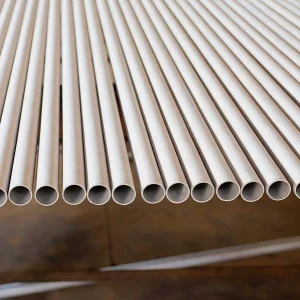





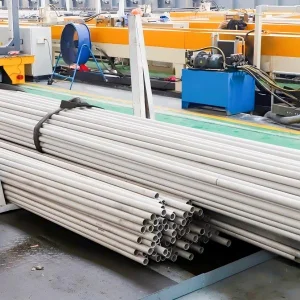
Need assistance selecting between CuNi 90/10 and CuNi 70/30 or custom tube sizing? Our metallurgical engineering team provides technical consultations, EN 10204 MTC samples, and direct factory pricing within 24 hours.
Contact Our Technical Sales Team