
The Global Industrial Heat Exchange & Condenser Engineering Landscape
In an era defined by aggressive decarbonization mandates, energy efficiency optimization, and severe operating environments, heat exchangers and steam surface condensers serve as the fundamental backbone of modern industrial infrastructure.
Global industrial processes rely heavily on optimal thermal transfer efficiency. From massive subsea Liquefied Natural Gas (LNG) re-gasification terminals and supercritical thermal power plants to nuclear steam generators, chemical refineries, and pharmaceutical clean-room HVAC-R systems, the mechanical integrity of heat exchanger tubes determines operational uptime, environmental safety, and overall Levelized Cost of Energy (LCOE).
Selecting the right heat exchanger supplier or tubular manufacturing factory requires far more than comparing initial Capital Expenditure (CAPEX). Modern procurement directors and principal corrosion engineers evaluate suppliers based on metallurgical precision, non-destructive testing (NDT) reliability, alloy purity, and long-term Operational Expenditure (OPEX) minimization. As global energy systems transition toward hydrogen-blend combustion, carbon capture and storage (CCS), and ultra-high-pressure chemical processes, the demand for high-performance tubular products—manufactured from advanced austenitic, duplex, super austenitic, nickel-base alloys, and titanium—has reached an unprecedented peak.
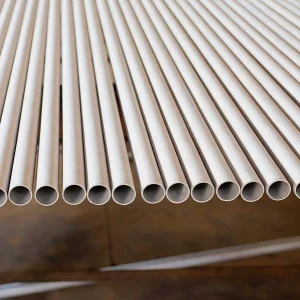
Featured Precision Tubular Product Catalog (Part I)








Global Industry Trends Shaping Heat Transfer Engineering
Four macro-technological pivots are revolutionizing how thermal systems are designed, fabricated, and specified by global engineering procurement construction (EPC) contractors.
1. Decarbonization & Extreme Energy Efficiency
Industries are moving toward waste heat recovery systems (WHRS) and high-efficiency condenser designs. Minimizing wall thickness variations while maximizing thermal conductivity allows for up to 18% higher heat transfer coefficients (U-values) in shell-and-tube exchangers.
2. Shift to Super Austenitic & Super Duplex Alloys
With process fluids operating at higher pressures, temperatures, and chloride concentrations, traditional 304/316 stainless steel is increasingly replaced by Super Duplex (S32750/S32760) and 6% Moly Super Austenitics (S31254/254SMO) to prevent Chloride Stress Corrosion Cracking (CSCC).
3. Transition to Titanium Grade 2 & Grade 3 in Coastal Condensers
Coastal power plants and marine desalination facilities are rapidly transitioning to Titanium (UNS R50400 / R50550) surface condenser tubes due to titanium’s near-total immunity to erosion-corrosion and micro-biofouling in untreated seawater environments.
4. Seamless Precision & Cold-Drawn Technology
The preference for Welded & Drawn (W&D) and Seamless ASTM SA213/SA249 tubes with bright annealed (BA) inner surfaces has expanded. Ultra-smooth inner diameters (Ra < 0.4 µm) significantly reduce boundary layer friction, fouling rates, and chemical cleaning frequencies.
China Industry 4.0: Supply Chain Resilience & Manufacturing Superiority
How modern Chinese tubular manufacturing facilities have evolved into automated, digitally verified global supply chain anchors for multinational EPCs.
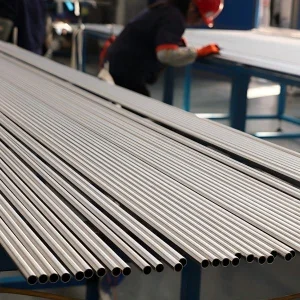
The global heat exchanger supply chain has undergone a profound transformation over the past decade. Modern Chinese tubular factories are no longer merely low-cost production centers; they represent state-of-the-art hubs of automated metallurgy, digital quality control, and vertical integration. Advanced facilities in key industrial clusters like Huzhou and Shanghai operate integrated Industry 4.0 infrastructure—combining real-time Manufacturing Execution Systems (MES), automated cold-pilgering mills, continuous bright annealing furnaces, and inline digital non-destructive testing suites.
Full Raw Material Traceability
From Vacuum Induction Melting (VIM) and Argon Oxygen Decarburization (AOD) refined raw mother hollows to finished bundles, every tube is tied to a specific heat number with complete Positive Material Identification (PMI) logs.
Custom U-Bending & Stress Relief
State-of-the-art automated U-bending machines produce tight bend radii down to 1.5 x OD. Post-bend heat treatment via localized resistance heating eliminates residual stress and prevents SCC in the bend area.
Supply Chain Resilience
China's fully integrated domestic alloy processing ecosystem mitigates global logistics bottlenecks, offering lead times 30% to 50% shorter than European counterparts without compromising international engineering compliance.
Global Procurement Requirements & Compliance Standards
Navigating international regulatory frameworks, pressure vessel codes, and material standards for seamless project integration.
Procuring heat exchanger and condenser tubing for enterprise-scale installations requires rigorous alignment with international pressure vessel design codes, such as ASME Section VIII Division 1 & 2, TEMA (Tubular Exchanger Manufacturers Association) Standards, and EN 13445. Below is an overview of mandatory international manufacturing standards for industrial tubing:
| Standard Specification | Material Category | Manufacturing Process | Primary Industrial Application | Mandatory Quality Verification |
|---|---|---|---|---|
| ASME SA213 / ASTM A213 | Seamless Austenitic & Ferritic Steel | Seamless Cold Drawn / Hot Finished | Boilers, Superheaters, High-Pressure Heat Exchangers | Hydrostatic / NDT ET, Grain Size, Hardness Test |
| ASME SA249 / ASTM A249 | Welded Austenitic Steel | Welded & Cold Worked (W&D) | Feedwater Heaters, Condensers, Heat Exchangers | Reverse Flattening, Flange, Eddy Current, Hydrostatic |
| ASTM A269 | Austenitic Stainless Steel | Seamless & Welded | General Service, Process Piping, Instrumentation | Dimensional Check, Flare Test, Flange Test |
| ASTM B338 / ASME SB338 | Seamless & Welded Titanium Alloys | Cold Drawing / Inert Gas Welding | Surface Condensers, Seawater Heat Exchangers | Pneumatic, Ultrasonic (UT), Eddy Current, Tension Test |
| EN 10217-7 | Stainless Steel Welded Tubes | Welded (TIG / Laser / Plasma) | Pressure Purposes, Chemical & Food Processing | EN 10204 3.1 / 3.2, Weld Seam Decay Test, NDT |
| ASTM B676 / B515 | High-Nickel Alloys (UNS N08367 / N08825) | Welded & Cold Worked | Severe Corrosive Media, Acid Plant Condensers | PMI, Intergranular Corrosion (IGC) ASTM A262 |
Material Test Report Integrity (EN 10204 3.1 vs. 3.2): A critical aspect of modern global procurement is inspection certification. Standard shipments are verified under EN 10204 3.1, issued directly by the mill’s independent QA department. For critical nuclear, offshore oil & gas, or lethal service applications, global buyers specify EN 10204 3.2 inspection—requiring independent third-party inspection agencies (such as TÜV, Lloyd's Register, DNV, or SGS) to witness chemical analysis, mechanical testing, non-destructive examination, and hydrostatic pressure testing prior to shipment release.
Localized Application Scenarios & Metallurgical Selection Benchmarks
Engineering analysis of material performance across severe operating environments.
Scenario A: Offshore Oil & Gas & Seawater Desalination
Operating Environment: Severe chloride exposure, hydrogen sulfide ($H_2S$), high-velocity seawater cooling.
Metallurgical Recommendation: Super Duplex Stainless Steel 2507 (UNS S32750 / 1.4410) or Titanium Grade 3 (UNS R50550).
Engineering Rationale: With a Pitting Resistance Equivalent Number (PREN) $\ge 42$, Super Duplex provides exceptional resistance to pitting and crevice corrosion. Titanium Grade 3 offers even higher yield strength than Grade 2 while maintaining immunity to seawater corrosion up to 260°C.
Scenario B: Petrochemical Refineries & High-Temp Cracking
Operating Environment: Severe thermal cycling, hydrocarbon gas oxidation, temperatures up to 850°C.
Metallurgical Recommendation: Austenitic Stainless Steel 310H (UNS S31009) or 347H (UNS S34709).
Engineering Rationale: Grade 310H contains high chromium (24-26%) and nickel (19-22%), forming a stable chromium oxide scale that prevents internal oxidation. Grade 347H is stabilized with Niobium (Nb) to prevent intergranular chromium carbide precipitation during thermal cycling.
Scenario C: Thermal Power Generation Steam Surface Condensers
Operating Environment: High-vacuum steam condensation, steam impingement, condensate purity management.
Metallurgical Recommendation: ASME SA249 TP304L / TP316L or Welded Titanium Grade 2.
Engineering Rationale: Low carbon variants (304L/316L) prevent intergranular corrosion in the heat-affected zone (HAZ) of welded tube bundles. Titanium Grade 2 provides thin-wall capabilities (0.5mm to 0.7mm WT), dramatically improving heat transfer efficiency while maintaining zero failure rates from steam erosion.
Scenario D: Chemical Processing & Acid Media Exchangers
Operating Environment: Concentrated sulfuric acid ($H_2SO_4$), phosphoric acid, highly acidic reducing environments.
Metallurgical Recommendation: Super Austenitic 904L (UNS N08904 / 1.4539) or SMO 254 (UNS S31254).
Engineering Rationale: 904L includes a 1.5% copper addition, which imparts exceptional resistance to strong reducing acids across all concentrations up to 40°C. SMO 254 features 6.1% Molybdenum and high Nitrogen content, making it vastly superior to conventional 316L in harsh acidic chloride media.
Engineering Material Selection Matrix for Heat Exchangers
A side-by-side technical performance comparison of major alloy classes utilized in surface condensers and shell-and-tube exchangers.
| Alloy Grade | UNS / EN Number | Microstructure Class | PREN Value Range | Thermal Cond. (W/m·K at 100°C) | Max Temp (°C) Oxidation Air | Primary Corrosive Resistance Strength |
|---|---|---|---|---|---|---|
| SS 304 / 304L | S30400 / 1.4301 | Austenitic | 18.0 – 20.0 | 16.2 | 870 | Freshwater, mild atmospheric, HVAC-R clean water |
| SS 316 / 316L | S31600 / 1.4401 | Austenitic | 23.1 – 25.0 | 16.3 | 870 | Low-chloride process fluids, industrial steam, food grade |
| SS 321H / 347H | S32109 / S34709 | Stabilized Austenitic | 19.0 – 21.0 | 16.1 | 815 – 850 | High-temperature gas heat recovery, thermal stress cycling |
| Duplex 2205 | S31803 / S32205 | Austenitic-Ferritic | 34.0 – 36.0 | 19.0 | 300 | High chloride SCC, oil & gas process lines, brackish cooling |
| Super Duplex 2507 | S32750 / 1.4410 | Austenitic-Ferritic | 42.0 – 45.0 | 15.0 | 250 | Offshore oil & gas, high-pressure seawater, desalination |
| Super Austenitic 904L | N08904 / 1.4539 | High-Alloy Austenitic | 36.0 – 39.0 | 12.9 | 400 | Sulfuric & phosphoric acid heat exchangers, bleach plants |
| Titanium Grade 3 | R50550 / 3.7055 | Alpha Titanium | N/A (Immune) | 19.9 | 300 | Seawater condensers, coastal power, chlor-alkali plants |
* PREN (Pitting Resistance Equivalent Number) = %Cr + 3.3(%Mo + 0.5%W) + 16(%N).
Technical & Procurement FAQ: Expert Knowledge Base
Addressing critical engineering, manufacturing, and compliance queries raised by global procurement and plant maintenance directors.
ASME SA213 governs seamless carbon, ferritic, and austenitic alloy steel tubes manufactured without any longitudinal weld seam. It is preferred in ultra-high-pressure applications, thick-wall bundles, and severe services where design codes explicitly prohibit weld seams. ASME SA249 covers welded austenitic tubes designed for condensers, boilers, and heat exchangers. Modern SA249 tubes undergo extensive cold-working (drawing) and bright annealing, resulting in a completely recrystallized weld seam that exhibits mechanical and corrosion resistance properties identical to the parent metal, alongside superior wall thickness uniformity and tighter outer diameter tolerances at a more competitive cost structure.
During cold drawing or welding, internal mechanical stress is introduced, and chromium carbides can precipitate along grain boundaries (sensitization), impairing corrosion resistance. Bright Annealing involves heating the tubes to solution anneal temperature (typically 1040°C to 1150°C for austenitic grades) in a controlled, 100% pure hydrogen atmosphere. This process redissolves chromium carbides back into the matrix without causing surface oxidation or scaling. The resulting mirror-smooth, oxide-free finish preserves original alloy chemistry, reduces boundary layer fluid drag, and prevents localized pitting initiation.
CSCC is a premature catastrophic failure mode occurring when tensile stress, elevated temperature (>60°C), and aqueous chloride ions coexist. Standard 304/304L stainless steels are highly susceptible to CSCC. Mitigation strategies include switching to Duplex grades like 2205 (S32205) or Super Duplex 2507 (S32750), whose dual-phase ferrite-austenite microstructure blocks transgranular crack propagation. Alternatively, high-nickel alloys (Inconel 625, Hastelloy C276) or pure Titanium Grade 2/3 can be specified for extreme environments.
Condenser tubes require 100% continuous non-destructive inspection. The industry standard mandates Eddy Current Testing (ET) per ASTM E426 or ASTM E243 to detect longitudinal, transverse, and subsurface flaws. For seamless high-pressure tubes, Ultrasonic Testing (UT) per ASTM E213 is applied. Furthermore, every tube undergoes hydrostatic testing (up to 20 MPa/2900 psi) or pneumatic testing under water per ASTM A1047 to guarantee zero pinhole leakage.
When a straight tube is cold-bent into a U-shape, severe cold work occurs at the bend radius, resulting in wall thinning on the outer leg (extrados), thickening on the inner leg (intrados), and high residual tensile stresses. If left untreated, the bend zone becomes a primary site for stress corrosion cracking. Advanced factories utilize electric resistance post-bend heat treatment to solution-anneal the U-bent section plus 150mm of adjacent straight legs, restoring mechanical ductility and corrosion resistance in strict compliance with TEMA standards and ASTM A688/A803.
A comprehensive factory audit evaluates five core criteria: (1) Quality System Certifications (ISO 9001, PED 2014/68/EU, AD2000, ASME NS/ISO 17025 laboratory accreditation); (2) Raw Material Vendor Qualification (origin of mother hollows/strips); (3) In-House Testing Capabilities (chemical wet lab, Optical Emission Spectroscopy, NDT equipment calibration, mechanical tensile/flaring/flattening testers); (4) Traceability Systems (ERP-integrated heat-to-tube tracking); and (5) Export Packaging Standards (wooden boxes with end caps and desiccants to prevent sea freight corrosion).
Featured Precision Tubular Product Catalog (Part II)
Additional engineered tubular products manufactured for specialized high-temperature, high-pressure, and severe acid environments.






Partner with a Reliable Global Tubular Manufacturer
Whether you require high-volume standard ASME SA249 316L heat exchanger tubes, custom U-bent 2507 Super Duplex bundles, or ultra-thin Titanium surface condenser tubes, our engineering sales group provides complete technical data packages, material certification, and global delivery schedules.
Request Engineering Consultation & Quote