
High-Performance Industrial Alloy Pipes
Explore our premium alloy tube selection engineered for extreme corrosive media, high-pressure heat exchangers, and chemical processing facilities.







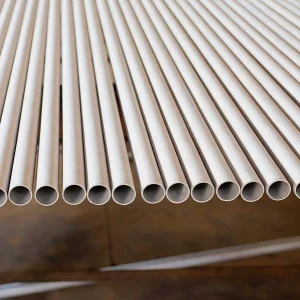
Nickel 201 (UNS N02201 / W.Nr. 2.4815): Technical Supremacy in Severe Caustic Environments
A rigorous examination of low-carbon commercially pure nickel piping, graphitization resistance, microstructural stability, and high-temperature performance.
In modern process engineering, Nickel 201 (UNS N02201 / DIN W.Nr. 2.4815 / 2.4816) represents the gold standard for commercially pure wrought nickel, specifically optimized to withstand extreme chemical attack and high-temperature operational stress. While standard Nickel 200 (UNS N02200) contains up to 0.15% carbon, Nickel 201 is chemically tailored with a strictly controlled maximum carbon content of 0.02%. This minute chemical distinction yields a transformative metallurgical advantage: complete immunity to intergranular graphitization at temperatures exceeding 315°C (600°F).
Critical Metallurgical Insight: Above 315°C, excess carbon in Nickel 200 precipitates out of the solid solution to form elemental graphite along grain boundaries. This microstructural phase transformation causes severe embrittlement, stress cracking, and catastrophic loss of ductility. Nickel 201's ultra-low carbon chemistry guarantees structural integrity up to 650°C (1200°F).
Chemical Composition & Microstructural Mechanisms
The chemical equilibrium of Nickel 201 is designed to maximize corrosion resistance while maintaining superior weldability and cold-forming capabilities. The element balance governed by ASME SB-161 / ASTM B161 standards requires a minimum pure Nickel (plus Cobalt) content of 99.0%.
- Nickel + Cobalt (Ni + Co): 99.0% minimum. Ensures high ferromagnetic response, exceptional electrical conductivity, and high thermal transfer properties.
- Carbon (C): 0.02% maximum. Eliminates grain boundary graphite precipitation during prolonged thermal exposure.
- Manganese (Mn): 0.35% maximum. Enhances hot workability and ties up residual sulfur trace impurities.
- Iron (Fe): 0.40% maximum. Maintained at sub-half-percent levels to prevent localized galvanic pitting in concentrated caustic solutions.
- Sulfur (S): 0.01% maximum. Strictly limited to eliminate low-melting-point nickel-sulfide eutectics that cause hot shortness during welding.
- Silicon (Si) & Copper (Cu): 0.35% and 0.25% maximum respectively, supporting microstructural purity.
Because Nickel 201 is a solid-solution single-phase face-centered cubic (FCC) alloy, it retains high impact toughness down to cryogenic temperatures (-196°C) without undergoing ductile-to-brittle transition. Concurrently, its high thermal conductivity (60.5 W/m·K at 20°C) outperforms standard austenitic stainless steels by more than 300%, making Nickel 201 seamless and welded pipes the preferred thermal transfer medium in heavy caustic evaporation boilers and high-duty heat exchangers.
Global Industrial Demand & Macro Trends for Nickel 201 Piping Systems
How the green hydrogen transition, chlor-alkali modernizations, and fluorochemical expansion are driving exponential demand for UNS N02201 seamless and welded tubes.
Alkaline Water Electrolysis & Green Hydrogen
The global push toward decarbonization has catalyzed massive investment in multi-megawatt Alkaline Electrolyzer (AWE) plants. Nickel 201 seamless pipes serve as critical manifold pipes and electrode conduits due to their absolute passivity in 30%–35% concentrated Potassium Hydroxide (KOH) electrolytes under elevated temperatures and operating pressures.
Chlor-Alkali Evaporation Unit Upgrades
Global production of caustic soda (NaOH) and caustic potash (KOH) requires multi-stage fall-film evaporator units operating at concentrations up to 98% molten state. Nickel 201 is the only cost-effective engineering alloy that resists caustic stress corrosion cracking (SCC) across all concentrations above 150°C.
Dry Halogen & Fluorochemical Processing
In semiconductor gas manufacturing and fluoropolymers synthesis, Nickel 201 pipes provide exceptional passivation against dry chlorine (Cl2) gas up to 540°C and dry fluorine (F2) gas up to 500°C. The formation of a dense nickel fluoride (NiF2) film prevents progressive metal degradation.
Metallurgical Comparison Matrix: Nickel 201 vs. Alternative Corrosion Alloys
A technical side-by-side evaluation helping procurement leaders and plant engineers select the ideal pipe grade for high-risk applications.
| Alloy Grade | UNS / W.Nr. | Carbon Content | Max Temp (Graphitization Safe) | Caustic Soda (NaOH) Resistance | Thermal Cond. (W/m·K) | Primary ASTM / ASME Standard |
|---|---|---|---|---|---|---|
| Nickel 201 | UNS N02201 / 2.4815 | ≤ 0.02% | 650°C (1200°F) | Outstanding (All Conc.) | 60.5 | ASTM B161 / B163 / B725 / B730 |
| Nickel 200 | UNS N02200 / 2.4816 | ≤ 0.15% | 315°C (600°F) | Outstanding (<315°C) | 70.2 | ASTM B161 / B163 / B725 |
| Monel 400 | UNS N04400 / 2.4360 | ≤ 0.30% | 480°C (900°F) | Good (Below 100°C) | 21.8 | ASTM B165 / B163 |
| Inconel 600 | UNS N06600 / 2.4816 | ≤ 0.15% | 1093°C (2000°F) | Moderate to High | 14.9 | ASTM B167 / B163 |
| Hastelloy C-276 | UNS N10276 / 2.4819 | ≤ 0.01% | 1040°C (1900°F) | Moderate (Prone to SCC in concentrated caustic) | 10.2 | ASTM B622 / B626 |
| SS 316L | UNS S31603 / 1.4404 | ≤ 0.03% | 450°C (840°F) | Poor in concentrated caustic above 80°C | 16.3 | ASTM A213 / A312 / A249 |
Mechanical Properties & Testing Benchmarks for Nickel 201 Pipes
Pursuant to ASME SB-161 (Seamless Pipe & Tube) and ASME SB-725 (Welded Pipe) specifications, manufactured Nickel 201 pipes undergo rigorous mechanical testing in annealed (Soft) condition:
- Tensile Strength (Minimum): 380 MPa (55,000 psi / 55 ksi)
- Yield Strength (0.2% Offset Min): 80 MPa (12,000 psi / 12 ksi)
- Elongation in 2 inches (Minimum): 40.0% — demonstrating exceptional ductility for orbital welding, flaring, cold bending, and U-tube bundling.
- Hardness Limit: Max 70 HRB (Rockwell B) / Max 140 HV (Vickers), preventing work-hardening micro-cracks during installation.
China Factory 4.0: Supply Chain Resilience, Precision Cold Drawing & Quality Verification
How state-of-the-art Chinese manufacturing facilities leverage digital automation, raw material tracing, and advanced NDE technology to supply zero-defect Nickel 201 pipes worldwide.
Automated Multi-Pass Cold Drawing (LG Pilgering)
Modern Chinese factories utilize high-precision cold pilger mills and multi-pass hydraulic draw benches with tungsten carbide dies. This guarantees dimensional wall tolerances within ±5% and smooth inner bore surface roughness (Ra < 0.4 μm) critical for high-purity chemical media flow.
In-Line Continuous Hydrogen Bright Annealing
Utilizing closed-loop atmosphere furnace lines supplied with 100% pure decomposed ammonia or ultra-pure dry hydrogen (dew point < -60°C), Nickel 201 pipes are heat-treated at 1100°C–1150°C. This delivers a oxide-free, mirror-bright surface finish with fully recrystallized equiaxed austenitic grain structure.
100% Non-Destructive Examination (NDE)
Every single length of Nickel 201 pipe undergoes full-body Eddy Current Testing (ECT per ASTM E426) and Hydrostatic Testing up to 20 MPa (3000 psi) or Ultrasonic Inspection (UT per ASTM E213) to ensure absolute weld joint density and wall integrity without sub-surface flaws.
End-to-End Raw Material Traceability & Export Compliance
Top-tier Chinese Nickel 201 pipe factories operate under ISO 9001:2015, ISO 14001, and PED 2014/68/EU certifications. Raw material melts originate exclusively from audited vacuum induction melting (VIM) plus electroslag remelting (ESR) master ingot suppliers. Full material traceability is certified through EN 10204 3.1 Mill Test Certificates (MTC) detailing chemical analysis, heat treatment history, grain size, mechanical properties, and Positive Material Identification (PMI) spectral analysis verified via handheld XRF analyzers before packing.
Worldwide Industrial Application Scenarios for Nickel 201 Piping
Real-world engineering installations where UNS N02201 pipe products deliver operational safety and extended service life under severe process conditions.
1. Caustic Soda Concentration Plants
In multi-effect falling film evaporators concentrating NaOH solution from 50% membrane cell output to 98% anhydrous molten liquid at temperatures above 400°C, Nickel 201 seamless heat exchanger tubes and steam distribution header pipes provide immunity to caustic stress cracking and erosion-corrosion.
2. Synthetic Viscose & Rayon Fiber Manufacturing
During the spin-bath chemical recovery cycle involving concentrated sodium hydroxide and sulfur-bearing byproducts, Nickel 201 pipes prevent metal ion contamination, preserving the high color purity of the chemical dope.
3. Anhydrous Hydrofluoric Acid (HF) Production
In thermal reaction vessels and distillation column transfer lines processing anhydrous HF acid, Nickel 201 forms a tight fluoride passive layer, outperforming 300-series stainless steel which suffers rapid pitting and stress corrosion failure.
4. Electronic-Grade Specialty Gas Transport
High-purity semiconductor fab gas lines handling ultra-pure Chlorine (Cl2), Hydrogen Chloride (HCl), and Fluorine (F2) rely on electropolished Nickel 201 pipes to minimize particle generation and outgassing under high vacuum.
5. Aerospace & Liquid Rocket Engine Conduits
Due to its high thermal stability, ductility, and resistance to high-pressure gaseous oxygen (GOX) and hypergolic fuels, Nickel 201 tubing is deployed in missile propulsion systems and rocket engine coolant jackets.
6. Molten Salt Solar Power Heat Exchangers
Concentrated solar power (CSP) facilities and advanced nuclear heat loops utilize Nickel 201 pipe networks for circulating nitrate and chloride molten salts up to 600°C without scaling or oxidation failure.
Frequently Asked Questions (FAQ): Procurement & Metallurgical Answers
Expert insights regarding Nickel 201 pipe manufacturing tolerances, welding filler wires, thermal limits, and inspection documentation.
- ASTM B161 / ASME SB-161: Standard Specification for Nickel Seamless Pipe and Tube.
- ASTM B163 / ASME SB-163: Standard Specification for Seamless Nickel and Nickel Alloy Condenser and Heat-Exchanger Tubes.
- ASTM B725 / ASME SB-725: Standard Specification for Welded Nickel Pipe.
- ASTM B730 / ASME SB-730: Standard Specification for Welded Nickel Alloy Tube.
- DIN 17751 / EN 10216-5: European norms for technical delivery conditions of seamless nickel pipes.
Specialty Nickel & Corrosion-Resistant Pipe Series
Complete your procurement requirements with our certified heat exchanger and process tubing lines.








Request Nickel 201 Specifications & Quotation
Connect directly with our metallurgical engineering team to review project datasheets, custom dimensional tolerances, non-destructive testing requirements, and global door-to-door delivery timelines.
