
Featured Precision Tubes & Seamless Alloy Products
Explore our primary certified austenitic, duplex, and nickel alloy tubing solutions manufactured to ASME, ASTM, and EN standards.








The Engineering Metallurgy of 316L Seamless Tubing
Understanding the microstructural mechanics, chemical stabilization, and mechanical resilience that define high-performance UNS S31603 / 1.4404 seamless piping.
Chemical Composition & Intergranular Corrosion Resistance
The primary advantage of Grade 316L (UNS S31603 / 1.4404) stainless steel over standard 304 lies in the strategic addition of 2.0% to 3.0% Molybdenum (Mo) and a controlled maximum Carbon (C) limit of 0.030%. Molybdenum significantly raises the alloy's Pitting Resistance Equivalent Number (PREN), conferring superior resistance to localized chloride pitting, crevice corrosion, and aggressive acidic media.
By enforcing an ultra-low carbon ceiling (≤ 0.030%), 316L eliminates chromium carbide precipitation at grain boundaries during welding or high-temperature exposure (within the sensitization range of 425°C to 860°C). This renders the seamless pipe immune to intergranular corrosion (IGC) without requiring post-weld solution annealing in field applications.
Seamless vs. Welded Microstructural Integrity
Seamless 316L pipes manufactured via hot extrusion followed by multi-pass cold pilgering or cold drawing exhibit an isotropic grain structure free of heat-affected zones (HAZ). Unlike welded pipes (ASTM A249 / ASTM A312 welded variants), seamless tubing eliminates the risk of preferential weld-seam attack, micro-segregation, or mechanical anisotropy.
For high-pressure hydraulic circuits, subsea control lines, boiler superheaters (ASME SA213), and ultra-pure chemical transport, seamless 316L provides structural uniformity. The cold-worked seamless matrix, subjected to continuous bright annealing in a hydrogen atmosphere, yields a clean, oxide-free surface (Ra < 0.4 μm upon request) and precise wall thickness tolerances (±10% or tighter).
Global Industry Trends & Procurement Demands (2025–2030)
An analysis of macro-industrial shifts driving global demand for high-integrity seamless corrosion-resistant alloy (CRA) tubing.
Hydrogen Infrastructure & Green Energy
The global acceleration toward hydrogen economy transition has placed unprecedented demand on seamless 316L stainless steel tubing. High-pressure gaseous hydrogen storage and transport require materials that exhibit high resistance to hydrogen embrittlement. Standardized 316L with optimized Nickel equivalent content delivers exceptional lattice stability, mitigating hydrogen diffusion under severe mechanical strain.
Semiconductor & Ultra-Pure Water (UPW)
Next-generation semiconductor fabrication plants (Fabs) require ultra-high purity (UHP) gas delivery and UPW distribution networks. The demand for electro-polished (EP) seamless 316L tubing with stringent surface roughness parameters (Ra ≤ 0.25 μm) and strict metallic trace contamination limits has surged globally across East Asia, North America, and Europe.
Total Cost of Ownership (TCO) Shift
International EPC contractors and procurement directors are actively shifting from initial CAPEX-focused sourcing to long-term TCO optimization. Unscheduled plant shutdowns caused by premature tube failures in marine heat exchangers or offshore platforms cost millions daily. High-quality 316L seamless pipes ensure extended lifecycle performance, driving high adoption in critical infrastructure.
China Factory 4.0: Supply Chain Resilience & Manufacturing Precision
How Spezilla integrates automated cold-working processes, digital twin quality tracking, and strategic port logistics to empower international buyers.
Automated Cold-Pilgering & Bright Annealing Lines
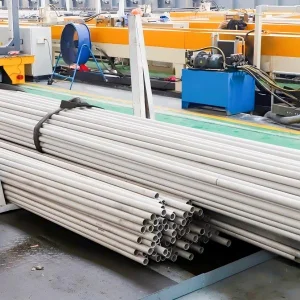
Our manufacturing base in Huzhou, Zhejiang utilizes state-of-the-art multi-roll cold pilger mills capable of maintaining tight wall thickness uniformity and surface finish parameters. The automated cold-working reduction process refines the grain boundaries of the 316L matrix.
Subsequent heat treatment is conducted in high-efficiency continuous bright annealing furnaces supplied with pure hydrogen atmosphere. This process avoids scale formation, eliminating the need for aggressive chemical pickling while preserving the aesthetic and functional cleanliness of the pipe exterior and bore.
Comprehensive Quality Assurance & Traceability
Every single seamless tube shipped from our facility undergoes 100% non-destructive testing (NDT), combining automated Eddy Current Testing (ECT) according to ASTM A450/A1016 and Hydrostatic Pressure Testing up to 300 bar.
All raw materials originate from audited, premium stainless steel mother-hollow heats. Heat numbers are digitally registered at raw material receipt and laser-etched onto every finished tube length, guaranteeing EN 10204 3.1 mill test certificates with full chemical, mechanical, and hydrostatic verification.
Integrated Manufacturing Process Flow
Standard Compliance & Dimensional Specifications
Detailed technical parameters for ordering custom 316L seamless stainless steel pipes and tubing.
| Specification Parameter | Standard / Technical Capability | Engineering Notes |
|---|---|---|
| International Standards | ASTM A213, ASTM A312, ASTM A269, ASTM A270, EN 10216-5, EN 10357 | Full ASME Section II Part A compliance for pressure vessels. |
| Grade Designation | UNS S31603, 1.4404, TP316L, X2CrNiMo17-12-2 | Dual certified 316/316L available upon request. |
| Outside Diameter (OD) Range | 4.00 mm to 114.30 mm (0.157" to 4.50") | Custom non-standard imperial and metric dimensions produced. |
| Wall Thickness (WT) Range | 0.40 mm to 3.05 mm (0.015" to 0.120") | Schedule 5S, 10S, 40S, 80S and specialized thin-wall tubing. |
| Surface Delivery Condition | Bright Annealed (BA), Annealed & Pickled (AP), Polished (Grit 180-400), Electro-polished (EP) | Bore surface roughness selectable down to Ra < 0.25 μm. |
| Delivery Forms | Straight lengths (up to 25,000 mm), Coiled Tubing, U-Bent Bundles | U-bends stress-relieved per heat treatment specifications. |
| Inspection Certification | EN 10204 3.1 Mill Test Certificate, EN 10204 3.2 Third-Party Inspection (TUV, SGS, BV) | Complete heat chemical, mechanical, hydro & NDT results included. |
Application Scenarios & Operating Environments
Where Spezilla 316L seamless pipes demonstrate zero-defect reliability across global industrial sectors.
Offshore Oil & Gas Platforms
Installed in subsea hydraulic control umbilical lines, topside process instrumentation, and gas lift systems. The high Molybdenum content protects against chloride-induced stress corrosion cracking (SCC) in saline splash zones.
Biopharmaceutical & Hygienic CIP/SIP
Seamless 316L electro-polished (EP) pipes are specified for Clean-In-Place (CIP) and Steam-In-Place (SIP) fluid distribution loops. Smooth internal surfaces prevent bacterial biofilm adhesion and maintain sterility.
Chemical Processing & Heat Exchangers
Utilized in shell-and-tube heat exchangers, condensers, and feed water heaters handling acetic acid, phosphoric acid, and organic compounds. Delivers superior heat transfer performance under elevated thermal gradients.
Specialty Alloy & Stainless Pipe Inventory
Explore additional high-grade austenitic, nickel alloy, and custom-engineered titanium products in our manufacturing line.







Frequently Asked Questions & Technical Consultation
In-depth answers to critical metallurgical, standards compliance, and purchasing queries for 316L seamless pipes.
What is the primary difference between ASTM A213 TP316L and ASTM A312 TP316L?
While both specifications cover 316L austenitic steel, ASTM A213 specifically addresses seamless ferritic and austenitic alloy-steel boilers, superheaters, and heat-exchanger tubes, placing strict emphasis on wall thickness uniformity, heat transfer efficiency, and elevated pressure testing. ASTM A312, on the other hand, governs seamless, welded, and heavily cold worked austenitic stainless steel pipes intended for general high-temperature and corrosive chemical fluid transport, covering standard nominal pipe sizes (NPS).
Why is 316L preferred over standard 316 for welded seamless assemblies?
Grade 316L contains a maximum carbon content of 0.030%, whereas standard 316 allows up to 0.080% carbon. When welding seamless pipes or connecting them to flanges, the lower carbon level prevents chromium carbide precipitation along the grain boundaries in the heat-affected zone (HAZ). This guarantees that the joint retains full resistance to intergranular corrosion without requiring post-weld solution annealing.
How does Spezilla guarantee the inner bore surface roughness for sanitary applications?
Through multi-stage cold pilgering and specialized bright annealing in pure hydrogen atmospheres, Spezilla controls internal bore smoothness naturally. For high-purity biopharmaceutical or semiconductor needs, we perform mechanical honing, mechanical polishing, and electro-polishing (EP) to achieve certified inner diameter roughness down to Ra < 0.25 μm (10 μin), fully compliant with ASME BPE standards.
What non-destructive testing (NDT) certifications accompany each batch?
Every production run is subjected to 100% Eddy Current Testing (ECT) per ASTM A450/A1016 or Hydrostatic Testing. For critical pressure applications, Ultrasonic Testing (UT) for wall thickness and internal flaw detection, as well as Intergranular Corrosion Testing according to ASTM A262 Practice E, are performed and documented on the EN 10204 3.1 Mill Test Certificate.
What lead times and logistics capabilities does Spezilla offer for international projects?
Leveraging our manufacturing hubs in Huzhou and our operations center in Shanghai, standard 316L seamless tubing orders are fulfilled within 20 to 35 days. Expedited production for emergency plant maintenance or offshore turnarounds can be scheduled within 14 days. We provide sea, air, and multimodal export packaging including wooden cases, plastic end caps, and vapor corrosion inhibitor (VCI) wrapping.
