
High-Precision Alloy Tubes & Custom Manufacturing
Engineered for high temperature, severe corrosion, and extreme mechanical pressures. Certified to ASTM, ASME, and EN standards.






1. Executive Overview: Global Trajectory of Industrial Stainless Steel & Alloy Tubing
The global infrastructure for fluid control, thermal energy conversion, and chemical containment relies fundamentally on advanced stainless steel pipes and high-performance alloy tubes. As global industrial initiatives accelerate toward decarbonization, green hydrogen production, supercritical power generation, and deepwater desalination, the engineering demands placed on mill fabricators have shifted from basic dimensional compliance to multi-dimensional operational reliability under extreme stress.
Modern industrial processing facilities operating in marine, sour gas, or hyper-acidic environments can no longer tolerate unexpected outages caused by localized pitting, stress corrosion cracking (SCC), or thermal creep. This white paper serves as an authoritative guide for EPC project managers, metallurgical engineers, and strategic procurement directors. It synthesizes material selection criteria, advanced manufacturing methodologies (welded, cold-drawn, and seamless), rigorous non-destructive testing (NDT) frameworks, and global supply chain risk mitigation protocols.
2. Metallurgical Classification & Material Performance Matrix
Understanding the microstructural evolution of iron-chromium-nickel systems—and their stabilization with molybdenum, titanium, and niobium—is vital for specifying the appropriate alloy grade. Selecting an inadequate grade risks premature fatigue or catastrophic stress corrosion cracking, while over-specifying inflates capital expenditure (CAPEX).
Standard & Super Austenitics
Austenitic stainless steels (e.g., TP304L, TP316L, TP316Ti, TP347H) maintain a face-centered cubic (FCC) crystal structure. Titanium-stabilized (TP316Ti) and Niobium-stabilized (TP347H) variants eliminate chromium carbide precipitation along grain boundaries during thermal exposure (450°C to 850°C), making them essential for boiler superheaters and high-temperature petrochemical lines. Super austenitics such as S31254 (254SMO) feature 6% Molybdenum content, delivering elevated Pitting Resistance Equivalent Numbers (PREN ≥ 43).
Duplex & Super Duplex Alloys
Duplex stainless steels (UNS S31803 / S32205) and Super Duplex steels (UNS S32750 / S32760) feature a dual-phase ferrite-austenite microstructure balanced precisely near 50/50. This structure yields nearly double the yield strength of standard austenitic grades alongside immunity to chloride-induced stress corrosion cracking. Super Duplex S32760 incorporates tungsten and copper additions, maximizing resistance to crevice corrosion in sour oilfield brines.
Nickel Alloys & Specialty Titanium
In environments exceeding the boundaries of stainless steel—such as boiling sulfuric acid, wet chlorine gas, or subsea hydraulic umbilical systems—nickel-base alloys (Alloy 825, Alloy 600, Alloy 400) and titanium tubes (Gr.1, Gr.2, Gr.12) are required. Alloy 825 (UNS N08825) offers exceptional resistance to both reducing and oxidizing acids, while Titanium Grade 2 provides unmatched weight-to-strength ratios and complete immunity to ambient marine corrosion.
| Grade Designation | UNS / EN Number | Standard Specification | PREN Index | Tensile Strength (MPa) | Primary Industry Applications |
|---|---|---|---|---|---|
| TP316Ti | S31635 / 1.4571 | ASME SA213 / SA312 | ~25.0 | ≥ 515 | Chemical processing, exhaust systems, thermal plants |
| S31254 (254SMO) | S31254 / 1.4547 | ASME SA213 / SA269 | ≥ 43.0 | ≥ 650 | Desalination, offshore oil & gas, pulp bleaching |
| TP347H | S34709 / 1.4912 | ASME SA213 / SA249 | N/A (High Temp) | ≥ 515 | Power generation superheaters, refinery hydrocrackers |
| Alloy 825 | N08825 / 2.4858 | ASTM B163 / B704 | ≥ 31.0 | ≥ 586 | Sour gas extraction, phosphoric acid production |
| Super Duplex 32760 | S32760 / 1.4501 | ASTM A789 / A790 | ≥ 42.0 | ≥ 750 | Subsea pipelines, marine heat exchangers, FGD scrubbers |
3. Macro-Industry Solutions & Global Procurement Dynamics
Global procurement teams face complex challenges beyond material selection. Supply chain risk, fluctuating nickel surcharge indices, strict local compliance (e.g., PED 2014/68/EU in Europe, ASME Section VIII in North America), and stringent carbon footprint monitoring require strategic planning.
Oil & Gas / Sour Service (NACE MR0175/ISO 15156)
Tubular products specified for upstream sour gas processing must pass rigorous testing to prevent Sulfide Stress Cracking (SSC). Mills must maintain strict control over heat treatment parameters to ensure microstructural homogeneity and hardness levels below 22 HRC in accordance with NACE guidelines.
Power Generation & Supercritical Steam
High-temperature fossil fuel, nuclear, and concentrated solar power (CSP) stations require creep-resistant austenitic alloys like TP316H, TP347H, and TP310S. Cold-drawn, bright-annealed U-bent tubes are regularly specified for feedwater heaters to prevent thermal fatigue under cyclic loads.
Sanitary, Pharma & High-Purity Applications
Food, beverage, and bio-pharmaceutical process lines rely on ASTM A270 compliant sanitary tubing. Mechanical polishing and electropolishing techniques achieve internal surface roughness ratings as smooth as Ra < 0.38 µm, preventing bacterial adhesion and enabling efficient Clean-In-Place (CIP) regimes.
4. Quality Assurance, NDT Infrastructure & Compliance Protocols
A supplier's quality control infrastructure defines its manufacturing capability. Achieving zero-defect shipment across tens of thousands of meters of tubing requires full integration of destructive and non-destructive testing directly into the production line.
- Hydrostatic Testing: Every individual tube undergoes hydrostatic pressure testing at pressures calculated to stress the tube wall to a minimum of 50% of specified yield strength, maintaining pressure for a minimum of 5 seconds.
- Eddy Current Testing (ECT): Compliant with ASTM E426 and EN 10246-2, automated encircling coil systems detect longitudinal, transverse, and subsurface flaws down to micro-millimeter thresholds.
- Ultrasonic Flaw Detection (UT): Reserved for high-pressure seamless tubing under ASTM A213/A312, UT ensures wall thickness uniformity and identifies internal laminations.
- Intergranular Corrosion Testing: Performed according to ASTM A262 Practice E (Strauss Test) or Practice A, verifying that thermal processing did not cause grain boundary sensitization.
- Traceability & Certification: Full documentation compliance with EN 10204 3.1 certification standard, with independent third-party verification (EN 10204 3.2 inspection by TUV, SGS, or Lloyd's Register) available upon request.
5. Manufacturing Technology Roadmap (2025–2035)
The manufacturing landscape for specialty tubing is undergoing rapid technological advancement. Key innovations driving next-generation quality include:
1. Ultra-Clean Melt Processing: Implementation of Vacuum Induction Melting (VIM) paired with Vacuum Arc Remelting (VAR) reduces non-metallic inclusion content, yielding ultra-clean steels with improved fatigue life for aerospace and hydraulic systems.
2. Automated Inert-Gas Bright Annealing: Continuous furnace atmospheres featuring 100% pure hydrogen gas prevent surface oxidation, eliminating acid pickling requirements and providing smooth, pristine outer and inner surface finishes.
3. AI-Assisted Defect Classification: Integrating artificial intelligence machine vision with real-time eddy current signal analysis allows instant, automated classification of surface anomalies, preventing defective material from reaching downstream finishing lines.
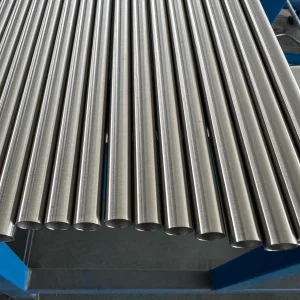
High-Performance Alloy Tubes & Custom Products
Explore our targeted production range of nickel alloys, super duplex compositions, and heat-resistant stainless steel tubes.







Frequently Asked Engineering Questions
In-depth responses to critical technical and quality compliance questions for international buyers.
Q1: What is the main structural difference between ASTM A213 and ASTM A249 specifications?
ASTM A213 covers seamless austenitic and alloy-steel boiler, superheater, and heat-exchanger tubes designed for critical high-pressure and high-temperature service where longitudinal welds are restricted. ASTM A249 covers welded austenitic steel tubes intended for heat exchangers, condensers, and general feedwater heating where uniform wall thickness and cost-efficiency are paramount. ASTM A249 requires post-weld cold working and bright annealing to ensure weld-joint integrity.
Q2: How does Pitting Resistance Equivalent Number (PREN) guide grade selection in marine applications?
PREN is a mathematical index calculated as PREN = %Cr + 3.3(%Mo + 0.5%W) + 16(%N). It quantifies a material's resistance to localized pitting in chloride-rich solutions. Standard 304L has a PREN of ~19, while 316L reaches ~24. For seawater and offshore marine environments, engineers specify materials with a PREN ≥ 40 (such as Super Duplex S32750 or 6% Mo Super Austenitic S31254) to prevent pitting corrosion under biofouling layers.
Q3: Why is stabilizing with Titanium (TP316Ti) or Niobium (TP347H) preferred over low-carbon variants in high-temperature applications?
While low-carbon "L" grades (316L) resist intergranular corrosion by limiting carbon to ≤0.03%, they lose mechanical creep strength at elevated service temperatures (>500°C). Stabilized grades like TP316Ti incorporate titanium, which forms stable titanium carbides (TiC) in place of chromium carbides. This prevents sensitization while preserving the high-temperature tensile and creep-rupture strength necessary for boiler and engine exhaust service.
Q4: What compliance documentation is included with international export shipments?
Every shipment is accompanied by a certified EN 10204 3.1 Mill Test Certificate detailing melt heat number, chemical composition analysis, mechanical properties (tensile, yield, elongation, hardness), dimensional verification, non-destructive test results (Eddy Current / Hydrostatic), and intergranular corrosion test compliance. Independent EN 10204 3.2 inspection reports endorsed by third parties (TUV, SGS, BV, ABS) are supplied upon contract request.
