
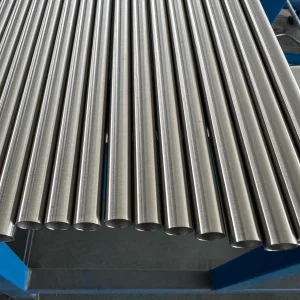
Featured Precision Corrosion-Resistant Tubing
Explore our certified inventory of mill-grade tubing engineered to stringent ASME, ASTM, and EN standards for critical fluid networks.








Global Enterprise Procurement Demands for Titanium Alloy Tubing
Modern industrial procurement directors face an evolving landscape: extreme operational pressures, aggressive media exposure, and strict regulatory compliance. Titanium alloy tubing has evolved from a niche aerospace material into a strategic baseline for chemical processing, power generation, and marine engineering.
Immunity to Chloride Pitting
Unlike conventional 316L stainless or duplex steels, titanium forms a instantaneous, self-healing oxide layer (TiO₂ passive film) that provides absolute immunity to crevice corrosion and chloride pitting in brine and marine environments.
High Specific Strength
Boasting a density of only 4.51 g/cm³ (roughly 56% that of steel), titanium alloys offer an exceptional strength-to-weight ratio. This allows EPC engineers to design thinner-walled heat exchanger tubes without compromising mechanical burst integrity.
Thermal Performance & Life-Cycle Cost
Higher initial material costs are offset within 24 to 36 months through eliminated downtime, zero tube-replacement cycles, and superior heat transfer rates due to clean, bio-fouling-resistant inner bore surfaces.
Titanium Grade Selection & Mechanical Science Matrix
Selecting the exact metallurgical composition is crucial for optimizing operating life against chemical corrosion and physical shear stress. Below is an engineering comparison of primary commercial titanium tubing grades.
| Grade & Class | UNS / EN Spec | Yield Strength (MPa) | Tensile Strength (MPa) | Primary Alloying Elements | Typical Industrial Environment |
|---|---|---|---|---|---|
| Grade 1 (CP Ti) | UNS R50250 / 3.7025 | 170 - 310 | 240 min | Unalloyed (Low O, Fe) | High formability plate heat exchangers, chemical tubing, chlor-alkali. |
| Grade 2 (CP Ti) | UNS R50400 / 3.7035 | 275 - 450 | 345 min | Unalloyed (Balanced O, Fe) | Industrial standard for power plant condensers, desalination, chemical piping. |
| Grade 5 (Ti-6Al-4V) | UNS R56400 / 3.7165 | 828 min | 895 min | 6% Al, 4% V (Alpha-Beta) | Aerospace hydraulic lines, high-pressure subsea manifolds, sports engineering. |
| Grade 7 (Ti-Pd) | UNS R52400 / 3.7235 | 275 - 450 | 345 min | CP Ti + 0.12-0.25% Palladium | Severe reducing acids (HCl, H₂SO₄), acidic chemical production systems. |
| Grade 9 (Ti-3Al-2.5V) | UNS R56320 / 3.7195 | 483 min | 620 min | 3% Al, 2.5% V (Near Alpha) | Aerospace fuel lines, high-performance bicycle tubing, offshore umbilical tubes. |
| Grade 12 (Ti-Mo-Ni) | UNS R53400 / 3.7105 | 345 min | 483 min | 0.3% Mo, 0.8% Ni | High-temperature chemical processing, crevice-corrosion resistant brine systems. |
Advanced Manufacturing Pathways: Seamless vs. Welded & Drawn
As a premium manufacturer, Spezilla utilizes dual production routes certified to international standards like ASTM B338, ASTM B861, and ASME SB338 to meet precise customer drawings and pressure codes.
Seamless Titanium Alloy Tubing (ASTM B861 / ASME SB861)
Manufactured from solid titanium billets through high-pressure hot extrusion followed by multi-pass cold pilgering and vacuum annealing. Seamless tubes eliminate weld seam discontinuities, making them the superior choice for high-pressure hydraulic circuits, aerospace actuators, and critical nuclear service where longitudinal welds are disallowed by design codes.
Welded & Cold Drawn Titanium Tubing (ASTM B338 / ASME SB338)
Produced from cold-rolled titanium coil stock utilizing automated inert-gas TIG (Tungsten Inert Gas) or High-Frequency Laser Welding. Following welding, tubes undergo cold drawing (bead working) to achieve precise wall uniformity, exact outer diameter tolerances, and complete recrystallization of the weld zone during protective atmosphere vacuum heat treatment.
Macro Industry Solutions & Turnkey Engineering Applications
Engineered titanium alloy tube solutions custom tailored to withstand severe mechanical fatigue, high velocity fluid erosion, and hostile chemical reactions.
Aerospace & Defense Hydraulics
Grade 9 (Ti-3Al-2.5V) seamless tubing delivers ultra-high fatigue strength and weight reduction for high-pressure commercial aircraft hydraulic lines operating up to 5,000 PSI (345 bar).
Desalination & Offshore Marine
Grade 2 titanium welded tubes are the benchmark material for Multi-Stage Flash (MSF) and Reverse Osmosis (RO) desalination heat exchangers due to complete resistance to stagnant seawater bio-fouling.
Chemical & Petrochemical Refining
Utilized in Pure Terephthalic Acid (PTA), chlor-alkali, and organic synthesis units. Titanium Grade 7 & 12 tubes resist hot nitric acid, wet chlorine gas, and organic chlorides.
Quality Assurance, NDT Testing & Global Compliance Safeguards
Quality reliability is backed by complete traceability and comprehensive Non-Destructive Testing (NDT) to prevent high-cost field failures.
100% Non-Destructive Verification
Every individual tube undergoes Eddy Current Testing (ECT) according to ASTM E426 or Ultrasonic Testing (UT) per ASTM E213 to ensure total freedom from surface cracks, pinholes, and internal wall lamination. Hydrostatic testing is conducted up to 10.5 MPa (1500 PSI) or pneumatic underwater testing as mandated by project specifications.
Material Certification & Traceability
All shipments are accompanied by comprehensive EN 10204 3.1 Mill Test Certificates (MTC) detailing real heat chemistry, mechanical yield/tensile testing, flare/flattening tests, and grain size analysis. Independent third-party inspection (TUV, SGS, BV, Lloyd's Register) for EN 10204 3.2 compliance is available upon request.
Technical Roadmap & Future Metallurgy Outlook
As decarbonization and ultra-high efficiency push engineering limits, our metallurgical research roadmap focuses on next-generation manufacturing technologies.
Additive Micro-Tubing
Development of ultra-thin wall titanium tubes featuring internal micro-turbulators manufactured via advanced cold-drawing process to increase heat transfer efficiency by over 28%.
Cryogenic Titanium Alloys
Optimization of Extra Low Interstitial (ELI) titanium grades (such as Ti-6Al-4V ELI Grade 23) for liquified hydrogen (LH2) and aerospace cryogenic fuel distribution lines.
Low-Carbon Production
Transitioning vacuum arc remelting (VAR) furnaces to 100% renewable energy grids to reduce the embodied carbon footprint of raw titanium sponge processing.
Frequently Asked Questions (Technical & Procurement Guidance)
Get immediate clarity on common engineering questions regarding titanium alloy tube selection, tolerances, and ordering requirements.
What is the difference between ASTM B338 and ASTM B861 titanium tubes?
ASTM B338 covers seamless and welded titanium and titanium alloy tubes intended for surface condensers, evaporators, and heat exchangers. ASTM B861 specifically governs seamless titanium and titanium alloy pipe and tube intended for general corrosion-resisting and industrial service. If your design requires cold-drawn welded tube for heat exchangers, ASTM B338 is the appropriate standard.
Why choose Grade 2 Titanium over 316L Stainless Steel for seawater heat exchangers?
Grade 2 Titanium provides complete immunity to pitting and crevice corrosion in seawater at temperatures up to 260°C, whereas 316L stainless steel suffers severe pitting and stress corrosion cracking in chloride environments exceeding 60°C. Additionally, titanium's lower wall thickness capability compensates for its raw material cost by improving thermal conductivity.
What outer diameter (OD) and wall thickness (WT) tolerances can Spezilla achieve?
Spezilla produces titanium alloy tubing with outside diameters ranging from 4.00 mm up to 114.30 mm, with wall thicknesses from 0.40 mm to 3.05 mm. Standard tolerances meet ASTM B338/EN 10216-5, while custom tight tolerances down to ±0.05 mm on OD and WT can be achieved for high-precision aerospace and instrumentation applications.
Are U-bent titanium tubes available for shell-and-tube heat exchangers?
Yes, we provide full custom fabrication including precision cold U-bending according to TEMA standards and ASTM B338 specifications. U-bent areas undergo stress-relieving vacuum heat treatment and hydrostatic testing to guarantee bend integrity and radius uniformity.
What surface finish options are supplied with titanium alloy tubing?
Tubes can be supplied in Vacuum Annealed (BA), Annealed & Pickled (AP), Mechanically Polished (up to 600 Grit / Ra < 0.2 µm), or Electropolished (EP) finishes, depending on sanitary or fluid dynamic requirements.
How does Spezilla guarantee zero contamination during titanium tube welding?
Titanium reacts readily with oxygen, nitrogen, and hydrogen at temperatures above 400°C. Spezilla utilizes enclosed trailing shield inert gas (99.999% pure Argon) purge systems on both the outer diameter and inner bore during automatic TIG welding, guaranteeing a bright silver weld bead free from discolored oxidation.
Complete High-Performance Alloy & Stainless Tube Range
Discover our wider range of high-nickel, super austenitic, and super duplex tubing engineered for high-temperature and severe chemical service.







Request an Engineering Quote for Your Titanium Tubing Project
Submit your detailed project drawings, material standards (ASTM/ASME/EN), wall tolerances, and testing specifications to our engineering sales team for rapid response within 24 hours.
