
Featured Duplex & Specialty Stainless Steel Tubing for Melbourne
Engineered to exceed ASTM/EN specifications, delivering double the yield strength of standard austenitics and complete immunity to chloride stress corrosion cracking.

High-strength dual-phase microstructure. Outstanding pitting resistance (PREN ≥35) in coastal Port Phillip environments.

High-nickel/chromium heat-resistant alloy designed for Melbourne thermal processing & furnace applications up to 1150°C.

Titanium-stabilized austenitic matrix preventing intergranular corrosion during welding in heavy chemical processing.

12% Chromium steel designed for structural applications and heat exchangers requiring resistance to high-temperature oxidation.
Melbourne & Victorian Macro-Industrial Landscape: The Case for Duplex Alloys
Addressing the aggressive microclimates, coastal marine exposures, and heavy processing standards defining Greater Melbourne, Geelong, and the Latrobe Valley.
Corrosion Dynamics in Port Phillip Bay & Western Port
Greater Melbourne’s industrial hubs—ranging from the maritime facilities along Port Phillip Bay to the chemical complexes in Altona and Geelong—operate under severe environmental stressors. Airborne marine salts combined with localized industrial pollutants create a highly aggressive atmospheric exposure matrix. Standard austenitic stainless steels like 304 and 316 frequently suffer from localized pitting and crevice corrosion, particularly in heat exchangers, cooling coils, and hydraulic tubing exposed to high chloride concentrations.
Duplex stainless steels (such as 2205 / UNS S32205) provide an essential metallurgical solution. With a balanced 50:50 ferrite-austenite microstructure and a Pitting Resistance Equivalent Number (PREN) exceeding 35, Duplex alloys eliminate the risk of Chloride-Induced Stress Corrosion Cracking (CSCC), ensuring decades of maintenance-free service life in Victorian coastal infrastructure.
Victorian Energy Transition & Water Security Infrastructure
As Victoria transitions toward green hydrogen generation, offshore wind projects in Bass Strait, and expanded desalination capabilities (such as the Victorian Desalination Plant in Wonthaggi), fluid handling systems face extreme operating pressures and aggressive chemical media. Traditional materials require thick wall designs to handle high pressure, significantly increasing structural weight and total material costs.
Duplex alloys possess roughly double the yield strength of conventional 300-series stainless steels (minimum yield strength ≥ 450 MPa for UNS S32205 vs. ~205 MPa for 316L). This mechanical advantage allows Victorian design engineers to specify thinner tube walls without sacrificing pressure containment integrity, reducing total material weight by up to 40% and dramatically cutting freight and installation costs across Melbourne capital projects.
Comparative Technical Analysis: Duplex vs. Standard Austenitic Steels
Understanding the chemical stoichiometry, phase balance, and mechanical capabilities required for Victorian engineering compliance.
To evaluate why Melbourne engineering consultants are increasingly phasing out traditional 316L for critical process tubing, we must look at the mathematical formulation of corrosion resistance. The Pitting Resistance Equivalent Number (PREN) measures an alloy's resistance to localized pitting in chloride-rich environments using the standard formula:
PREN = %Cr + (3.3 × %Mo) + (16 × %N)
| Alloy Grade & Specification | UNS / EN Number | Microstructural Phase | Yield Strength (MPa Min) | PREN Value | Resistance to Chloride SCC |
|---|---|---|---|---|---|
| Austenitic 304L | S30403 / 1.4307 | 100% Austenite | 170–205 | 19.0 | Low (Vulnerable) |
| Austenitic 316L | S31603 / 1.4404 | 100% Austenite | 220–240 | 25.0 | Moderate |
| Austenitic 310S | S31008 / 1.4845 | 100% Austenite | 205 | 26.5 | Moderate (High Temp) |
| Duplex 2205 (S31803/S32205) | S32205 / 1.4462 | 50% Ferrite / 50% Austenite | ≥ 450 | 35.0–36.0 | Immune (< 150°C) |
| Super Duplex 2507 | S32750 / 1.4410 | 50% Ferrite / 50% Austenite | ≥ 550 | 42.0–45.0 | Extreme Immunity |
High Mechanical Efficiency
By leveraging double the allowable design stress of standard 316 stainless tubing (under ASME Boiler and Pressure Vessel Code Section VIII), engineering teams across Victoria can specify reduced wall thicknesses without compromising pressure safety factors.
Superior Erosion-Corrosion Resistance
The increased hardness of Duplex 2205 (typically 31 HRC max compared to 316L’s 95 HRB max) provides exceptional resistance to abrasive slurries, particulate-laden fluid flows, and high-velocity steam erosion found in power and chemical processing lines.
Low Thermal Expansion Coefficient
Duplex stainless steels exhibit a thermal expansion coefficient closer to carbon steel than austenitic grades ($13.0 \times 10^{-6}/K$). This minimizes thermal fatigue and stress at tube sheet joints in heat exchangers subject to frequent thermal cycling.
Localized Application Scenarios across Greater Melbourne & Victoria
Serving critical industrial nodes with certified, high-performance alloy tubing manufactured to exact client dimensions.
1. Petrochemical & Refining Precincts (Altona & Geelong)
The refinery and organic chemical processing hubs in Altona and Geelong require robust tubing solutions capable of handling sour water, hydrocarbon condensate mixtures, and organic acids at elevated temperatures. Duplex 2205 and 316Ti tubes serve as core components in shell-and-tube heat exchangers, process inter-coolers, and instrumentation lines where sour gas ($H_2S$) and chlorides co-exist.
2. Food, Dairy & Beverage Processing (Yarra Valley & Goulburn Valley)
Victoria produces over 60% of Australia's exported dairy goods. High-temperature sanitization procedures involving aggressive CIP (Clean-In-Place) solutions containing active chlorine and hot caustic wash down degrade standard sanitary tubing over time. Our precision-drawn bright-annealed austenitic (316L, 304H) and lean duplex tubing ensure pit-free internal surfaces ($Ra < 0.4\,\mu m$), preventing bio-film accumulation and product contamination.
3. Desalination & Coastal Marine Infrastructure
The Victorian Desalination Project and coastal municipal water filtration facilities utilize high-pressure reverse osmosis (SWRO) systems. Seawater feed lines operating under pressures up to 70 bar require Super Duplex 2507 or Duplex 2205 seamless and welded-drawn tubes to eliminate localized crevice corrosion beneath tube supports and flanges exposed to continuous high-salinity brine.
4. Renewable Energy & Hydrogen Storage (Latrobe Valley)
In line with Victoria's Renewable Energy Target (VRET), Gippsland and the Latrobe Valley are turning into hydrogen generation hubs. High-pressure gas transport lines and cooling systems call for ultra-clean, high-yield strength tubing capable of resisting hydrogen embrittlement while maintaining structural reliability under cyclic pressure loads.
Global Manufacturing Standards & Australian Compliance Frameworks
Every tube shipped to Melbourne undergoes rigorous non-destructive testing, dimensional validation, and mill certification to guarantee full alignment with AS/NZS and international standards.
Full EN 10204 3.1 & 3.2 Traceability
We provide comprehensive Mill Test Certificates (MTC) detailing melt chemical heat analysis, mechanical tensile and yield testing, hardness numbers, microstructural ferrite content percentages (per ASTM E562), and corrosion testing results (per ASTM A923 Method C).
Strict NDT Inspection Protocols
100% of manufactured tubes undergo non-destructive inspection prior to dispatch. Inspection methodologies include hydrostatic pressure testing up to 300 bar, Eddy Current testing (per ASTM A1016 / EN 10246-2), and ultrasonic wall thickness measurement to prevent micro-defects.
Harmonized AS/NZS & ASTM Standards
Our manufacturing routes directly align with Australian standards including AS 1528 (for sanitary tubing), AS 2837, and AS/NZS 4673, alongside international specifications ASTM A789/A790 (Duplex tubing/pipe) and ASTM A213/A249 (Heat exchanger tubes).
Third-Party Inspection Support for Victorian Projects
To support high-consequence energy and municipal projects across Victoria, we facilitate independent third-party witness inspection (EN 10204 3.2 certification) through accredited agencies including TÜV Rheinland, Lloyd's Register, Bureau Veritas, and SGS. Inspections cover PMI (Positive Material Identification), intergranular corrosion tests, and dimensional audits.
Technical Roadmap: Sustainable Steelmaking & Next-Gen Alloys
Advancing material science to support net-zero industrial transformations across Australia.
Green Steel Manufacturing Initiatives
Partnering with forward-looking mills utilizing Electric Arc Furnaces (EAF) powered by renewable energy, reducing embedded carbon emissions ($CO_2e$) per ton of alloy tubing supplied to Australian decarbonization projects.
Lean Duplex Alloy Expansion
Integrating advanced Lean Duplex grades (UNS S32101 / S32304) into standard inventory to provide cost-stable alternatives to 316L, mitigating nickel price volatility while offering superior corrosion resistance.
AI-Precision Wall Control
Employing real-time laser diffraction and ultrasonic gauging during cold drawing processes to achieve hyper-tight wall thickness tolerances ($\pm 5\%$), optimizing fluid dynamics and heat transfer efficiency.
Complete Specialty Stainless & Alloy Tube Catalog
Supplying precision boiler tubes, heat exchanger U-bends, and high-temperature austenitic solutions to Victorian industry.

Seamless molybdenum-bearing alloy tube designed for high-pressure boilers and heat exchangers in chemical plants.

Titanium-stabilized stainless steel offering excellent resistance to intergranular corrosion between 427°C and 816°C.

Columbium/Tantalum stabilized heat-resistant alloy tube preventing chromium carbide precipitation during welding.

High-carbon variant of 304 stainless providing elevated creep strength at temperatures exceeding 500°C.

Precision welded and cold-drawn boiler/superheater tubes engineered for uniform wall integrity and tight tolerances.
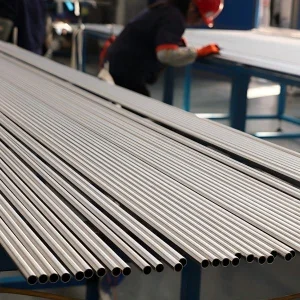
High-carbon titanium-stabilized seamless steel tube optimized for high-temperature refinery heater coils.

Niobium-stabilized high-carbon seamless tubing designed for critical power generation superheater service.

High-carbon molybdenum stainless tubing formulated for structural strength in elevated-temperature chemical lines.
Frequently Asked Questions for Melbourne Procurement & Engineering Teams
Direct, specification-level answers regarding material selection, Australian compliance, logistics, and testing.
Partner with Australia’s Trusted Duplex Alloys & Specialty Steel Supplier
Connect with our technical metallurgy team today to discuss your Melbourne project specs, request physical material samples, or obtain a comprehensive project quote within 24 hours.
