
Precision Tubular Materials for Milan Engineering Specifications
Engineered for extreme thermal resistance, chloride stress cracking protection, and severe pressure loops.

Custom Ferritic & Martensitic Steels 405 Stainless Steel Tubes, UNS S40500, 1.4002 (Milan Spec)

High-Quality Nickel Alloy Tubes 276 • UNS N10276 • 2.4819 Suppliers & Products in Milan

High-Quality Austenitic steel ASME SA213 · TP304H Manufacturer, Products for Lombardy Energy

Custom Austenitic steel ASME SA213 · TP316H Manufacturers, Products (Milan Petrochemical Grade)
Milan & Lombardy Industrial Ecosystem: The Hub of High-Performance Metallurgy
Evaluating local procurement dynamics, EPC engineering demand, and critical material standards across Northern Italy's manufacturing heartland.
Lombardy Industrial Integration
Milan serves as the financial, managerial, and technological epicenter for Italy's most sophisticated heavy machinery, chemical processing, and plant engineering clusters. The surrounding industrial zones—spanning Bergamo, Brescia, and Sesto San Giovanni—house world-renowned Engineering, Procurement, and Construction (EPC) contractors and original equipment manufacturers (OEMs). Demand for corrosion-resistant tubular products, particularly Duplex (UNS S31803 / S32205 / 1.4462) and Super Duplex alloys, has intensified as regional chemical refineries and energy plant operators upgrade to extend asset lifecycles.
Energy Corridor & Refining Demand
With major energy engineering enterprises operating in the greater Milan metropolitan area, specifications for heat exchangers, boiler pressure tubes, and condensers demand rigorous compliance with European Directive PED 2014/68/EU and ASME Section II Part A/B. Local operators managing hydrocarbon refining, district thermal networks, and specialty chemical synthesis require materials capable of surviving high-sulfur media, aggressive chloride streams, and cyclical mechanical loads without pitting or sudden brittle failure.
Technical Deep-Dive: Metallurgy & Phase Thermodynamics of Duplex Steels
Understanding why microstructural balance between face-centered cubic (FCC) austenite and body-centered cubic (BCC) ferrite provides superior fatigue and SCC resistance.
Duplex stainless steels—exemplified by grade 2205 (UNS S31803 / UNS S32205 / EN 1.4462)—were developed to bridge the mechanical and chemical limitations of traditional 300-series austenitic stainless steels (such as 304L and 316L) and 400-series ferritic alloys. In high-chloride environments typical of industrial heat exchangers, offshore marine cooling loops, and chemical synthesis units in Northern Italy, austenitic steels often suffer from micro-pitting and catastrophic Stress Corrosion Cracking (SCC) at temperatures exceeding 60°C.
The microstructural architecture of Duplex 2205 consists of approximately equal volume fractions of ferrite (α) and austenite (γ). This dual-phase structure is achieved through precise chemical formulation and controlled solution annealing heat treatment within the temperature range of 1020°C to 1100°C, followed by rapid water quenching to prevent the precipitation of embrittling intermetallic phases such as Sigma (σ), Chi (χ), and chromium nitrides (Cr2N).
Pitting Resistance Equivalent Number (PREN) Calculation
Pitting and crevice corrosion resistance in chloride-containing media is quantified using the PREN formula:
While standard 316L achieves a PREN value of ~25, Duplex 2205 consistently delivers a PREN between 35 and 38, guaranteeing immunity to pitting under aggressive localized concentrations of dissolved chlorides and organic acids.
Comparative Mechanical & Physical Properties Table
| Material Grade | UNS / EN Designation | Yield Strength 0.2% (MPa) | Tensile Strength (MPa) | PREN Rating | Thermal Expansion (×10-6/K) |
|---|---|---|---|---|---|
| Duplex 2205 | UNS S31803 / 1.4462 | ≥ 450 | 655 - 880 | 35 - 38 | 13.0 |
| Austenitic 316L | UNS S31603 / 1.4404 | ≥ 220 | 520 - 670 | ~25 | 16.5 |
| Austenitic 304H | UNS S30409 / 1.4948 | ≥ 205 | 515 - 690 | ~19 | 17.2 |
| Ferritic 405 | UNS S40500 / 1.4002 | ≥ 205 | 415 - 580 | ~13 | 10.8 |
| Nickel Alloy C276 | UNS N10276 / 2.4819 | ≥ 355 | ≥ 790 | ≥ 67 | 11.2 |
Global Procurement Dynamics for Milan Engineering Contracts
Mitigating material lead-time risks, guaranteeing traceability, and fulfilling stringent European quality standards.
Total Cost of Ownership (TCO)
Procurement departments in Milan engineering firms increasingly select Duplex 2205 over 316L due to its double yield strength. Higher design stress limits allow engineers to down-gauge tube wall thickness by up to 30-40% without compromising pressure-containing integrity. This wall reduction directly translates into weight savings, lower transport costs, faster welding speed, and significantly lower initial raw material expenditures.
Stringent Compliance Verification
Every batch of specialty tubular products shipped into Lombardy undergoes strict mill verification. Materials must comply with EN 10204 3.1 or independent 3.2 third-party inspection certificates (witnessed by TÜV, Lloyd’s Register, or RINA). Full mechanical testing includes hydrostatic testing, eddy current non-destructive examination (NDE), intergranular corrosion testing per ASTM A262 Practice E / ISO 3651-2, and impact energy testing down to -40°C.
Sector-Specific Engineering Solutions for Northern Italy
Targeted metallurgical interventions designed for chemical processing, municipal geothermal grids, and heavy power equipment.
1. District Heating & Geothermal Networks
Lombardy’s municipal energy transition utilizes deep geothermal aquifers and biomass heat-recovery plants. Tubing deployed in downhole exchangers and central pump stations faces brackish geothermal brine containing dissolved hydrogen sulfide (H2S) and heavy carbonates. Duplex 2205 seamless and welded-and-drawn tubes provide zero-leakage confidence and eliminate localized crevice corrosion near tube-to-tubesheet joints.
2. Petrochemical Refineries & Fertilizer Plants
Processing units handling urea, nitric acid, and organic compounds require tubes that resist severe nitric oxidation and amine-induced stress corrosion. Custom austenitic-ferritic tubing solutions engineered to ASME SA213 and EN 10216-5 preserve inner diameter micro-smoothness, minimizing fouling and reducing maintenance downtime during mandatory Italian industrial safety inspections.
3. Hydrogen Economy & Renewable Fuel Infrastructure
As Milan positions itself at the forefront of the European Green Deal, regional industrial gas suppliers are scaling high-pressure hydrogen transport lines and industrial electrolysis modules. High-integrity stainless and duplex tubing prevents hydrogen embrittlement under cyclic loading, providing high mechanical fatigue endurance up to 450 bar operating pressures.
Compliance Safeguards & Rapid Logistics to Milan Metro Terminals
Seamless delivery, certified manufacturing standards, and direct project support across Italy.
Regulatory Compliance Architecture
- PED 2014/68/EU Annex I: Full conformance for pressure equipment designed for European installation.
- NACE MR0175 / ISO 15156: Hardness control (≤ 28 HRC for 2205) for sour gas and sulfide service safety.
- EN 10204 Type 3.1 & 3.2: Complete heat traceability with chemical, mechanical, and non-destructive testing reports.
- AD 2000-Merkblatt W0: Specialized German/European pressure vessel material certification.
Dedicated Italian Supply Chain
To serve the fast-paced schedules of Milan EPC projects, our streamlined logistical protocol ensures swift dispatch to major freight terminals including Milan Malpensa Logistics Park, the Brescia Intermodal Hub, and the Port of Genoa container facilities. Customized protective packaging—including end caps, wooden cases, and plastic wrapping—prevents atmospheric salt or mechanical damage during transit.
Metallurgy 4.0: Next-Generation Duplex Engineering & Future Outlook
Innovations in digital quality verification, zero-carbon steel manufacturing, and hyper-duplex alloys.
AI-Driven Ultrasonic & NDT Inspection
Our manufacturing lines integrate high-frequency automated ultrasonic flaw detection (UT) and digital eddy current testing (ECT). Machine-learning algorithms continuously scan 100% of the tube seam and wall profile, identifying sub-surface micro-voids, inclusions, or wall thickness variations finer than ±0.02 mm before tube release.
Sustainable Electric Arc Furnace (EAF) Processing
Aligning with the European Union's Carbon Border Adjustment Mechanism (CBAM) and sustainability mandates of Italian contractors, our duplex tubes are manufactured using low-emission EAF routes backed by recycled high-grade scrap. Solar-powered bright annealing lines minimize embedded carbon intensity per linear meter of tube.
Emerging Hyper-Duplex Alloys
Future energy systems demand extreme resistance. Research into Hyper-Duplex grades (PREN > 48, such as UNS S32707) offers enhanced performance for ultra-deep offshore drilling and severe acidic media, setting new standards for the next generation of Milan energy projects.
Frequently Asked Questions (FAQ) for Engineering Buyers in Milan
Direct answers to critical procurement, metallurgical, and specification questions.
Why should engineers in Milan choose Duplex 2205 over Austenitic 316L for heat exchangers?
Duplex 2205 (1.4462) offers approximately twice the yield strength of 316L, allowing designers to reduce tube wall thickness while maintaining equivalent pressure ratings. Furthermore, its 50:50 ferrite-austenite structure provides near-total immunity to chloride-induced Stress Corrosion Cracking (SCC), a common cause of premature failure in 316L heat exchangers operating at elevated temperatures in industrial Lombardy.
Are your tubular products fully compliant with European Pressure Equipment Directive PED 2014/68/EU?
Yes. All seamless, welded, and welded-and-drawn tubes supplied for pressure service in Italy undergo rigorous quality assurance adhering to PED 2014/68/EU Annex I requirements. Each shipment is accompanied by EN 10204 3.1 material test certificates detailing chemical heat analysis, mechanical values, and 100% NDT verification. EN 10204 3.2 third-party inspection certificates (RINA, TÜV, SGS) are provided upon project request.
What size ranges and fabrication options are available for custom project orders?
We supply tube outside diameters ranging from 4.00 mm up to 114.30 mm, with wall thicknesses from 0.40 mm to 3.05 mm, and straight lengths up to 25 meters. In addition to straight lengths, we provide pre-bent U-tubes for heat exchangers, bright annealed coil tubing, and specialized polished inner/outer diameter surface finishes tailored to customer drawing specifications.
How do you handle delivery lead times to projects located in Milan and Northern Italy?
By coordinating production scheduling with optimized logistics routes to Northern Italy, we ensure rapid freight processing through major European intermodal terminals. Standard manufacturing runs and custom project orders are packed in heavy-duty seaworthy and air-freight wooden boxes with protective caps, ensuring fast clearance and direct delivery to site work sites in Milan, Bergamo, or Genoa.
Complete Range of Austenitic, Duplex & Nickel Tubes
Full dimensional availability manufactured to ASTM A213, A249, A312, A789, EN 10216-5, and EN 10217-7 standards.

High-Quality Austenitic Steels 316 • UNS S31600 • 1.4401 Factory, Product (Milan Grade)

Custom Austenitic Steels 316Ti • UNS S31635 • 1.4571 Manufacturer, Products in Milan

Custom Austenitic steel ASME SA312 · TP304 Stainless Steel Pipe Manufacturers, Supplier Milan

Custom Austenitic steel ASME SA213 · TP316LN UNS S31653 Manufacturers, Factory for Milan Projects

Custom Nickel Alloy Tubes 800 • UNS N08800 • 1.4876 Manufacturer, Products Milan

Custom Nickel Alloy Tubes 825 • UNS N08825 • 2.4858 Suppliers, Product for Lombardy Chemical
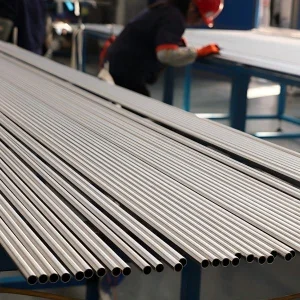
Custom Austenitic steel ASME SA213 · TP321H Manufacturer, Supplier (Milan High-Temp Line)

High-Quality Duplex Steels 2205 • S31803/S32205 • 1.4462 Manufacturer, Products in Milan
Ready to Optimize Your Tube Procurement in Milan?
Contact our technical sales team today for precise metallurgical consultations, fast quotation turnaround, and certified EN 10204 3.1/3.2 tubular solutions tailored to your engineering drawing.
Send Inquiry Now