
Featured Alloy & Stainless Tubing Solutions
Explore our high-performance tubular products manufactured under strict ASME/ASTM specifications for extreme corrosive operational environments.







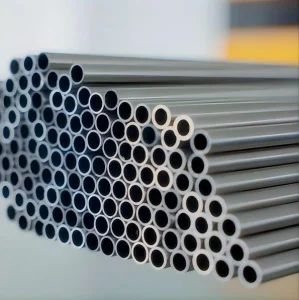
Global Commercial Overview: The Economics of Cupro Nickel Piping
Cupro nickel (copper-nickel) alloys—principally UNS C70600 (90/10) and UNS C71500 (70/30)—represent the benchmark standard for severe marine, naval, desalination, and offshore engineering installations. As global maritime infrastructure expands alongside increasing demands for high-efficiency thermal management, custom cupro nickel pipe factories serve a critical role in supplying corrosion-resistant, biofouling-immune fluid handling channels.
Supply Chain & Procurement Drivers
Industrial EPCs and naval procurement officers face strict total-cost-of-ownership (TCO) constraints. While initial raw material costs for copper-nickel exceed standard 316L stainless steel, the elimination of antifouling dosing equipment, chemical biocide treatments, and frequent heat exchanger retubing operations results in a net-present-value (NPV) savings exceeding 40% over a 25-year operational lifecycle.
Custom Manufacturing Flexibility
Tier-1 custom cupro nickel pipe factories maintain advanced cold-drawing, seam-welding, and seamless hot extrusion infrastructure. Factories capable of manufacturing precision thin-wall and thick-wall dimensions (OD 6 mm to 419 mm) to tight DIN, EEMUA, and ASTM specifications enable engineers to optimize weight, thermal conductivity, and structural integrity.
Comparative Alloy Specifications: UNS C70600 vs UNS C71500
Selecting the correct cupro nickel formulation requires a precise evaluation of flow velocities, operating temperatures, mechanical stress, and chemical exposure. Below is a comprehensive metallurgical and mechanical comparison table.
| Property / Parameter | Cupro Nickel 90/10 (UNS C70600) | Cupro Nickel 70/30 (UNS C71500) | Standards Compliance |
|---|---|---|---|
| Nominal Composition | 88.6% Cu, 10% Ni, 1.4% Fe, 1.0% Mn | 66.5% Cu, 30% Ni, 0.7% Fe, 1.0% Mn | ASTM B466 / B111 / DIN 86019 |
| Tensile Strength (Annealed) | Min. 275 MPa (40 ksi) | Min. 360 MPa (52 ksi) | EEMUA 144 / BS 2871 |
| Yield Strength (0.2% Offset) | Min. 105 MPa (15 ksi) | Min. 125 MPa (18 ksi) | ASME SB-466 / MIL-T-16420K |
| Max Seawater Flow Velocity | 2.2 - 2.5 m/s (7.5 - 8.2 ft/s) | 3.5 - 4.5 m/s (11.5 - 14.7 ft/s) | Naval Engineering Design Guides |
| Thermal Conductivity | 50 W/m·K (at 20°C) | 29 W/m·K (at 20°C) | TEMA Heat Exchanger Data |
| Pitting & Crevice Resistance | High in stagnant seawater | Exceptional under high turbulence & shear | ISO 15156 / NACE MR0175 |
| Primary Application Focus | Shipboard cooling, seawater piping, MSF shells | High-pressure hydraulic, naval hull, fast flow | Global Marine Classification (DNV, ABS, LR) |
Optimized Thermal Performance
Containing 10% nickel paired with controlled iron (1.0–1.8%) and manganese additions, C70600 provides an optimal compromise between high thermal transfer rate and robust erosion resistance. It is the primary choice for shell-and-tube heat exchanger bundles, multi-stage flash (MSF) evaporators, and low-velocity ballast piping systems.
High-Turbulence Erosion Armor
With a 30% nickel content, C71500 increases shear resistance against turbulent, sand-laden seawater flows. It is preferred for high-pressure firewater deluge systems, naval submarine cooling loops, and high-velocity pump suction lines where localized shear stress exceeds 2.5 m/s.
Dimensional Precision
Custom cupro nickel pipe factories utilize hydraulic cold-drawing benches to achieve precise wall thickness tolerances (±5%), tight out-of-roundness controls, and ultra-smooth inner surface roughness ($Ra < 0.4 \mu m$), reducing fluid drag and boundary layer micro-turbulence.
Macro-Industry Solutions & Localized Application Matrix
Engineered cupro nickel piping serves as the primary fluid artery across four critical infrastructure sectors worldwide, offering unyielding durability against biological attack and chloride-induced cracking.
Marine & Naval Shipbuilding
Extensively used for sea chest suction piping, engine cooling loops, bilge and ballast systems, sanitary lines, and fire main networks onboard commercial container vessels, LNG carriers, and naval defense frigates.
Desalination Plants
Essential for Multi-Stage Flash (MSF), Multiple Effect Distillation (MED), and Reverse Osmosis (RO) intake plants. CuNi tubes resist hot brine concentration, sulfide corruption, and thermal fatigue in vapor heat exchangers.
Offshore Oil & Gas
FPSO topside sea-water hydraulic lines, splash-zone riser protection, and firewater deluge piping. Excellent resistance to stress-corrosion cracking (SCC) caused by hydrogen sulfide ($H_2S$) in sour environments.
Power & Petrochemical
Coastal power plant steam surface condensers, auxiliary heat exchangers, and chemical plant cooling towers operating with untreated brackish or estuarine water feeds.
Compliance Assurance & Global Factory Quality Controls
Full traceability, non-destructive testing (NDT), and adherence to international design codes guarantee zero-defect operational readiness in high-consequence marine and industrial applications.
International Manufacturing Standards
Custom cupro nickel pipe factories operate under stringent quality management systems certified to ISO 9001:2015, ISO 14001, and ISO 45001. Pipes and seamless tubes are extruded, drawn, and heat-treated in exact compliance with:
- DIN 86019 / BS 2871: Seamless cupro nickel pipes for offshore and naval piping systems.
- EEMUA Publication 144: Specification for 90/10 copper nickel tubes for offshore applications.
- ASTM B466 / B467: Seamless and welded copper-nickel pipe standard specifications.
- MIL-T-16420K: Military spec for seamless and welded copper-nickel alloy tube for naval ships.
- ASME SB-111 / SB-466: Boiler & Pressure Vessel Code for heat exchanger tubes.
Factory Inspection & Mill Test Certification
Every production batch undergoes mandatory multi-stage quality gates before dispatch, ensuring complete compliance with EN 10204 3.1 / 3.2 inspection certificates:
- 100% Eddy Current Testing (ECT): Automated electromagnetic flaw detection per ASTM E243 to eliminate micro-cracks and seam defects.
- Hydrostatic Testing: High-pressure testing up to 250 bar (or pneumatic under-water bubble test) confirming structural soundness.
- Positive Material Identification (PMI): X-Ray Fluorescence (XRF) verification of Ni, Fe, and Mn alloy ratios.
- Grain Size & Flare Testing: Metallographic grain refinement analysis ensuring optimal ductility during cold bending and flanging.
Biofouling Resistance & Fluid Hydrodynamics
Understanding the electrochemistry of cupro nickel protection provides engineers with crucial insights into preventing macro-fouling and velocity-induced erosion.
The Self-Cleaning Oxidic Mechanism
Upon initial immersion in aerated seawater, cupro nickel undergoes controlled oxidation to form cuprous oxide ($Cu_2O$). Over several weeks, this film gradually transforms into a darker cupric hydroxychloride layer [$Cu_2(OH)_3Cl$]. The slow, steady release of copper ions ($Cu^{2+}$) at the fluid-metal interface creates a microscopic toxicity gradient that prevents barnacles, macro-algae, and tubeworms from adhering.
Because the biocide effect is intrinsic to the alloy's corrosion reaction, no external chemical dosing, electro-chlorination, or toxic anti-fouling coatings are required, reducing environmental toxicity and operational overhead.
Erosion-Corrosion Velocity Control
Erosion-corrosion occurs when localized flow velocities strip away the protective cuprous oxide film, exposing fresh metal to accelerated localized attack. Custom cupro nickel pipe design must respect alloy-specific shear stress limits:
• CuNi 70/30: Maximum continuous flow of 3.5 m/s to 4.5 m/s.
• Bends & Fittings: Maintain bend radii $R \ge 3D$ to minimize localized turbulence intensity.
Technical Roadmap: Next-Generation Cupro Nickel Manufacturing
As offshore hydrogen production, zero-liquid discharge (ZLD) desalination, and deep-sea mineral harvesting expand, custom cupro nickel factories are pioneering advanced metallurgical refinements.
Micro-Alloyed Iron-Manganese Balancing
Precision controlling trace iron distribution prevents precipitation along grain boundaries, increasing burst strength by 15% while improving weldability in thick-wall offshore piping.
Offshore Green Ammonia & $H_2$ Cooling
Adapting 70/30 copper-nickel piping networks for offshore electrolyzer cooling units operating under combined high chloride and elevated hydrogen embrittlement risks.
AI-Controlled Continuous Cold Drawing
Deploying real-time laser micrometer inspection and closed-loop hydraulic drawing benches to achieve ultra-tight wall tolerances (±2%), optimizing piping weight for FPSO topsides.
Frequently Asked Technical Questions
Detailed answers to critical engineering, manufacturing, and procurement inquiries regarding custom cupro nickel pipes.
High-Grade Austenitic & Duplex Steel Tubing
Additional corrosion-resistant alloy tubes custom-manufactured for critical chemical, oil & gas, and power infrastructure.
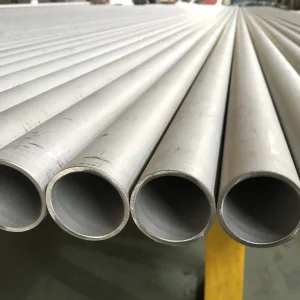







Request a Custom Cupro Nickel Piping Specification Consultation
Partner with our metallurgists and engineering team to evaluate fluid velocity profiles, alloy grades (C70600 vs C71500), dimensional tolerances, and EN 10204 3.2 inspection requirements for your next project.
Contact Engineering Team