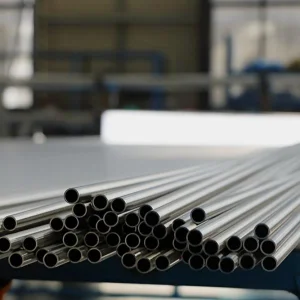
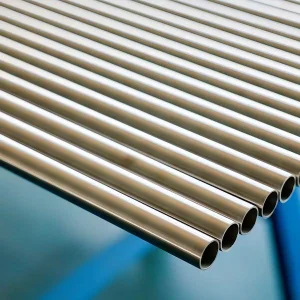
Custom Austenitic & Alloy Pipe Portfolio
Precision-manufactured seamless and welded tubular solutions engineered for extreme heat, pressure, and corrosive fluids under ASME SA213, SA312, and ASTM standards.






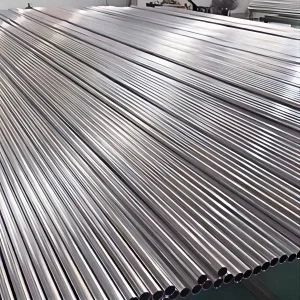
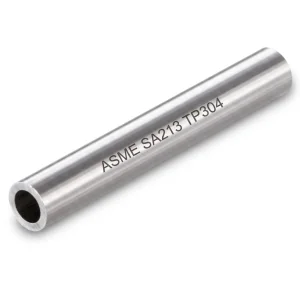
Metallurgical Architecture of Duplex Stainless Steel Pipes
Understanding the biphasic microstructure equilibrium that delivers double the mechanical strength of conventional austenitic alloys alongside superior localized corrosion resistance.
Biphasic Microstructure Control
Duplex stainless steels consist of roughly equal proportions of face-centered cubic (FCC) austenite and body-centered cubic (BCC) ferrite. This dual-phase matrix combines the high toughness and ease of fabrication of austenitic alloys with the high yield strength and stress-corrosion cracking (SCC) resistance of ferritic steels.
PREN Engineering Dynamics
Pitting Resistance Equivalent Number (PREN = %Cr + 3.3%Mo + 16%N) governs material survival in marine and acidic environments. While 316L achieves a PREN of ~25, Standard Duplex (2205) reaches 35, and Super Duplex (2507) exceeds 42, guaranteeing complete resistance to aggressive chloride-induced pitting.
Sigma Phase Mitigation
Improper cooling between 600°C and 1000°C precipitates brittle intermetallic sigma (σ) and chi (χ) phases, severely impairing impact toughness and corrosion resistance. Our factory employs precision solution annealing (1020°C–1100°C) followed by rapid automated water quenching.
| Duplex Alloy Family | UNS / EN Standard | Nominal Chemical Composition (%) | PREN Rating | Yield Strength (Rp0.2 MPa) | Key Industrial Service |
|---|---|---|---|---|---|
| Lean Duplex | UNS S32101 / 1.4162 | 21.5Cr - 1.5Ni - 5Mn - 0.22N | 26 - 28 | ≥ 450 | Civil infrastructure, storage tanks, structural tubing |
| Standard Duplex (2205) | UNS S31803 / S32205 / 1.4462 | 22Cr - 5.5Ni - 3.2Mo - 0.18N | 35 - 38 | ≥ 450 - 520 | Chemical tankers, oil & gas gas-lift lines, heat exchangers |
| Super Duplex (2507) | UNS S32750 / 1.4410 | 25Cr - 7Ni - 4Mo - 0.27N | 42 - 45 | ≥ 550 | Offshore oil platforms, RO desalination, subsea manifolds |
| Super Duplex (Zeron 100) | UNS S32760 / 1.4501 | 25Cr - 7Ni - 3.5Mo - 0.7W - 0.2N | > 42 | ≥ 550 | Sour service (H2S), aggressive acid refining pipelines |
| Hyper Duplex | UNS S32707 / 1.4658 | 27Cr - 6.5Ni - 4.8Mo - 0.4N | 48 - 50 | ≥ 700 | Deepwater subsea Umbilicals, high-severity geothermal wells |
Why Global Enterprise Procurement Prefers Our China Factory Base
Combining tier-1 raw material sourcing, automated cold-pilgering infrastructure, and rigorous compliance to eliminate lead-time bottlenecks and lower total cost of ownership.
Upstream Raw Material Security
We maintain direct strategic partnerships with premier stainless steel melt shops including TISCO and Tsingshan. Every mother tube, billet, or strip comes with verified melt numbers, low residual trace elements, and tight composition tolerances for optimum hot/cold workability.
Advanced Cold Pilgering & Drawing
Our facility houses 12 multi-roll cold pilgering mills and heavy-duty hydraulic bench drawing equipment. This allows us to achieve precise dimensional tolerances (±0.05 mm on OD, ±7.5% on WT) and flawless surface finishes down to Ra < 0.4 μm for high-purity process piping.
Capital Efficiency & Scalability
Leveraging China's comprehensive industrial supply cluster, our integrated manufacturing model reduces production cycles by up to 35% compared to Western mills, offering global EPC contractors highly competitive pricing without sacrificing E-E-A-T benchmark quality.
Every single Duplex pipe produced in our Huzhou manufacturing plant follows a strict ISO 9001, ISO 14001, and PED 2014/68/EU quality plan. From raw material spectrum PMI testing to final hydrostatic testing at pressures up to 100 MPa, we guarantee complete non-destructive traceability.
Raw Material PMI & UT
Spectrometric verification of Cr, Ni, Mo, N content and ultrasonic scanning of hollow billets.
Cold Pilgering & Forming
Multi-pass reduction of outer diameter and wall thickness to refine microstructural grain boundaries.
Solution Anneal & Quench
Induction heating to 1080°C followed by forced water quenching within 10 seconds to lock 50/50 phase.
NDT & MTC Certification
Eddy current, hydrostatic, microstructural ferrite count, and EN 10204 3.1/3.2 test report issuance.
Localized Support, International Compliance & Engineering Standards
Designing custom tubular products to fulfill stringent engineering codes across North America, Europe, the Middle East, and Asia-Pacific.
Code Compliance: ASTM / ASME / EN / ISO
Our products fully comply with ASME SA789/SA790 (seamless and welded duplex tubes for general service), ASTM A928 (welded duplex pipe with filler metal), EN 10216-5 (seamless steel tubes for pressure purposes), and NORSOK M-650 qualification for offshore installation.
NACE MR0175 / ISO 15156 H2S Service
For sour oilfield applications where hydrogen sulfide stress cracking is a critical failure mode, our custom 2205 and 2507 pipes undergo rigorous hardness testing (≤ 28 HRC for 2205 and ≤ 32 HRC for 2507) and microstructural phase balance audits per ASTM E562.
Localized Technical & Freight Support
We provide end-to-end support for international clients, including localized engineering consultation, third-party inspection management (SGS, TÜV, DNV, BV), specialized beveling (30°/37.5°), seaworthy wooden crate packaging with VCI anti-corrosion lining, and DDP shipping to project sites.
Localized Application Scenarios for Custom Duplex Piping
Engineered for extreme operating environments where conventional 304/316 austenitic stainless steels fail due to chloride stress corrosion cracking or erosive wear.
Offshore Oil & Gas Platforms
Subsea flowlines, riser pipes, FPSO top-side process modules, and firewater systems utilize Super Duplex UNS S32750 due to its resistance to high-pressure sour gas, high chloride concentration, and wave-induced mechanical fatigue.
Reverse Osmosis (RO) Desalination
High-pressure seawater feed pumps and energy recovery devices rely on Standard Duplex 2205 and Super Duplex 2507 manifolds to withstand continuous exposure to 35,000+ ppm chloride brine without pitting or crevice corrosion.
Chemical Processing & Refining
Nitric acid production, organic acid synthesis, vinyl chloride monomer (VCM) distillation, and urea plants demand custom Duplex heat exchanger tubing to prevent catastrophic chloride stress cracking under elevated thermal pressure.
Pulp & Paper Bleaching Towers
Bleach plants utilizing chlorine dioxide (ClO2) and aggressive washing liquors rely on high-molybdenum Duplex pipes to replace expensive nickel alloys, dramatically lowering capital expenditure while preserving system integrity.
Geothermal & Blue Hydrogen Lines
High-temperature geothermal brine wells and hydrogen transportation piping operating under severe pressure cycles utilize custom seamless 2205/2507 pipes to eliminate hydrogen embrittlement risks.
Marine Scrubbers & Defense Shipbuilding
Exhaust gas cleaning systems (EGCS) installed on commercial ocean-going vessels utilize lean and standard Duplex pipes to resist hot sulfur-bearing washwater condensation.
Industry Trends & Next-Generation Duplex Innovations
How emerging metallurgical advancements and smart manufacturing paradigms are transforming global duplex stainless steel pipe production.
Rise of Hyper & Ultra Duplex Grades
With deepwater oil wells reaching deeper reserves and higher temperatures (> 200°C), demand is shifting toward Hyper Duplex (e.g., UNS S32707) with PREN values up to 50, providing high yield strength without relying on expensive titanium or high-nickel alloys.
AI-Assisted Ultrasonic Defect Inspection
Integrating machine learning algorithms into automated phased-array ultrasonic testing (PAUT) units allows real-time detection of internal micro-voids, inclusions, or wall thickness variations down to 0.01 mm, achieving zero-defect production runs.
Decarbonized Green Steel Production
Driven by global ESG requirements and the EU Carbon Border Adjustment Mechanism (CBAM), modern Chinese mills are transitioning to Electric Arc Furnaces (EAF) powered by renewable energy, reducing embodied carbon per ton of finished duplex pipe by over 40%.
Frequently Asked Questions by Global Engineers & Buyers
Expert responses regarding specification, welding, testing, and delivery of custom duplex stainless steel pipes.
What is the key difference between Standard Duplex 2205 and Super Duplex 2507 pipes?
The fundamental distinction lies in chromium, molybdenum, and nitrogen alloy content, which dictates pitting corrosion resistance and mechanical strength. Standard Duplex 2205 (UNS S31803/S32205) features ~22% Cr, 3% Mo, and a PREN of 35, delivering a minimum yield strength of 450 MPa. Super Duplex 2507 (UNS S32750) contains ~25% Cr, 4% Mo, and 0.27% N, boosting PREN to >42 and yield strength to ≥550 MPa. Consequently, 2507 is selected for aggressive marine environments, high-chloride RO desalination, and severe H2S sour gas applications.
How does your factory ensure the correct 50/50 phase balance during manufacturing?
Achieving an optimal ferrite-austenite phase balance requires precise control over solution annealing heat treatment temperatures (typically 1020°C to 1100°C) combined with rapid water quenching. Slow cooling can lead to nitrogen loss or phase imbalance, triggering detrimental intermetallic precipitation (sigma phase). We verify phase distribution on every production heat using automated image analysis and magnetic ferritometer testing in accordance with ASTM E562, guaranteeing a compliant ferrite content of 40% to 60%.
What special precautions are required when welding custom duplex stainless steel pipes?
Welding duplex stainless steel requires tight heat-input management (typically 0.5 to 2.5 kJ/mm) to prevent excessive ferrite growth in the Heat-Affected Zone (HAZ) or sigma phase precipitation. Over-alloyed filler metals (such as 2209 for welding 2205, or 2509 for 2507) are required to ensure the weld root re-austenitizes properly. Pure argon or argon + 2-3% N2 purging gas should be used to preserve nitrogen balance in the weld root.
Can you provide non-standard custom wall thickness and custom bevel end preparations?
Yes. Our factory specializes in customized dimensional production beyond standard ASME B36.19 schedules. We manufacture custom outside diameters (from 4.00 mm to 114.30 mm), extra-heavy wall thicknesses up to 12 mm, straight lengths up to 25 meters, and specialized end preparations including 30° / 37.5° compound weld bevels, square cuts, polished sanitary ends, or U-bent heat exchanger tubes.
What third-party inspection (TPI) agencies do you work with for EN 10204 3.2 certification?
We routinely collaborate with leading global inspection bodies including Lloyd's Register (LR), TÜV Rheinland / TÜV SÜD, Bureau Veritas (BV), Det Norske Veritas (DNV), and SGS. When an EN 10204 3.2 Material Test Certificate is specified, an independent TPI inspector witnesses melt verification, sample cutting, tensile/impact testing, hydrostatic testing, and seals the final export packages prior to dispatch.
Specialized Titanium, High-Temp Austenitic & Nickel Alloy Tubes
Explore our full catalog of high-performance alloy tubing engineered for extreme chemical, cryogenic, and high-temperature furnace applications.