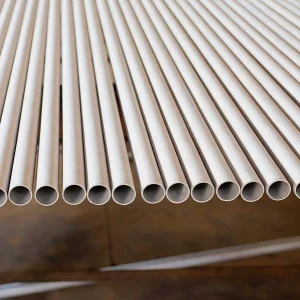
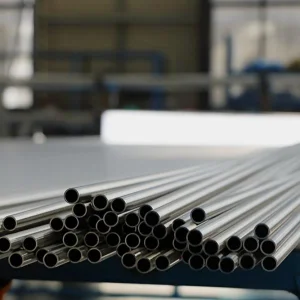
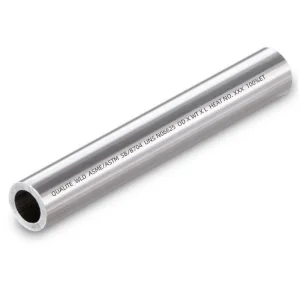
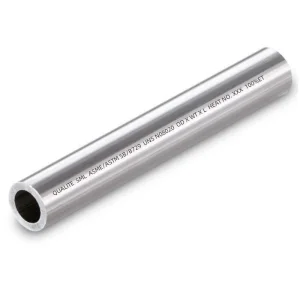
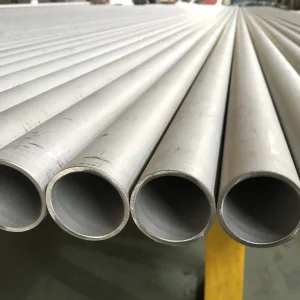
Featured Specialty Tubing Catalog (Part I)
Explore our certified range of high-performance titanium, austenitic, and specialty alloy tubes manufactured under strict ISO 9001 and ASTM / ASME specifications.






1. Global Industrial Landscape & Market Macro-Trends
Analyzing the pivotal shift toward super-alloys in energy transition, deepwater extraction, chemical refining, and zero-emission industrial infrastructures.
Accelerating Demand in Critical Energy & Petrochemical Systems
Modern process industries operate under increasingly severe thermodynamic conditions. Standard 300-series austenitic stainless steels (such as 304L and 316L) often reach their operational thresholds when subjected to localized pitting, chloride-induced stress corrosion cracking (SCC), or polythionic acid attack. The global industrial transition toward high-efficiency LNG liquefaction, deep-sea oil extraction, and green hydrogen electrolysis has elevated demand for **custom nickel alloy tubes** (Inconel, Incoloy, Monel, and Hastelloy grades).
Severe Environment Material Substitution Trends
Global engineering procurement organizations are shifting from traditional heavy-wall carbon steels to corrosion-resistant alloy (CRA) tubing. Nickel-chromium-molybdenum matrices provide superior passivation film stability in severe oxidizing, reducing, and acidic environments. Selecting specialized factory partners capable of consistent cold-drawing, bright annealing, and ultra-smooth inner diameter polishing is imperative to preventing costly unscheduled plant shutdowns.
Information Gain Insight: The Total Cost of Ownership (TCO) Shift
While initial capital expenditure for nickel alloy tubing exceeds standard stainless steel by 2.5x to 4x, field empirical data indicates a 300% to 500% extension in component service life under severe chloride or acid service, dropping life-cycle maintenance costs dramatically.
2. Metallurgical Guide & Material Grade Selection Matrix
Technical breakdown of alloy composition, PREN ratings, thermal stability, and standard specifications for precision tubing.
| Alloy Family / Grade | UNS / Werkstoff | Nominal Composition | PREN Value | Primary ASTM/ASME Standard | Key Performance Attribute |
|---|---|---|---|---|---|
| Inconel 625 | UNS N06625 / 2.4856 | 58Ni - 21Cr - 9Mo - 3.5Nb | > 48.0 | ASTM B444 / ASME SB444 | Exceptional fatigue strength, severe chloride pitting resistance. |
| Incoloy 800H | UNS N08810 / 1.4958 | 32Ni - 21Cr - 46Fe - Al+Ti | ~ 22.5 | ASTM B407 / ASME SB407 | High creep-rupture resistance above 600°C up to 1100°C. |
| Alloy 20 | UNS N08020 / 2.4660 | 35Ni - 20Cr - 3.5Cu - 2.5Mo | ~ 30.0 | ASTM B729 / ASME SB729 | Formulated specifically to resist sulfuric acid boiling conditions. |
| Hastelloy C276 | UNS N10276 / 2.4819 | 57Ni - 16Cr - 16Mo - 4W | > 64.0 | ASTM B622 / ASME SB622 | Outstanding resistance to strong oxidizers, wet chlorine, and ferric chloride. |
| Monel 400 | UNS N04400 / 2.4360 | 67Ni - 30Cu - 2Fe | N/A | ASTM B163 / ASME SB163 | Immune to chloride SCC, exceptional in hydrofluoric acid and seawater. |
| Super Duplex 2507 | UNS S32750 / 1.4410 | 25Cr - 7Ni - 4Mo - 0.28N | > 42.0 | ASTM A789 / ASTM A790 | High yield strength (650 MPa) paired with superior crevice corrosion immunity. |
Pitting Resistance Equivalent (PREN)
The mathematical evaluation of localized pitting resistance is defined by: PREN = %Cr + 3.3(%Mo + 0.5%W) + 16%N. Higher PREN values guarantee long-term stability in stagnant seawater and acidic bleach solutions.
Cold Drawing vs. Seamless Routes
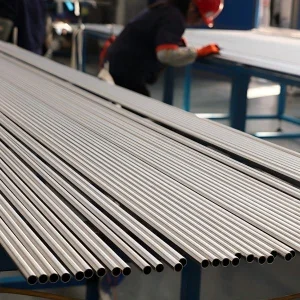
Cold Pilgering and precision cold drawing refine grain boundaries, achieve wall thickness tolerances down to ±0.05 mm, and deliver inner surface roughness values below Ra 0.4 µm for critical instrumentation lines.
Bright Annealing (BA) Precision
Thermally processed in pure hydrogen protective atmospheres at 1050°C - 1180°C to eliminate intergranular carbide precipitation and ensure oxidation-free, mirror-bright surface finishes.
3. China Manufacturing Ecosystem & Supply Chain Resilience
How localized industrial clusters in Huzhou and Shanghai optimize production cost, speed, metallurgical consistency, and global delivery agility.
Vertical Upstream Integration
Our manufacturing cluster leverages direct access to high-purity master alloy melting facilities utilizing Vacuum Induction Melting (VIM) followed by Electro-Slag Remelting (ESR). This ingot-to-tube integration guarantees ultra-low gas content (O, N, H) and pristine cleanliness across all nickel alloy melts.
Unmatched Production Lead Times
With multi-line cold pilgering mills, continuous hydrogen bright annealing furnaces, and automated U-bending machines operating 24/7 in Zhejiang, custom order lead times are compressed from industry averages of 16–20 weeks down to 4–6 weeks for critical plant emergency turnarounds.
30-40% Cost-Efficiency Advantage
By streamlining raw material procurement, localized tool-making, and high-efficiency automation, Chinese specialized factories deliver certified ASME/ASTM nickel alloy tubing at a competitive total landed cost—without compromising metallurgical integrity.
4. Global Application Scenarios & Engineering Field Deployment
Tailored performance engineering for localized industrial environments across North America, Europe, Middle East, and Asia-Pacific.
North America: Gulf Coast Petrochemical & LNG Terminals
In Texas and Louisiana chemical corridors, heat exchangers operate continuously in humid, salt-laden marine air while processing high-temperature hydrocarbon streams. Inconel 625 and Incoloy 800H U-bend heat exchanger tubes are extensively deployed in feed-water preheaters and ethylene cracking units to eliminate stress corrosion cracking.
Middle East: SWRO Desalination & Sour Gas (H2S) Recovery
Offshore gas fields in Qatar, UAE, and Saudi Arabia require strict compliance with NACE MR0175 / ISO 15156. In sour wells loaded with toxic H2S and high chlorides, Hastelloy C276 and Super Duplex 2507 tubing prevent sulfide stress cracking (SSC) and hydrogen embrittlement.
Europe: Green Hydrogen & Offshore Wind Energy Integration
North Sea hydrogen electrolysis projects demand high-purity, ultra-clean nickel alloy hydraulic lines capable of withstanding pressures up to 700 bar while maintaining zero hydrogen permeability and zero micro-fissures along cold-drawn welds.
Asia-Pacific: Supercritical Power & PTA Chemical Plants
Rapid expansion of PTA (Purified Terephthalic Acid) and mega-scale nuclear power stations in China, Vietnam, and India utilizes titanium Grade 2 and Alloy 20 condenser tubing to combat severe acetic acid and high-velocity sea water erosion.
5. Technology Roadmap & Manufacturing Innovation
Emerging metallurgical advances, zero-defect AI monitoring, and ultra-precision processing shapes the next generation of industrial tubing.
1. AI-Powered NDT Defect Detection
Integrating real-time multi-frequency Eddy Current (ECT) combined with phased-array Ultrasonic Testing (UT) algorithms allows detection of surface micro-defects down to 0.02 mm depth during high-speed cold drawing, eliminating human inspection bias.
2. High-Entropy Alloy (HEA) Tubing
Research and development into multi-principal element superalloys (Fe-Co-Ni-Cr-Mo) promises temperature capabilities exceeding 1200°C while increasing oxidation resistance for next-generation aerospace and nuclear fusion cooling circuits.
3. Ultra-Thin Wall Cold Pilgering
Advanced 3-roll cold pilgering mills now achieve wall thickness to outer diameter (WT/OD) ratios below 1:50 with microscopic concentricity, reducing structural weight in aerospace fuel manifolds while preserving burst pressure safety factors.
6. Compliance Assurance, Quality Control & E-E-A-T Framework
Rigorous verification protocols and internationally recognized certifications ensuring 100% material traceability and compliance.
EN 10204 3.1 & 3.2 Material Test Certificates (MTC)
Every shipment is accompanied by a comprehensive EN 10204 3.1 mill test certificate detailing heat number, chemical ladle analysis, mechanical tension test results, hardness values, grain size analysis, micro-etch inspection, and hydrostatic test pressures. Third-party EN 10204 3.2 certification via TÜV Rheinland, SGS, Lloyd's Register, or DNV is routinely provided upon project specification.
International Pressure Vessel & Piping Code Compliance
Manufacturing protocols comply strictly with Pressure Equipment Directive (PED 2014/68/EU), ASME Boiler and Pressure Vessel Code (BPVC) Section II Part B, AD 2000-Merkblatt W2/W10, and ISO 9001:2015 / ISO 14001:2015 quality environmental management standards.
7. Technical FAQ for Engineering Procurement Teams
Addressing critical engineering questions regarding tube selection, heat treatment, tolerances, and quality verification.
Featured Specialty Tubing Catalog (Part II)
Browse our specialized super austenitic, high-temperature nickel alloy, and titanium grade product range for industrial machinery and refinery integration.