
Featured Titanium & Corrosion-Resistant Tubing Portfolio
Explore our primary industrial tube stock manufactured under rigorous ASTM, ASME, and EN quality standards with full material test certification (EN 10204 3.1/3.2).




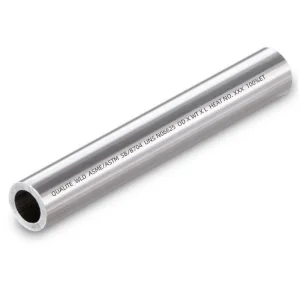



Titanium Grade 5 (Ti-6Al-4V, UNS R56400) Mechanical & Microstructural Profile
Titanium Grade 5—designated as UNS R56400 and Werkstoff Nr. 3.7165—represents the cornerstone alloy of the global titanium manufacturing sector, accounting for over 50% of total titanium usage worldwide. Unlike commercially pure (CP) titanium grades (Grades 1 through 4), Grade 5 is an alpha-beta (α+β) alloy microstructurally engineered with 6% aluminum (alpha stabilizer) and 4% vanadium (beta stabilizer).
The addition of aluminum raises the phase transformation temperature between the alpha and beta phases, strengthening the hexagonal close-packed (HCP) lattice through solid solution hardening. Meanwhile, vanadium stabilizes the body-centered cubic (BCC) beta phase, allowing heat treatment capability via solution treating and aging (STA). When cold-drawn or hot-extruded into seamless and welded tubular forms, Custom Titanium Tube Grade 5 achieves an unparalleled ratio of tensile strength to density, surpassing conventional austenitic stainless steels (316L, 304L) and nickel-base superalloys while reducing net component weight by up to 45%.
From a corrosion science perspective, Ti-6Al-4V forms an instantaneous, tenacious passive oxide film ($\text{TiO}_2$, rutile/anatase structure) upon exposure to oxygen or moisture. This oxide layer provides complete resistance to wet chlorine gas, chlorite solutions, hypochlorites, seawater, brackish water, and organic acids. Consequently, precision Grade 5 tubing is widely specified across subsea petroleum extraction, aerospace hydraulic circuits, advanced automotive exhaust headers, and medical device fluid conduits.
| Titanium Grade | UNS / EN Standard | Alloy Structure | Yield Strength (MPa) | Tensile Strength (MPa) | Key Industrial Applications |
|---|---|---|---|---|---|
| Grade 1 | UNS R50250 / 3.7025 | Unalloyed Alpha (α) | 170 - 310 | 240 min | Chemical lining, high formability heat exchangers |
| Grade 2 | UNS R50400 / 3.7035 | Unalloyed Alpha (α) | 275 - 450 | 345 min | Desalination plants, marine condenser tubes |
| Grade 5 (Ti-6Al-4V) | UNS R56400 / 3.7165 | Alpha-Beta (α+β) | 828 min | 895 min | Aerospace hydraulics, racing exhaust, deep-sea risers |
| Grade 9 (Ti-3Al-2.5V) | UNS R56320 / 3.7195 | Near Alpha (α) | 483 min | 620 min | High-pressure hydraulic lines, sporting goods |
| Grade 23 (Ti-6Al-4V ELI) | UNS R56401 / 3.7165 | Alpha-Beta (α+β) ELI | 795 min | 860 min | Biomedical implants, cryogenic pressure vessels |
Global Industry Trends Driving Grade 5 Titanium Tubing Demand
Analyzing macro-economic shifts, decarbonization mandates, deepwater oil exploration, and next-generation mobility platforms shaping procurement behavior worldwide.
1. Aerospace Fleet Modernization
Commercial aviation OEMs are aggressively migrating toward high-pressure 5,000 PSI hydraulic systems. Custom Grade 5 seamless tubing provides the requisite fatigue strength under pressure pulsing while delivering critical weight savings necessary to meet global SAF (Sustainable Aviation Fuel) efficiency goals.
2. Ultra-Deepwater Offshore Risers
As offshore oil production pushes beyond 3,000 meters depth, hydrostatic pressure and high concentrations of sour gas ($\text{H}_2\text{S}$) render conventional steel tubes vulnerable to stress corrosion cracking (SCC). Grade 5 titanium offers complete immunity to chloride-induced SCC in marine environments up to 260°C.
3. Green Hydrogen & Electrolyzer Stack Design
Proton Exchange Membrane (PEM) electrolyzers operate in highly acidic, oxidative liquid environments. Custom titanium tubes act as durable transport conduits for deionized water and hydrogen output, ensuring zero ion leaching that could contaminate delicate catalytic membranes.
Enterprise Procurement Specifications & NDT Inspection Protocols
Global B2B procurement teams require absolute material integrity, tight dimensional tolerances, and full heat-traceability to eliminate supply chain failure risks in mission-critical applications.
When sourcing Custom Titanium Tube Grade 5 products, standard industrial tolerances are frequently insufficient. Leading EPC engineering firms and tier-1 aerospace suppliers enforce strict quality assurance frameworks that span raw material melt controls down to non-destructive testing (NDT) of final tube dimensions.
Raw Material Ingot Control (VAR / EBCHR)
Grade 5 titanium ingots must undergo multiple Vacuum Arc Remelting (VAR) or Electron Beam Cold Hearth Remelting (EBCHR) cycles to ensure complete elimination of high-density inclusions (HDI) like tungsten carbide and low-density interstitials (LDI) such as nitrogen-rich alpha voids.
Comprehensive Non-Destructive Testing (NDT)
Every individual tube must undergo 100% Eddy Current Testing (ECT) per ASTM E426 or Ultrasonic Testing (UT) per ASTM E213. Additionally, hydrostatic pressure testing up to 100 MPa (14,500 PSI) or pneumatic testing under liquid guarantees zero micro-fissures or longitudinal seam faults.
Dimensional & Concentricity Verification
Wall thickness concentricity must exceed 90% across the total length of the tube. Precision cold pilgering lines achieve outer diameter (OD) tolerances within ±0.05 mm and wall thickness tolerances within ±5%, providing smooth inner bore surface finishes down to $Ra < 0.4 \, \mu m$.
Macro-Industry Solutions & Customized Material Applications
Tailored technical tubing formats engineered to resolve critical engineering bottlenecks across major industrial sectors.
Aerospace & Defense Hydraulics
Problem: Extreme impulse vibration and micro-cracking in stainless steel hydraulic conduits operating under 350 bar line pressure.
Solution: Custom Grade 5 seamless cold-drawn tubes heat-treated to an annealed state per AMS 4928. Provides high endurance limit ($>450 \text{ MPa}$) and reduces overall fluid distribution network weight by 42%.
Desalination & Brine Evaporators
Problem: Rapid pitting and erosion-corrosion of copper-nickel exchanger tubes exposed to high-velocity hot brine (95°C) containing dissolved sulphides.
Solution: Grade 5 titanium thin-wall tubing with localized palladium addition (or standard Ti-6Al-4V). Zero wall loss after 100,000 continuous operating hours; thermal efficiency maintained without scaling.
High-Performance Automotive Exhaust
Problem: Thermal fatigue, oxidization flaking, and high system mass in stainless steel performance downpipes and turbo manifold bends.
Solution: Custom mandril-bent Grade 5 titanium thin-wall welded tubing (0.9 mm to 1.2 mm WT). Offers resistance to exhaust gas temperatures up to 600°C while yielding aggressive acoustic resonance and weight reduction.
Advanced Titanium Manufacturing Roadmap & Processing Technologies
From raw sponge processing to automated cold pilgering and vacuum bright annealing—how modern mills deliver consistent Grade 5 tube geometry.
Kroll Vacuum Melting
Reduction of titanium tetrachloride ($\text{TiCl}_4$) with molten magnesium produces high-purity titanium sponge, blended with 6% Al / 4% V master alloy.
Rotary Piercing / Extrusion
Hot extrusion of hollow billets at 950°C - 1050°C into thick-walled mother tubes, maintaining tight concentricity control.
Multi-Pass Cold Pilgering
Iterative cold reduction over stationary mandrels, refining grain structure and achieving precise outer diameter and wall thickness dimensions.
Vacuum Bright Annealing
Heat treatment in ultra-high vacuum furnaces ($<10^{-4} \text{ mbar}$) at 750°C to relieve internal stresses without causing surface alpha-case oxidation.
Secondary Specialty Alloy & Tubular Solutions
Complementary stainless steel, duplex, and nickel alloy tubing options for high-pressure, heat exchanger, and chemical process installations.






Global Compliance Standards & Mill Test Traceability
Comprehensive material verification supporting strict international norms across aerospace, pressure equipment, and nuclear infrastructure.
ASTM & ASME Specifications
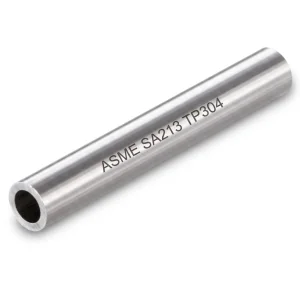
Full compliance with ASTM B338 (Standard Specification for Seamless and Welded Titanium and Titanium Alloy Tubes for Condensers and Heat Exchangers), ASTM B861 (Seamless Pipe/Tube), ASTM B862 (Welded Pipe), and ASME SB-338 code requirements.
EN 10204 3.1 / 3.2 Certification
Every export shipment is accompanied by EN 10204 3.1 Material Test Certificates detailing chemical heat analysis, mechanical tensile/yield testing, flattening tests, flaring tests, microstructural grain size evaluation, and NDT test reports. Independent 3.2 inspection (TÜV, DNV, SGS, Lloyd's Register) is supported.
Aerospace AS9100D & NADCAP
Manufacturing facilities maintain quality management systems certified to AS9100D and ISO 9001:2015, alongside NADCAP accreditation for heat treating, non-destructive testing, and chemical processing of reactive metals.
Frequently Asked Technical Questions: Titanium Grade 5 Tubing
Direct answers to common engineering, procurement, and metallurgic queries regarding Grade 5 (Ti-6Al-4V) tube specification and fabrication.
Titanium Grade 2 is commercially pure (CP) unalloyed titanium with an alpha crystal structure. It offers lower tensile strength (~345 MPa) but high ductility and excellent weldability. Grade 5 (Ti-6Al-4V) is an alpha-beta alloy containing 6% aluminum and 4% vanadium, delivering more than double the tensile strength (895+ MPa) and significantly higher fatigue resistance, making Grade 5 ideal for structural and high-pressure hydraulic service, whereas Grade 2 is typically preferred for low-pressure heat exchangers.
Yes, Grade 5 titanium can be welded using Gas Tungsten Arc Welding (GTAW / TIG) or Electron Beam Welding (EBW). However, because titanium reacts aggressively with oxygen, nitrogen, and hydrogen at temperatures above 400°C, absolute gas shielding (using 99.999% pure argon) is required on both the weld pool face and the internal root side (trailing shield and back-purge) to prevent interstitial embrittlement.
Due to its high yield strength (828+ MPa) and modulus of elasticity (~114 GPa), Grade 5 exhibits significant springback during cold forming. The recommended cold bend radius is typically $R \ge 4.5 \times \text{OD}$ (Outer Diameter). For tighter bends ($R < 3 \times \text{OD}$), rotary draw bending under hot forming conditions (450°C to 600°C) is recommended to prevent wall necking or outer radius splitting.
Grade 5 maintains structural integrity and oxidation resistance in continuous service up to approximately 400°C (752°F). Above 450°C, the passive oxide surface layer degrades, leading to oxygen diffusion into the surface layer (forming an embrittled "alpha case"). For continuous operating temperatures exceeding 500°C, high-temperature nickel superalloys (such as Alloy 625 or Alloy 800H) or Grade 12 titanium are recommended.
Grade 23 is the "Extra Low Interstitial" (ELI) version of Grade 5. In Grade 23, maximum allowable interstitial elements—specifically oxygen ($<0.13\%$), iron, carbon, and nitrogen—are strictly reduced. This lower oxygen content slightly reduces tensile strength but dramatically improves fracture toughness ($K_{IC}$) and ductility at cryogenic temperatures, making Grade 23 preferred for surgical implants and space cryogenic fluid tanks.
