
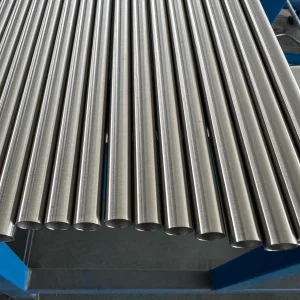
Featured UNS S31603 & Specialty Alloy Tubes
Explore our premier line of custom austenitic, duplex, super austenitic, and titanium tubular products engineered for high-stress and corrosive environments.








UNS S31603 (316L): Technical Architecture & Chemical Superiority
Understanding the elemental synergy, phase stability, and anti-corrosion mechanics of low-carbon molybdenum-alloyed austenitic stainless steel.
1. The Engineering Significance of Carbon Restriction in UNS S31603
UNS S31603, globally designated as AISI 316L or EN 1.4404, represents an evolution in austenitic stainless steel metallurgy. The critical distinction between standard UNS S31600 (316) and UNS S31603 (316L) lies in the strict constraint placed on carbon concentration. By maintaining carbon levels at or below 0.030%, factories effectively eliminate the risk of chromium carbide precipitation ($\text{Cr}_{23}\text{C}_6$) along grain boundaries during welding or stress-relief heat treatment operations.
When conventional stainless steels are exposed to the sensitization temperature window of 425°C to 860°C (797°F to 1580°F), chromium atoms diffuse toward grain boundaries to combine with carbon. This depletes the adjacent matrix of elemental Chromium below the critical 10.5% threshold necessary for passive film re-passivation, rendering the material vulnerable to severe Intergranular Corrosion (IGC). UNS S31603 factories overcome this via vacuum oxygen decarburization (VOD) or argon oxygen decarburization (AOD) refining, guaranteeing immune performance in as-welded fluid systems.
2. Chemical Composition Limits & Structural Equivalency Table
To meet international quality standards such as ASTM A213, ASTM A249, ASTM A269, ASTM A312, and European standards EN 10217-7 / EN 10216-5, UNS S31603 factory heats must strictly conform to tight compositional bandwidths:
| Alloy Parameter | UNS S31603 (316L) | UNS S31600 (316) | EN 1.4404 | UNS S31703 (317L) | Duplex S32205 (2205) |
|---|---|---|---|---|---|
| Carbon (C) max | 0.030% | 0.080% | 0.030% | 0.030% | 0.030% |
| Chromium (Cr) | 16.0 - 18.0% | 16.0 - 18.0% | 16.5 - 18.5% | 18.0 - 20.0% | 22.0 - 23.0% |
| Nickel (Ni) | 10.0 - 14.0% | 10.0 - 14.0% | 10.0 - 13.0% | 11.0 - 15.0% | 4.5 - 6.5% |
| Molybdenum (Mo) | 2.00 - 3.00% | 2.00 - 3.00% | 2.00 - 2.50% | 3.00 - 4.00% | 3.00 - 3.50% |
| Nitrogen (N) | ≤ 0.10% | ≤ 0.10% | ≤ 0.11% | ≤ 0.10% | 0.14 - 0.20% |
| Yield Strength (Rp0.2) | ≥ 170 MPa | ≥ 205 MPa | ≥ 200 MPa | ≥ 205 MPa | ≥ 450 MPa |
| Tensile Strength (Rm) | ≥ 485 MPa | ≥ 515 MPa | 500 - 700 MPa | ≥ 485 MPa | 650 - 880 MPa |
| PREN Index (~Approx) | 23.0 - 25.5 | 23.0 - 25.5 | 23.5 - 26.0 | 28.0 - 31.0 | 34.0 - 36.0 |
The PREN formula for austenitic stainless steel is calculated as: PREN = %Cr + 3.3(%Mo) + 16(%N). The addition of 2.0–3.0% Molybdenum in UNS S31603 significantly enhances passive film repair velocity under acidic chloride media compared to 304/304L (PREN ~19), making S31603 the industry baseline for marine, chemical, and pharmaceutical fluid transmission.
Global Commercial & Industrial Landscape for UNS S31603
Analysis of international consumption trends, sector-specific procurement drivers, and supply chain allocation across key industrial regions.
Biopharmaceutical & Cleanroom Piping
UNS S31603 is the mandatory material of choice for Water-for-Injection (WFI) systems, clean steam lines, and bioreactor vessels. Vacuum Bright Annealed (BA) and Electro-Polished (EP) internal surface treatments (Ra ≤ 0.25 μm) prevent biofilm accumulation and withstand stringent CIP/SIP sterilization routines.
Chemical & Petrochemical Processing
Extensively deployed in heat exchangers, condensers, evaporators, and process piping carrying organic acids, acetic media, bromides, and mild sulfuric solutions. The presence of Molybdenum prevents severe pitting under stagnant fluid conditions.
Marine & Offshore Oil & Gas
In offshore topsides, subsea control lines, hydraulic instrumentation tubing, and seawater cooling systems, UNS S31603 delivers optimal life-cycle ROI over standard carbon or non-moly stainless alloys, resisting atmospheric splash zone corrosion.
Semiconductor & UHV Tech
Ultra-High Vacuum (UHV) systems require low outgassing rates and micro-clean internal tube surfaces. UNS S31603 specialized factory lines utilize double-melt procedures (VIM + VAR) to control non-metallic inclusions to microscopic minimums.
China's Factory Supply Chain Resilience & Efficiency Advantages
How integrated manufacturing clusters, vertical quality control, and scale economies deliver uncompromised value for international EPC contractors and OEMs.
In the global procurement ecosystem, purchasing managers and engineering specifiers require more than just technical compliance; they demand supply chain predictability, rapid scaling capabilities, and cost efficiency. Chinese specialized UNS S31603 factories have transformed from regional suppliers into global technology powerhouses through systematic supply chain integration.
1. End-to-End Vertical Integration
Leading Chinese factory clusters operate unified production lines starting from raw stainless steel master-alloy melting (AOD/VOD refining), hot-extruded tube hollow preparation, multi-pass cold rolling (Pilgering), continuous bright annealing, through to automated ultrasonic and eddy current non-destructive testing (NDT). This eliminates intermediate logistics markups and reduces lead times by up to 40%.
2. Advanced Quality Management Systems
Modern Chinese UNS S31603 manufacturing plants operate strict quality gates certified under ISO 9001, ISO 14001, ISO 45001, PED 2014/68/EU, and AD2000-W0. Material Test Certificates (MTC) are issued strictly in accordance with EN 10204 3.1, with seamless provision for independent third-party inspection (EN 10204 3.2 by TÜV, SGS, Lloyd's Register, or DNV).
3. Scale, Capacity & Raw Material Stability
Benefiting from direct partnerships with major primary nickel and chromium refiners, Chinese factories maintain extensive buffer stocks of certified UNS S31603 mother tubes and coils. This insulates global buyers from volatile LME metal surcharges and guarantees stable contract pricing during large-scale project execution phases.
Localized Application Scenarios & Field Engineering
Deep dive into real-world industrial deployments where custom UNS S31603 products deliver failure-proof fluid containment.
Scenario A: Coastal Power Station Heat Exchanger Retrofit
In a major coastal thermal power installation, conventional TP304 heat exchanger tubes suffered localized crevice corrosion within 18 months of commissioning due to brackish cooling water intake with chloride ions exceeding 800 ppm. The plant engineering team mandated a full bundle retubing utilizing custom UNS S31603 (ASTM A249 / ASME SA249) Welded & Drawn (W&D) Tubes (19.05 mm OD x 1.24 mm WT, 12,000 mm straight lengths).
Outcome: The cold-worked weld seam, combined with full bright solution annealing at 1080°C and rapid water quenching, completely restored the austenitic structure. Hydrostatic testing at 15 MPa followed by 100% Eddy Current Inspection (ET per ASTM E426) guaranteed zero leakage. The unit has operated for over 6 years without a single tube wall degradation event.
Scenario B: High-Purity Pharmaceutical WFI Distribution Loops
A global biotechnology facility commissioned a multi-tier Water-for-Injection (WFI) distribution loop requiring ultra-smooth internal surfaces to eliminate bacterial adhesion sites. Custom manufactured UNS S31603 Seamless Tubes (ASTM A269 / DIN 17458) were electro-polished internally to achieve a surface roughness rating of Ra ≤ 0.38 μm (15 μin).
Outcome: Augmented by rigorous chemical passivation (citric/nitric acid treatment), the passive chromic oxide layer ratio ($\text{Cr}/\text{Fe} \ge 2.0$) prevented rouge formation under continuous 85°C circulating hot WFI conditions, ensuring complete compliance with US FDA and EU GMP regulations.
Technology Roadmap & Future Outlook (2025–2030)
Emerging manufacturing methodologies, digital transformation, and sustainable metallurgy shaping the next decade of UNS S31603 tube production.
1. AI-Driven Smart Pilgering & Real-Time Wall Control
Next-generation cold rolling mills integrate laser-interferometer wall thickness monitoring systems. Coupled with machine-learning feedback loops, roll gaps are dynamically adjusted during high-speed pilgering to achieve tight wall thickness tolerances within ±3%, outperforming traditional ASTM standards.
2. Ultra-Clean Vacuum Melting & Nitrogen Fine-Tuning
To maximize pitting resistance without compromising micro-ductility, factories are implementing micro-alloying protocols featuring precise Nitrogen additions (0.06 - 0.08% N) paired with ultra-low sulfur (≤ 0.005% S). This refined micro-cleanliness dramatically increases fatigue resistance under cyclic pressure loads.
3. Decarbonized Green Steel & Hydrogen Annealing
Leading UNS S31603 factories are transitioning to 100% green hydrogen atmosphere bright annealing furnaces and sourcing raw billets produced via Electric Arc Furnaces (EAF) powered by renewable energy, reducing product carbon footprint (PCF) by over 60%.
Localized Support, Global Compliance & Testing Rigor
Verification frameworks ensuring every meter of UNS S31603 tubing shipped adheres strictly to international engineering specifications.
Purchasing engineered tubular products from top-tier UNS S31603 factories entails rigorous verification at every step. Comprehensive testing regimes are mandatory to ensure structural integrity and corrosion resistance prior to global deployment:
NDT Non-Destructive Inspection
- Eddy Current Testing (ECT): Per ASTM E426 / EN 10246-2, identifying pinhole defects and weld discontinuity.
- Hydrostatic Pressure Testing: 100% testing up to 30 MPa (4350 PSI) without permanent deformation.
- Ultrasonic Testing (UT): Per ASTM A450 / EN 10246-7 for seamless wall flaw detection.
Mechanical & Metallurgical Tests
- Intergranular Corrosion Test: Mandatory Practice E testing according to ASTM A262.
- Flaring & Flattening Tests: Per ASTM A1016 to guarantee cold formability during bundle assembly.
- Grain Size & Microstructure: Verification of uniform austenitic grain size (ASTM No. 7 or finer) per ASTM E112.
Surface Integrity & Cleanliness
- Surface Roughness (Ra): Precision profilometer measurement ensuring contract compliance.
- PMI Verification: 100% Positive Material Identification via XRF analyzers prior to packing.
- Packaging & Protection: Plastic end caps, wooden case cradles, and moisture-proof wrapping.
Extended UNS S31603 & Alloy Tubing Portfolio
Select from our certified range of custom nickel alloy, super austenitic, and heat-resistant stainless steel tube products.







Frequently Asked Questions (FAQ) - UNS S31603
Expert answers addressing critical metallurgical, manufacturing, standard compliance, and international ordering inquiries.
