
Precision Austenitic & Special Alloy Tubing Solutions
Explore our certified mill inventory engineered for severe corrosive service, high-pressure thermal exchange, and ultra-pure fluid transfer.




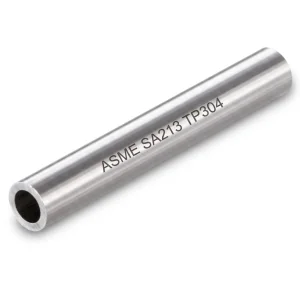



Technical Whitepaper: The Science of Low-Carbon 304L (UNS S30403 / 1.4307)
Understanding chemical matrix stabilization, intergranular corrosion mitigation, and high-integrity fabrication specs for industrial tubing infrastructure.
Carbon Control & Intergranular Protection
In standard 304 stainless steel, exposing the metal to temperatures between 800°F and 1500°F (425°C to 815°C) leads to chromium carbide precipitation at the grain boundaries—a phenomenon known as sensitization. This strips chromium from the surrounding matrix, leaving the heat-affected zone (HAZ) susceptible to aggressive intergranular corrosion.
Grade 304L restricts carbon content to a strict maximum of 0.030%. This low carbon chemistry drastically retards chromium carbide formation during welding and stress-relieving thermal operations, eliminating the need for post-weld solution annealing in most industrial installations.
Austenitic Microstructure Stability
With a nominal chemical allocation of 18% Chromium and 8-10% Nickel, 304L exhibits a face-centered cubic (FCC) austenitic crystal structure. This microscopic arrangement imparts exceptional ductility, impact resistance at cryogenic temperatures (down to -196°C), and non-magnetic properties in the annealed state.
Advanced tube manufacturing requires fine-tuning of Nickel and Nitrogen equivalents to balance mechanical yield strength with cold-drawing formability, ensuring zero deformation micro-cracking during tight-radius U-bending.
Mechanical Property Dynamics
While 304L features a slightly lower minimum yield strength (25 ksi / 170 MPa) compared to standard 304 (30 ksi / 205 MPa), modern multi-stage cold drawing and precision nitrogen alloying (such as 304LN) restore mechanical performance while maintaining ultra-low carbon benefits.
Factories adhering to ASTM A213 / ASME SA213 and ASTM A249 standards perform rigorous micro-hardness testing and hydrostatic burst stress validation to verify structural wall integrity under high operating pressures.
Global Industrial Trends: The Evolving Demand for 304L Tubing
How green transition mandates, hydrogen economy infrastructure, and high-purity manufacturing are restructuring global procurement vectors.
Green Energy & Hydrogen Value Chains
As global energy sectors shift toward decarbonization, 304L stainless steel tubing has emerged as a crucial conduit for cryogenic Liquefied Natural Gas (LNG) processing and green hydrogen distribution networks. Its low-temperature toughness prevents hydrogen embrittlement under medium-pressure ambient distribution conditions.
High-Purity Semiconductor & Pharma Demands
The expansion of gigafab semiconductor foundries and biopharmaceutical processing facilities demands ultra-high purity (UHP) fluid handling. 304L tubes subjected to Electropolishing (EP) and Bright Annealing (BA) deliver surface roughness values as smooth as Ra 0.15 µm, preventing bacterial adhesion and particle contamination.
Life Cycle Cost Optimization (LCC)
Global engineering procurement teams are abandoning short-term material cost evaluations in favor of 30-year Life Cycle Cost (LCC) models. 304L tubing reduces maintenance downtime, eliminates frequent chemical flushing, and offers 100% recyclability at end-of-life, directly supporting global corporate ESG metrics.
Global Corporate Procurement Decision Matrix & Standards Alignment
How tier-1 EPC contractors and OEM procurement directors audit manufacturers, verify material certificates, and enforce compliance.
1. Standard Specification Verification
Selecting the correct governing specification is critical to structural safety:
- ASTM A213 / ASME SA213: Seamless Ferritic and Austenitic Alloy-Steel Boiler, Superheater, and Heat-Exchanger Tubes.
- ASTM A249 / ASME SA249: Welded Austenitic Steel Boiler, Superheater, Heat-Exchanger, and Condenser Tubes.
- ASTM A269: Seamless and Welded Austenitic Stainless Steel Tubing for General Service and Sanitary Instrumentation.
- EN 10217-7 / EN 10216-5: European directives for welded and seamless stainless steel tubes for pressure purposes.
2. Material Test Certificate Integrity (MTC)
Distributors and end-users require authentic documentation to avoid counterfeit raw material risks. Leading factories supply EN 10204 3.1 certificates directly linked to master heat numbers. For critical offshore nuclear or subsea installations, third-party inspection (TPI) agency sign-offs (SGS, TUV, Bureau Veritas, Lloyd's Register) yield EN 10204 3.2 validation.
Key MTC data verified includes: Melt Heat Chemistry, PMI (Positive Material Identification), Grain Size Analysis per ASTM E112, Hydrostatic Test Pressure, and Eddy Current Flaw Identification.
3. Tolerances & Dimensional Precision
Automated tube bending and orbital welding machines require tight outer diameter (OD) and wall thickness (WT) consistency. Premium suppliers maintain tolerances significantly tighter than standard ASTM A1016 / A1016M requirements:
- OD Tolerance: ±0.05 mm on precision small-bore instrumentation tubing.
- WT Concentricity: >90% wall uniformity achieved via cold-pilgering and precision drawing.
China Factory 4.0: Supply Chain Resilience & Advanced Manufacturing
How smart manufacturing hubs in China leverage vertical integration, automated cold-drawing, and AI visual quality control to deliver global cost-efficiency.
Continuous Automated Forming & Welding
Modern Chinese stainless steel tube factories deploy multi-head automated TIG (Tungsten Inert Gas), Plasma, and Laser welding lines equipped with real-time seam tracking and inert gas shielding (inner purging with pure Argon) to ensure 100% full-penetration welds without oxidation or porosity.
Hydrogen-Atmosphere Bright Annealing
To maintain an mirror-like, oxide-free surface finish without chemical acid pickling, advanced production lines utilize inline continuous bright annealing furnaces operating under a pure Hydrogen (H2) or Dissociated Ammonia protective atmosphere at 1050°C to 1150°C, followed by rapid cooling.
Clustered Industrial Ecosystem Density
Concentrated industrial tubing centers in Huzhou, Zhejiang, and Jiangsu integrate raw material mother-tube extrusion, cold-pilgering, precision drawing, heat treatment, and port logistics within a 50-mile radius. This geographical density compresses production lead times by 35% to 50% compared to Western counterparts.
Localized Application Scenarios & Technical Case Analysis
Engineering performance evaluations of 304L stainless steel tubing across demanding operational environments.
A. Petrochemical Condensers & Heat Exchangers
Operating Environment: Shell-and-tube heat exchangers handling organic acid mixtures and cooling water at 180°C.
Engineering Solution: ASTM A249 / A213 TP304L U-bent tubes with stress-relieved bend legs. The low carbon content eliminates localized pitting in heat-affected zones, while bright annealing ensures frictionless flow and minimal fouling layer accumulation over 150,000 continuous operating hours.
B. Sanitary Dairy & Bioprocess Transfer Lines
Operating Environment: Continuous Clean-in-Place (CIP) loops utilizing caustic soda and nitric acid sterilizing agents.
Engineering Solution: ASTM A270 TP304L mechanically polished and electropolished tubing with internal surface roughness Ra < 0.4 µm. Crevice-free orbital weldability prevents biofilm accumulation and maintains strict compliance with 3-A Sanitary Standards and FDA guidelines.
C. Cryogenic Fuel Transfer & LNG Terminals
Operating Environment: Liquefied gas containment at temperatures dropping below -162°C under dynamic pressure surging.
Engineering Solution: Seamless ASTM A213 TP304L heavy-wall tubing subjected to Charpy V-notch impact testing at -196°C. The stable FCC crystal matrix exhibits zero ductile-to-brittle transition, preventing catastrophic brittle fracturing under extreme thermal shock.
Stainless Steel Alloy Specification Comparison Matrix
Comparative analysis of chemical chemistry, mechanical strength, and service suitability for engineering material selection.
| Grade Designation | UNS / EN Number | Carbon Max (%) | Chromium (%) | Nickel (%) | Yield Strength Min (MPa) | Primary Industrial Application |
|---|---|---|---|---|---|---|
| 304L | UNS S30403 / 1.4307 | 0.030 | 17.5 - 19.5 | 8.0 - 10.5 | 170 | Welded Heat Exchangers, Food/Pharma, Cryogenics |
| 304 | UNS S30400 / 1.4301 | 0.070 | 17.5 - 19.5 | 8.0 - 10.5 | 205 | General Structural, Decorative, Non-Welded Lines |
| 304H | UNS S30409 / 1.4948 | 0.040 - 0.100 | 18.0 - 20.0 | 8.0 - 11.0 | 205 | High-Temperature Boilers, Refinery Superheaters (>500°C) |
| 316L | UNS S31603 / 1.4404 | 0.030 | 16.0 - 18.0 | 10.0 - 14.0 (Mo 2.0-3.0) | 170 | Marine Environments, Chloride Processing, Acid Tanks |
| 321 | UNS S32100 / 1.4541 | 0.080 | 17.0 - 19.0 | 9.0 - 12.0 (Ti 5xC min) | 205 | Aircraft Exhaust, High-Temp Chemical Oxidation Systems |
High-Performance Stainless Steel & Super Alloy Series
Explore additional factory-direct grade tubing engineered to global industrial specifications.







Frequently Asked Questions (FAQ) — Engineering & Sourcing
Expert insights on metallurgical specifications, manufacturing options, quality testing, and international compliance.
1. What is the fundamental difference between standard 304 and low-carbon 304L stainless steel tubes?
The main difference lies in carbon concentration. Standard 304 contains up to 0.08% Carbon, whereas 304L is restricted to a maximum of 0.030%. This lower carbon level prevents chromium carbide precipitation during welding (sensitization), protecting the heat-affected zone from intergranular corrosion without requiring post-weld solution heat treatment.
2. When should an engineer choose Seamless (ASTM A213) over Welded & Drawn (ASTM A249 / A269) 304L tubing?
Seamless 304L tubing is chosen for extreme high-pressure applications or when pressure vessel design codes (such as ASME Section VIII) mandate zero longitudinal weld seams. However, modern Welded & Drawn (W&D) tubing undergoes cold working and full bright annealing, yielding uniform wall thickness, exceptional concentricity, and lower procurement costs, making W&D the preferred standard for heat exchangers and condensers.
3. Which non-destructive testing (NDT) procedures are performed on 304L heat exchanger tubes before release?
Every tube undergoes 100% Eddy Current Testing (ECT) per ASTM E426 or EN 10246-2 to detect surface and internal flaws. In addition, hydrostatic testing (up to 200 bar) or pneumatic underwater bubble testing is conducted, alongside dimensional laser scanning, air gauge concentricity checks, and Positive Material Identification (PMI).
4. What surface finishes are available for 304L stainless steel tubing, and how do they impact corrosion resistance?
Standard options include Annealed & Pickled (AP), Bright Annealed (BA), Mechanically Polished (Grit 180 to 400), and Electropolished (EP). A smoother surface finish (lower Ra) eliminates microscopic crevices where chlorides gather, significantly boosting resistance to localized pitting and crevice corrosion.
5. What mill certifications and documentation accompany international shipments?
Shipments come standard with an EN 10204 3.1 Mill Test Certificate detailing melt heat chemistry, mechanical yield/tensile tests, elongation, hardness, NDT results, and grain size. EN 10204 3.2 certification co-signed by an independent third-party inspector (TUV, SGS, BV) is available upon request.
