
Explore our inventory of precision-engineered austenitic steels, titanium alloys, and nickel alloy tubes manufactured strictly under ASME SA213, SA249, ASTM B338, and ASTM B515 specifications.








Navigating the distinction between ASTM (American Society for Testing and Materials) and ASME (American Society of Mechanical Engineers) standards is paramount for engineering safety, pressure vessel code compliance, and structural longevity in extreme operational environments.
In modern process industries—spanning petrochemical refineries, supercritical power plants, LNG cryogenic terminals, and marine desalination facilities—tubing failures account for high operational downtime costs and potential safety hazards. Selecting a trustworthy High-Quality ASTM ASME Standard Specialty Tubing Supplier requires deep understanding of material metallurgy, cold pilgering processes, non-destructive examination (NDE) methods, and heat-treatment controls.
Covers seamless ferritic and austenitic alloy-steel boiler, superheater, and heat-exchanger tubes. Demands stringent microstructural grain size verification, high-temperature creep strength, hydrostatic testing, and ultrasonic inspection for high-pressure boilers.
Standard specification for welded austenitic steel boiler, superheater, heat-exchanger, and condenser tubes. Features cold working of the weld seam prior to final bright annealing to eliminate weld seam porosity and match parent metal strength.
Covers seamless and welded Titanium and Titanium Alloy tubes (B338) and Nickel-Chromium-Iron Alloy tubes (B515). Designed for severe chloride pitting, sour gas (H2S), and acidic media resistance beyond traditional stainless steel limits.
| Standard Code | Material Family | Primary Grades Covered | Typical Application Range | Key NDT Quality Controls |
|---|---|---|---|---|
| ASME SA213 / ASTM A213 | Seamless Austenitic | TP304/304L, TP316/316L, TP321, TP347H, TP310H | Superheaters, reheaters, high-pressure steam boilers | Eddy Current (ET), Hydrostatic (up to 300 bar), UT |
| ASME SA249 / ASTM A249 | Welded & Drawn Austenitic | TP316L, TP316Ti, TP304L, 904L (UNS N08904) | Shell and tube heat exchangers, condensers | Weld seam decay test, Flaring, Flattening, ET |
| ASTM B163 / B407 / B444 | Nickel & Cobalt Alloys | Alloy 600, Alloy 625, Alloy 800H/800HT, Alloy C276 | Chemical processing, nuclear steam generators, sour gas | Intergranular Corrosion (ASTM A262 Pr. E), PMI 100% |
| ASTM B338 / ASME SB338 | Titanium & Titanium Alloys | Grade 1 (UNS R50250), Grade 2, Grade 12 (UNS R53400) | Seawater cooling systems, offshore desalination plants | Pneumatic pressure test, Air underwater leak test, ET |
China's modern metallurgical ecosystem has evolved into a powerhouse of high-precision tubing manufacturing. Through end-to-end integration—from Vacuum Induction Melting (VIM) and Electroslag Remelting (ESR) master alloys to multi-roll cold pilgering and continuous bright annealing—Chinese specialty tube manufacturers offer world-class reliability, rapid scalability, and structural cost efficiencies.
Direct sourcing of high-purity mother hollows and raw coils guarantees minimal non-metallic inclusions. Strict control over trace elements like Sulfur (S < 0.005%) and Phosphorus (P < 0.015%) delivers enhanced weldability and pitting corrosion resistance.
By leveraging fully automated tube mill lines, advanced NDT automated sorting, and mature logistics hubs in Shanghai and Zhejiang, global buyers achieve 20% to 35% cost savings without sacrificing material compliance or certification standards.
Equipped with flexible pilger tooling for non-standard ODs and wall thicknesses. Project orders for specialized stainless, duplex, and nickel alloy tubing are dispatched rapidly with complete Third-Party Inspection (TPI by TUV, SGS, BV, Lloyd's).
For international EPCs, system integrators, and OEM boiler manufacturers, procuring specialty tubing requires rigorous compliance verification to prevent premature fatigue, stress corrosion cracking (SCC), or chemical leaching.
A reliable global supplier must fulfill strict quality governance protocols. Every batch of tubing exported under ASTM ASME standards undergoes multi-tier physical, chemical, and dimensional validation:
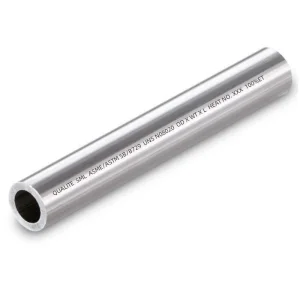
Every individual length of tube is stenciled with Heat Number, Standard, Grade, Dimension, and Manufacturer Logo. Accompanied by EN 10204 3.1 Mill Test Certificates detailing spectral chemical analysis and mechanical pull test results.
Heat treatment performed in 100% pure Hydrogen atmosphere at temperatures exceeding 1050°C. Prevents surface oxidation and carbon depletion, delivering a mirror-like Ra < 0.4 µm inner and outer wall surface without acid pickling contamination.
For shell and tube heat exchanger U-tubes, bending radius (R=1.5D to 1500mm) tolerances comply with ASTM A556/A688. Bending areas undergo localized resistance or furnace heat treatment to relieve residual tensile stresses.
As global energy transition accelerates and heavy chemical processing conditions become increasingly aggressive, specialty tubing design is advancing across three key vectors:
Demand is shifting toward stabilized high-temperature austenitic grades like ASME SA213 TP347H and TP310H. The addition of Niobium (Nb) and Titanium (Ti) forms fine grain carbides, offering long-term creep rupture strength at operating temperatures above 650°C.
Zero-carbon hydrogen infrastructure mandates high-purity 316L and Nickel Alloy (Alloy 625, Alloy 825) seamless tubes with micro-polished bore (Ra < 0.25 µm) to withstand hydrogen embrittlement under high pressures up to 1000 bar.
Desalination and offshore oil platforms are replacing standard 316L with Super Austenitic 904L (UNS N08904) and Titanium Grade 12 (UNS R53400). High Pitting Resistance Equivalent Number (PREN > 42) ensures immune performance in hot chloride marine environments.
Specialty tubing performance is dictated by fluid chemistry, temperature gradients, velocity, and pressure dynamics. Below is a structured engineering alignment matrix:
| Industry Sector | Specific Environment / Process | Recommended Standard & Grade | Metallurgical Advantage |
|---|---|---|---|
| Refining & Petrochemical | Hydrocracking, Ethylene Pyrolysis Furnaces, Catalytic Reforming | ASME SA213 TP347H, TP310H, TP309S | Stabilized against intergranular corrosion at 500°C–850°C; high oxidation resistance. |
| Chemical Processing | Sulfuric, Phosphoric & Hydrofluoric Acid Production | Nickel Alloy C276 (UNS N10276), Alloy 20 (UNS N08020) | Exceptional resistance to strong reducing acids, wet chlorine gas, and ferric chlorides. |
| Thermal Power & Boilers | Superheater Bundles, Feedwater Heaters, Reboilers | ASME SA213 TP316L, ASME SA249 TP304 Seamless/Welded | Uniform wall thickness ensures superior heat transfer coefficients and burst pressure margins. |
| Desalination & Marine | Seawater Evaporators, Shell & Tube Condensers | Titanium Gr. 1 (UNS R50250), Titanium Gr. 12 (UNS R53400) | Complete immunity to chloride pitting, crevice corrosion, and erosion by sand-bearing seawater. |
| High-Purity Bio-Pharma | Clean-in-Place (CIP) Lines, Water-for-Injection (WFI) Piping | ASTM A270 / ASME SA213 TP316L Electro-Polished | Ultra-smooth bore prevents bacterial entrapment and biofilm formation; ultra-low extractables. |
Browse our additional catalog of high-performance nickel alloys, super austenitic steels, and elevated-temperature stainless steel tubing.







Addressing essential engineering queries regarding ASTM vs ASME standard compliance, mill test certifications, NDE testing, and localized logistics support.
