
High-Purity Electropolished & Custom Stainless Tubing
Explore our primary portfolio of custom manufactured austenitic and heat-resistant stainless steel tubes certified for high-pressure, cryogenic, and ultra-pure fluid conveyance.

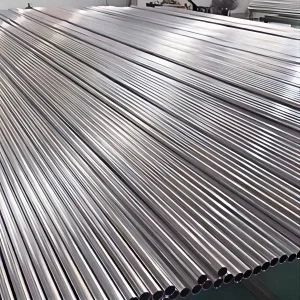

High-Quality Austenitic Steels 321 • UNS S32100 • 1.4541 Manufacturers, Factories
View Product Details
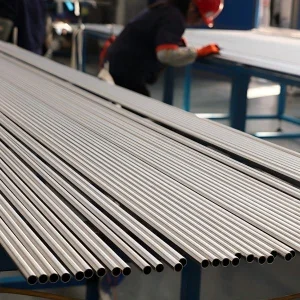

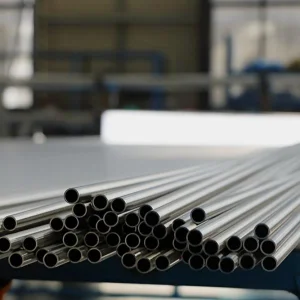

Macro Industrial Landscape: The Escalating Demand for Electropolished Stainless Tubing
A comprehensive metallurgical and commercial analysis of high-purity fluid transfer environments across semiconductor manufacturing, biotechnology, and green hydrogen supply chains.
Sub-Nanometer Semiconductor Fab Drivers
As semiconductor fabrication nodes shrink past 3nm into extreme ultraviolet (EUV) lithography and gate-all-around (GAA) architectures, the sensitivity of process gases to metallic contamination and particle entrapment reaches ultra-critical thresholds. Electropolished (EP) stainless steel tubing—specifically manufactured from vacuum induction melted and vacuum arc remelted (VIM/VAR) 316L stainless steel—serves as the indispensable backbone for ultra-high purity (UHP) gas lines conveying corrosive gases like silane, nitrogen trifluoride, and specialty dopants.
Any microscopic irregularity on the internal surface of unpolished or mechanically polished tubing acts as a catchment site for moisture and sub-micron particulates. Electropolishing eliminates these micro-peaks, producing a mirror-like finish with surface roughness values ($R_a$) routinely certified below $10\ \mu\text{in}$ ($0.25\ \mu\text{m}$) and down to $5\ \mu\text{in}$ ($0.13\ \mu\text{m}$). This minimizes outgassing and particle generation to absolute physical limits.
Biopharmaceutical & Hygienic Process Imperatives
In sterile biopharmaceutical manufacturing, compliance with ASME BPE (Bio-Processing Equipment) standard is non-negotiable. Clean-in-Place (CIP) and Steam-in-Place (SIP) thermal cycling protocols subject process piping to extreme caustic washes and superheated steam. Non-electropolished surfaces harbor microscopic micro-pits where biofilm accumulation, bacterial endotoxins, and protein entrapment occur, triggering catastrophic batch failures.
Electropolishing creates an enriched Chromium-to-Iron ($\text{Cr/Fe}$) ratio on the internal tube surface ($\ge 1.5$), forming a continuous, dense passive chromium oxide layer ($\text{Cr}_2\text{O}_3$). This impenetrable oxide barrier prevents corrosion under aggressive sanitization chemicals while ensuring zero product adherence and frictionless cleaning kinetics.
Electrochemical Mechanism & Surface Metallurgy of Electropolishing
Understanding the anodic dissolution process that converts raw inner-diameter surfaces into ultra-clean, corrosion-resistant passive barriers.
Anodic Dissolution Mechanics
Electropolishing is an electrochemical process opposite to electroplating. The stainless steel tube is submerged in a temperature-controlled bath of phosphoric and sulfuric acids and connected to the positive terminal (anode) of a DC power supply. As electrical current flows, metal ions dissolve from the surface. Microscopic high points (peaks) experience higher current density than valleys, causing selective removal of surface roughness and creating a true planar surface.
Passive Layer Thickening
During anodic dissolution, iron is preferentially extracted from the crystal lattice compared to chromium. This preferential dissolution enriches the surface layer with chromium. When exposed to clean air or secondary chemical passivation (ASTM A967 / ASTM B912), the enriched surface reacts instantly with oxygen to form a dense, uniform oxide layer ($\text{Cr}_2\text{O}_3$) ranging from $20\text{ \AA}$ to $50\text{ \AA}$ in thickness, preventing hydrogen embrittlement and chloride-induced pitting.
Stress Relief & Micro-Crack Elimination
Mechanical grinding or polishing leaves behind a disturbed, cold-worked surface layer known as the Beilby layer, filled with micro-cracks, embedded abrasives, and residual tensile stresses. Electropolishing chemically removes this damaged metallic skin, exposing the undisturbed crystalline grain structure. This stress-relieved condition drastically reduces stress corrosion cracking (SCC) risks in high-temperature or aggressive cyclic load systems.
| Alloy Grade | UNS / EN Designation | Surface Finish ($R_a$) | Primary Regulatory Compliance | Core Application Domain |
|---|---|---|---|---|
| 316L VIM/VAR | UNS S31603 / 1.4404 | ≤ 5 µin (0.13 µm) EP | SEMI F19, ASME BPE SF4 | UHP Semiconductor Gas Distribution |
| 316L Standard | UNS S31603 / 1.4404 | ≤ 10 µin (0.25 µm) EP | ASME BPE SF1, ASTM A270 | Biopharmaceutical WFI & CIP Lines |
| 304L Austenitic | UNS S30403 / 1.4307 | ≤ 15 µin (0.38 µm) EP | ASTM A269, 3-A Sanitary | Hygienic Food, Beverage & Dairy |
| 254 SMO Super Austenitic | UNS S31254 / 1.4547 | ≤ 15 µin (0.38 µm) EP | NACE MR0175, EN 10216-5 | Desalination & High-Chloride Chemical |
| Duplex 2205 | UNS S32205 / 1.4462 | ≤ 20 µin (0.51 µm) EP | ASTM A789, PED 2014/68/EU | Offshore Oil & Gas Skid Piping |
| Nickel Alloy 625 | UNS N06625 / 2.4856 | ≤ 20 µin (0.51 µm) EP | ASTM B444, ASME SB444 | Extreme Acid Exhaust & Aerospace Systems |
International Standards Compliance & Localized Quality Governance
How our precision manufacturing processes adhere strictly to North American, European, and Asia-Pacific industrial norms to ensure seamless supply chain integration.
Verification Protocols & Spectroscopy
To validate electropolishing efficiency beyond simple profilometry, advanced surface diagnostic techniques are executed in accordance with international protocols:
- Auger Electron Spectroscopy (AES): Determines oxide layer depth profile and verifies the $\text{Cr/Fe}$ atomic ratio ($\ge 1.5$) and chromium oxide thickness ($\ge 20\text{ \AA}$).
- X-ray Photoelectron Spectroscopy (XPS): Quantifies chemical state distributions of oxide compounds, confirming complete elimination of free iron and manganese inclusions.
- Scanning Electron Microscopy (SEM): Inspects inner diameter surface morphology at up to 10,000x magnification to guarantee zero micro-pitting, etch lines, or grain boundary attack.
- ASTM B912 Passivation Verification: Standard test methods for evaluating electropolished stainless steel surfaces via Ferroxyl testing and water immersion tests.
Ultra-Clean Cleanroom Packaging Protocols
A high-quality electropolished tube is useless if contaminated during storage or transit. All EP tubes undergo multi-stage ultrasonic deionized water rinsing ($18.2\text{ M}\Omega\cdot\text{cm}$ resistivity) before entering an ISO Class 4 (Class 10) Cleanroom for final inspection, purging, and packaging.
Tubes are purged with high-purity filtered Nitrogen gas (99.9999% purity), fitted with ultra-clean color-coded vinyl end caps (blue for EP ID/OD, yellow for EP ID only), sealed in double-layered anti-static polyethylene bags, and boxed in reinforced wooden crates engineered for overseas maritime and air transport.
Engineering Case Scenarios: Electropolished Tubing in Action
Real-world applications where EP stainless tubing eliminates operational risks, reduces maintenance downtime, and secures high-purity media integrity.
Semiconductor Bulk Gas Mains
In mega-fab construction across North America, East Asia, and Europe, EP 316L VIM/VAR tubing is welded using automated orbital TIG equipment under argon purge. The ultra-smooth inner surface prevents trace moisture retention, ensuring that corrosive gases like hydrogen chloride ($\text{HCl}$) do not react with residual water to form hydrochloric acid, which would otherwise breach line integrity.
Biopharmaceutical WFI Loops
Continuous recirculation loops for Water-for-Injection (WFI) operate at elevated temperatures ($80^\circ\text{C}$). Electropolished 316L tubing installed in accordance with ASME BPE SF4 prevents Rouging (the accumulation of red-brown iron oxide debris). Smooth geometry minimizes shear forces on fragile biological macromolecules and cell cultures.
Hydrogen Refueling Infrastructure
At high-pressure green hydrogen refueling stations operating at $70\text{ MPa}$ ($10,000\text{ psi}$), hydrogen embrittlement poses severe structural hazards. Heavy-wall electropolished 316/316L seamless tubing eliminates microscopic micro-cracks on the inner wall, eliminating stress concentration points where atomic hydrogen can collect and induce brittle fracture.
Technology Roadmap & Next-Generation Innovations (2026–2035)
Advancing electropolishing parameters through artificial intelligence, real-time chemical bath sensing, and sub-atomic passivation layers.
AI-Controlled Pulse EP Bath Control
Implementing real-time electrolyte concentration monitoring and adaptive pulse current waveforms to guarantee $R_a < 3\ \mu\text{in}$ on small-bore tubing ID ($< 1/8\text{ inch}$).
Atomic Layer Deposition (ALD) Hybrids
Integrating ALD nanocoatings directly over electropolished surfaces to create ultra-thin alumina or silica barriers for maximum resistance against fluorinated gases.
Eco-Friendly Non-Acid Electrolytes
Pioneering sustainable, low-toxicity ionic liquid electrolytes that replace traditional sulfuric/phosphoric acid baths while keeping identical metal dissolution rates.
Quantum Metrology In-Line Inspection
Deploying optical coherence tomography and non-contact quantum laser sensors for 100% continuous full-length inner-wall surface roughness mapping.
Specialty Austenitic, Duplex & Nickel Alloy Tubing Series
Browse our high-performance corrosion resistant seamless and welded tubing solutions engineered for severe chemical processing and thermal management environments.
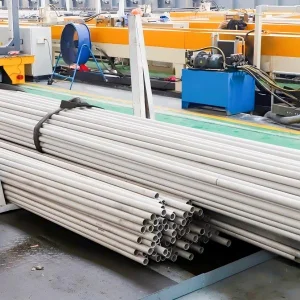

High-Quality Super Austenitic Steels 254SMO • UNS S31254 • 1.4547 Factory, Factories
View Product Details

High-Quality Super Duplex Steels 32760 • S32760 • 1.4501 Manufacturers, Suppliers
View Product Details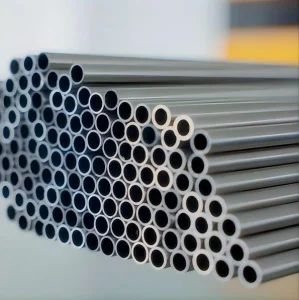
High-Quality ASME SA249 TP304 Welded Stainless Steel Tubes Manufacturer, Suppliers
View Product Details
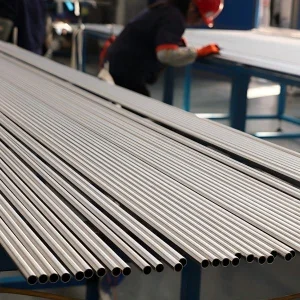

High-Quality Nickel Alloy Tubes 800HT • UNS N08811 • 1.4959 Manufacturer, Product
View Product DetailsTechnical & Procurement Q&A: Electropolished Stainless Tubing
Engineering answers to critical questions regarding specifications, surface metrics, chemical resistance, and quality documentation.
What is the fundamental technical difference between MP (Mechanical Polish), BA (Bright Annealed), and EP (Electropolished) tubing?
Mechanically Polished (MP) tubing uses abrasive belts or compounds to reduce wall roughness; however, it leaves cold-worked metallic debris and directional micro-scratches. Bright Annealed (BA) tubing is heat-treated in a reducing hydrogen atmosphere to produce a smooth finish without oxidation, but it retains the original surface micro-geometry. Electropolished (EP) tubing combines chemical dissolution and electrical current to remove micro-peaks electrochemically, producing a non-directional planar surface ($R_a \le 5\text{–}10\ \mu\text{in}$), enriching the chromium-to-iron ratio ($\text{Cr/Fe} \ge 1.5$), and completely removing mechanical stress layers.
Why is 316L VIM/VAR chemistry mandatory for semiconductor UHP electropolished tubing?
Standard 316L air-melted steel contains non-metallic inclusions such as manganese sulfides ($\text{MnS}$) and oxides. During electropolishing, these inclusions dissolve faster than the surrounding steel matrix, leaving micro-voids or pit holes that trap moisture and specialty gas molecules. Vacuum Induction Melting followed by Vacuum Arc Remelting (VIM/VAR) minimizes non-metallic inclusions, ensuring a uniform crystal structure capable of achieving a defect-free mirror surface with zero particle entrapment sites under SEM evaluation.
How does Electropolishing comply with ASME BPE standards for biopharmaceutical equipment?
ASME BPE categorizes internal surface finishes into SF classifications. For example, ASME BPE SF4 requires a maximum surface roughness $R_a$ of $15\ \mu\text{in}$ ($0.38\ \mu\text{m}$) achieved via electropolishing. Electropolishing meets ASME BPE by eliminating bacterial attachment sites, preventing rouge formation, ensuring compatibility with CIP/SIP sanitization cycles, and guaranteeing full traceability via EN 10204 3.1 Material Test Certificates (MTCs).
What quality assurance inspection reports are provided with EP stainless steel tubing orders?
Every shipment is accompanied by comprehensive documentation: EN 10204 3.1 or 3.2 Mill Test Certificates detailing chemical composition and mechanical properties, Surface Profilometer $R_a$ measurement logs, Auger Electron Spectroscopy (AES) passive layer analysis reports, Eddy Current and Hydrostatic test certificates, Helium Leak Test reports ($1\times 10^{-9}\text{ atm}\cdot\text{cc/sec}$), and Cleanroom ISO Class 4 packaging compliance declarations.
Can electropolished stainless steel tubing be welded without destroying the surface finish?
Yes. EP tubing is routinely joined using automated orbital TIG (GTAW) welding equipment inside cleanroom conditions. To maintain the electropolished inner surface during welding, high-purity ultra-clean backing gas (typically 99.9999% argon) must purge the interior to prevent thermal tint oxide formation. Proper heat input control preserves the smooth surface geometry and prevents chromium depletion in the Heat-Affected Zone (HAZ).
What are the standard size ranges and custom fabrication options available for EP tubing?
Standard imperial sizes range from $1/8\text{ inch}$ to $6\text{ inches}$ Outside Diameter (OD) with wall thicknesses from $0.028\text{ inch}$ to $0.109\text{ inch}$. Metric dimensions span from $3.00\text{ mm}$ to $150.00\text{ mm}$ OD. Custom options include continuous bright-annealed straight lengths up to $25\text{ meters}$, coiled lines, pre-cleand U-bends for heat exchangers, and precision face-seal end pre-fabrications.
