
Explore our certified precision tubing products designed for extreme chemical processing, heat exchangers, and high-pressure steam boilers.

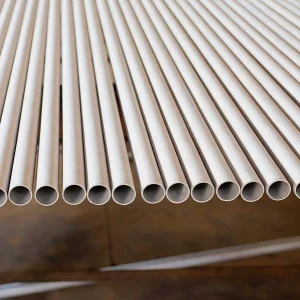



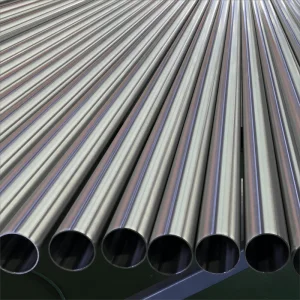
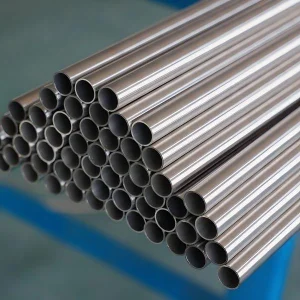
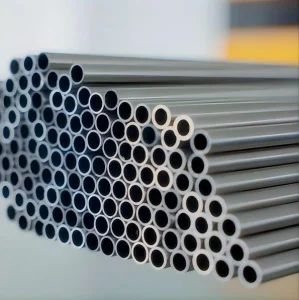
In high-stakes industrial processing, Titanium Grade 7 (UNS R52400 / 3.7235) represents the pinnacle of unalloyed titanium resistance. Chemically and mechanically equivalent to Commercially Pure Grade 2 Titanium, Grade 7 incorporates a deliberate micro-alloying addition of 0.12% to 0.25% Palladium (Pd). This minimal addition fundamentally transforms the alloy’s electrochemical behavior, elevating its corrosion resistance in reducing acid media and high-temperature crevice conditions where standard Grade 2 titanium suffers catastrophic passivity breakdown.
The Palladium Passivation Mechanism
Unalloyed titanium relies on a naturally formed, self-healing oxide film ($\text{TiO}_2$, Rutile/Anatase) for protection. However, in low-pH reducing acids (such as Hydrochloric acid, Sulfuric acid, Phosphoric acid) or stagnant halide solutions where oxygen is depleted, this passive film dissolves, triggering rapid uniform or localized corrosion.
When Palladium is micro-alloyed into the titanium matrix, it acts as a low-overpotential cathodic site. During initial chemical attack, titanium dissolves preferentially, causing a tiny enrichment of palladium nanoparticles on the tube surface. These palladium sites promote hydrogen evolution at significantly noble potentials, shifting the corrosion potential ($E_{corr}$) of the alloy back into the passive region of the titanium phase diagram. Consequently, the protective $\text{TiO}_2$ oxide layer spontaneously reforms even under aggressive reducing environments.
Crevice Corrosion Immunity
In heat exchangers, tube-to-tubesheet joints, and gasketed flanges, crevice corrosion is a primary mode of failure. Under elevated temperatures ($>70^\circ\text{C}$), oxygen depletion within tight crevices causes $\text{pH}$ levels to drop drastically due to metal ion hydrolysis, while chloride ions migrate into the gap.
While standard Grade 2 titanium suffers severe pitting and crevice breakdown under these conditions, Titanium Grade 7 demonstrates virtual immunity to crevice corrosion in high-salinity solutions up to 260°C. This makes Grade 7 tubing the definitive material choice for high-temperature brine, chlor-alkali production, and sour gas handling.
Comparative Alloy Matrix: Titanium Grade 7 vs. Alternate Engineering Grades
| Property / Grade | Grade 1 (UNS R50250) | Grade 2 (UNS R50400) | Grade 7 (UNS R52400) | Grade 12 (UNS R53400) | Hastelloy C276 (N10276) |
|---|---|---|---|---|---|
| Nominal Composition | Unalloyed Ti (Low O) | Unalloyed Ti (Standard) | Ti + 0.12-0.25% Pd | Ti + 0.3% Mo + 0.8% Ni | Ni-16Mo-16Cr-4W |
| Tensile Strength (MPa) | 240 min | 345 min | 345 min | 483 min | 690 min |
| Yield Strength 0.2% (MPa) | 170 - 310 | 275 - 450 | 275 - 450 | 345 min | 283 min |
| Density ($\text{g/cm}^3$) | 4.51 | 4.51 | 4.51 | 4.51 | 8.89 |
| Crevice Corrosion Temp Limit (Brine) | < 70°C | < 80°C | > 260°C | ~ 170°C | ~ 120°C |
| Reducing Acid Resistance | Poor | Moderate | Exceptional | Good | Excellent |
The demand for seamless and welded Titanium Grade 7 Tubes has experienced robust growth globally, driven by stringent environmental regulations, aggressive processing chemistry, and the high financial cost of unscheduled plant shutdowns. Engineers across Europe, North America, the Middle East, and Asia-Pacific are increasingly specifying Grade 7 tubing for life-critical heat transfer equipment.
Purified Terephthalic Acid (PTA) Plants
PTA production involves highly corrosive acetic acid, bromides, and elevated operating temperatures ($180^\circ\text{C}-220^\circ\text{C}$). Standard stainless steels and nickel alloys fail rapidly due to stress corrosion cracking and pitting. Titanium Grade 7 tubes in PTA reactors and condensers deliver multi-decade reliability.
Chlor-Alkali & Wet Chlorine Processing
In electrolysis plants producing chlorine gas and caustic soda, equipment faces saturated brine and hot wet chlorine gas. Grade 7 titanium tubes resist both anodic oxidation and acidic crevice conditions inside titanium heat exchangers and chlorine coolers.
Hydrochloric & Sulfuric Acid Pickling
Steel pickling lines and chemical recovery systems utilize heating coils and heat exchangers immersed in dilute $\text{HCl}$ and $\text{H}_2\text{SO}_4$. Grade 7 tubes provide superior corrosion rates ($<0.01\text{ mm/year}$) in non-oxidizing acids compared to high-silicon iron or graphite heaters.
Desalination & High-Temperature MSF
Multi-Stage Flash (MSF) and Multi-Effect Distillation (MED) desalination plants operating at top brine temperatures ($>110^\circ\text{C}$) utilize thin-walled Titanium Grade 7 seamless tubes to withstand high flow velocities, erosion-corrosion, and heavy sulfide pollution in sea feed waters.
Geothermal Power Generation
Geothermal fluids contain complex dissolved salts, hydrogen sulfide ($\text{H}_2\text{S}$), carbon dioxide ($\text{CO}_2$), and heavy chlorides under high pressure. Grade 7 tubes in heat exchangers prevent scaling-induced crevice corrosion and stress corrosion cracking.
Pharmaceutical & Specialty Fine Chemicals
High-purity organic synthesis involving halide catalysts requires corrosion-resistant metallic piping to prevent ion contamination of active pharmaceutical ingredients (APIs). Grade 7 provides metal-purity assurance without product leaching.
As the world’s largest producer and refiner of industrial titanium, modern Chinese specialty mills have integrated advanced metallurgical infrastructure, cold-drawing automation, and stringent quality control protocols. This industrial cluster provides global engineering buyers with unmatched technical compliance, scale efficiency, and rapid execution.
Integrated Vacuum Arc Remelting (VAR) & Sponge Quality
The foundation of exceptional Grade 7 tubing lies in ingot purity. Advanced Chinese production facilities employ triple Vacuum Arc Remelting (3X VAR) technology. Micro-alloying with high-purity palladium sponge is executed under computer-controlled vacuum parameters to guarantee zero macro-segregation and homogeneous palladium distribution throughout the titanium matrix.
- Strict control of interstitial elements ($\text{Fe} \le 0.12\%$, $\text{O} \le 0.18\%$, $\text{H} \le 0.015\%$).
- 100% Ultrasonic Testing (UT) of heavy blooms before tube extrusion.
- Grain size refinement achieved through controlled hot extrusion and intermediate cold rolling stages.
Precision Cold Pilgering & Inert Gas Bright Annealing
Seamless Titanium Grade 7 tubes are fabricated using high-precision LG-series cold pilgering mills, achieving ultra-tight wall thickness concentricity ($<\pm 8\%$) and flawless surface roughness ($\text{Ra} \le 0.4\,\mu\text{m}$).
Post-forming thermal treatment is conducted in continuous vacuum or ultra-pure argon atmosphere bright annealing furnaces at 680°C - 720°C. This eliminates surface oxidation, preserves micro-palladium dispersion, and restores full ductility for tube-sheet expanding and U-bending operations.
When ordering Titanium Grade 7 Tubes for critical heat transfer or process piping systems, international procurement teams must verify full alignment with international material standards, non-destructive testing requirements, and mill test certification protocols.
Primary International Manufacturing Standards
Standard Specification for Seamless and Welded Titanium and Titanium Alloy Tubes for Condensers and Heat Exchangers.
Standard Specification for Titanium and Titanium Alloy Seamless Pipe for general corrosion resisting and elevated-temperature service.
European specification for seamless titanium tubes with strict dimensional tolerances and pressure vessel certification.
ASTM B338 Grade 7 Chemical & Mechanical Specification Limits
| Element / Parameter | Standard Weight Percentage (%) | Mechanical Property | Specified Min / Max Limit |
|---|---|---|---|
| Palladium (Pd) | 0.12 - 0.25 % | Tensile Strength, min | 345 MPa (50,000 psi) |
| Iron (Fe) | 0.30 % max | Yield Strength (0.2% offset) | 275 - 450 MPa (40,000 - 65,000 psi) |
| Oxygen (O) | 0.25 % max | Elongation in 2 in (50mm), min | 20 % |
| Carbon (C) | 0.08 % max | Flattening Test | No cracking when $H = \frac{(1+e)t}{e+t/D}$ |
| Nitrogen (N) | 0.03 % max | Flaring Test | 15% expansion minimum without failure |
| Hydrogen (H) | 0.015 % max | NDT Inspection | 100% Eddy Current (ECT) & Hydrostatic/Pneumatic |
| Titanium (Ti) | Balance | Mill Certificate | EN 10204 3.1 / 3.2 (Independent Third-Party) |
While the initial CAPEX for Titanium Grade 7 tubing includes the premium cost of palladium micro-alloying, engineering procurement managers must evaluate the total Life-Cycle Cost (LCC) over a 20 to 30-year operational horizon. Unscheduled downtime in chemical plants can cost upwards of $100,000 per day in lost production.
Failure Rate in Hot Acid / Chloride Environments
In hot brine and dilute acid heat exchangers, lower-tier alloys exhibit short service intervals:
- 316L Stainless Steel: Fails within 6 - 18 months due to Chloride Stress Corrosion Cracking (CSCC).
- Super Duplex 2507: Suffers crevice corrosion within 2 - 4 years at temperatures $>110^\circ\text{C}$.
- Titanium Grade 2: Experiences localized crevice failure in tight tubesheet joints within 3 - 5 years.
- Titanium Grade 7: Maintains zero measurable corrosion rate after 25+ years of continuous service.
ROI Calculation Formula & Maintenance Savings
The total life-cycle cost model is defined as:
LCC = C_ic + C_in + C_e + C_o + C_m + C_s - C_res
Where $C_{ic}$ is initial material acquisition, $C_{m}$ is maintenance cost, and $C_{s}$ is shutdown loss. Because Grade 7 eliminates retubing labor, bundle replacements, and lost throughput, the payback period for Titanium Grade 7 over Grade 2 or Nickel Alloy C276 is typically achieved within 14 to 22 months of plant operation.
Mechanically and dimensionally, Titanium Grade 2 and Grade 7 are identical, exhibiting similar yield strength (275-450 MPa) and tensile strength (345 MPa). The critical chemical difference is the addition of 0.12% to 0.25% Palladium in Grade 7 (UNS R52400). This palladium addition extends the material’s corrosion resistance into reducing acid media (dilute $\text{HCl}$, $\text{H}_2\text{SO}_4$) and elevates the crevice corrosion threshold temperature from 80°C up to over 260°C in saturated chloride solutions.
Yes, Titanium Grade 7 possesses excellent weldability using Gas Tungsten Arc Welding (GTAW / TIG) or plasma arc welding. Because titanium oxidizes rapidly at temperatures above 400°C, strict inert gas shielding is mandatory. The weld pool, trailing weld bead, and inner tube bore must be protected with high-purity Argon (99.999% purity) using a trailing shield and secondary purging to prevent oxygen or nitrogen embrittlement.
Both options are governed by ASTM B338. Seamless tubes (cold drawn from extruded hollows) are preferred for extreme high-pressure applications or where end-user design codes strictly prohibit longitudinal weld seams. Welded and cold-drawn (W&D) tubes, fabricated from precision rolled strip and redrawn, offer exceptional wall uniformity, tighter concentricity, and cost advantages for standard shell-and-tube heat exchangers.
Every production lot is dispatched with an EN 10204 3.1 Material Test Certificate (MTC) detailing melt heat chemical analysis, mechanical property test results (tensile, yield, elongation), flattening and flaring results, 100% Non-Destructive Testing (Eddy Current Testing / Hydrostatic), and dimensional inspection reports. EN 10204 3.2 certificates issued by third-party agencies (TÜV, Lloyd’s Register, SGS, BV) are available upon request.
Yes. Grade 7 tubes in the fully annealed condition possess high ductility (minimum 20% elongation). They are easily expanded into tubesheets via roller expanding or hydraulic expansion techniques. For U-bend configurations, bending is performed cold, and post-bend stress-relief annealing in an inert atmosphere is performed on the bend area when specified by ASME design codes.
Complete your system design with our extended range of super austenitic, super duplex, and nickel alloy tubular products.






Partner with a Certified Titanium Grade 7 Tubing Manufacturer
Whether you require ASTM B338 seamless tubes for a PTA plant heat exchanger overhaul or custom-bent U-tubes for a high-temperature chlor-alkali facility, our engineering metallurgical team delivers fully certified, defect-free tubular solutions.
