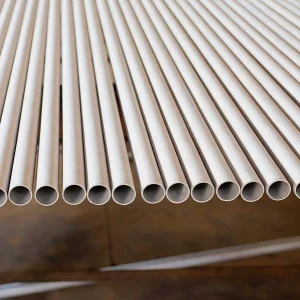
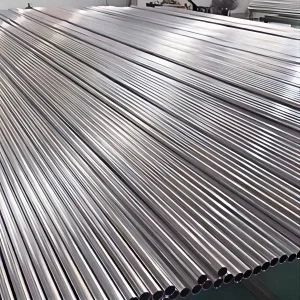
High-Performance Alloy & Stainless Tubing Solutions
Directly sourced mill-certified tubing engineered to withstand extreme corrosion, high thermal loads, and rigorous industrial pressure ratings.








Grade 2 Titanium Tubing: Metallurgical Anatomy & Performance Boundaries
Commercially Pure (CP) Grade 2 Titanium (UNS R50400 / Werkstoff 3.7035) serves as the undisputed benchmark material for extreme fluid handling and aggressive thermochemical environments.
Self-Healing Passive Oxide Layer
The operational reliability of Grade 2 Titanium stems from its spontaneous formation of a tenacious, highly adherent, protective surface oxide film (primarily TiO₂). When exposed to oxygen in aqueous or atmospheric environments, damaged oxide films re-passivate instantaneously, rendering the tubing practically immune to pitting and crevice corrosion in chloride environments up to 300°C.
Optimized Strength-to-Weight Ratio
With a density of only 4.51 g/cm³—roughly 56% that of stainless steels or nickel alloys—Grade 2 Titanium delivers yield strengths equivalent to standard austenitic grades (275–450 MPa). This structural efficiency enables thinner wall tube designs (down to 0.40 mm), dramatically boosting overall thermal conductivity in multi-pass heat exchangers.
Interstitial Chemical Equilibrium
Strict control over interstitial elements (Iron ≤ 0.30%, Oxygen ≤ 0.25%, Carbon ≤ 0.08%, Nitrogen ≤ 0.03%, Hydrogen ≤ 0.015%) guarantees exceptional cold ductility and impact toughness. This allows tight-radius bending, expandability into tube-sheets, and crack-free orbital TIG seam welding.
Titanium Grade 2 vs. Alternative Industrial Alloy Tubing
Selecting the right material requires evaluating chemical stability, corrosion immunity, thermal efficiency, and lifecycle ROI against conventional stainless steels and super alloys.
| Material Grade | UNS Standard | Yield Strength (MPa) | Pitting Resistance (PREN) | Seawater Resistance | Primary Industrial Utility |
|---|---|---|---|---|---|
| Titanium Grade 2 (CP) | UNS R50400 | 275 - 450 | Immune (Oxide Passivation) | Superior (> 30 Years) | Desalination, Surface Condensers, Marine & Chlor-Alkali |
| Stainless Steel 316L | UNS S31603 | ≥ 170 | ~ 24 | Poor (Prone to Crevice Corrosion) | Dairy, General Chemical, Low-Chloride Fluid Transfer |
| Super Duplex 2507 | UNS S32750 | ≥ 550 | ≥ 42 | High (High Cost & Weight) | High-Pressure Offshore Oil & Gas Topsides |
| Super Austenitic 6Mo (S31254) | UNS S31254 | ≥ 300 | ≥ 43 | High | Flue Gas Desulfurization (FGD), Pulp Bleaching |
| Nickel Alloy 625 | UNS N06625 | ≥ 415 | ≥ 51 | Excellent (High Density / Heavy) | High-Temperature Aerospace & Nuclear Reactor Components |
*Note: Grade 2 Titanium relies on a passive oxide film (TiO2) which renders standard PREN formulas obsolete; it exhibits zero measurable corrosion rate in stagnant seawater up to 120°C.
Localized Field Applications & Real-World Operating Environments
From coastal desalination mega-projects to heavy chemical synthesis, Grade 2 Titanium tubes eliminate catastrophic corrosion failures.
1. Desalination Plants (MSF, MED & Reverse Osmosis)
In Multi-Stage Flash (MSF) and Multi-Effect Distillation (MED) evaporators operating across the Middle East and Mediterranean, seawater brine velocity can exceed 2.5 m/s at elevated temperatures. Grade 2 Titanium seamless and welded-and-drawn (W&D) tubes resist impingement attack, micro-fouling, and sulfide-induced erosion, maintaining heat transfer efficiency for 30+ years without wall degradation.
2. Chlor-Alkali & Chemical Processing Facilities
Titanium Grade 2 tubing is indispensable in wet chlorine gas cooling, chlorine dioxide bleaching towers, and nitric acid recovery lines. Its immunity to oxidizing acids and chlorate solutions prevents pitting and intergranular failure that quickly destroy 316L and 904L stainless steels, ensuring zero-leakage chemical compliance.
3. Power Station Steam Surface Condensers
Nuclear and fossil-fuel thermal power stations situated on coastal waters use raw seawater for turbine exhaust steam condensation. Grade 2 titanium tubes eliminate tube-to-tubesheet joint leaks, protecting steam turbines against chloride contamination and costly unscheduled shutdowns.
4. Offshore Oil & Gas Topside Heat Exchangers
On FPSO vessels and fixed offshore platforms, weight reduction directly translates to structural cost savings. Utilizing Grade 2 thin-walled titanium tubes inside shell-and-tube heat exchangers reduces topside skid mass by up to 45% compared to heavy copper-nickel or duplex steel alternatives.
China's Supply Chain Resilience & Production Efficiency
Combining raw titanium sponge reserves with advanced cold-pilgering, vacuum heat treatment, and fully automated non-destructive testing (NDT).
Upstream Raw Sponge Integration
China accounts for over 50% of the world's titanium sponge production capacity. Our factories directly partner with tier-1 smelters, utilizing Vacuum Arc Remelting (VAR) and Electron Beam (EB) hearth refining to ensure chemical homogeneity, zero inclusions, and minimal gas content before ingot processing.
Multi-Stage Cold Pilgering & Vacuum Annealing
Using ultra-precise multi-roll cold pilger mills, tube dimensions are forged to precise outer diameter (OD: 4.00 to 114.30 mm) and wall thickness (WT: 0.40 to 3.05 mm) tolerances. Bright vacuum annealing at 650°C–700°C eliminates residual stresses while maintaining a mirror-finish surface without oxidation scale.
Rigorous Quality Assurance & Lead Time Control
Every meter of Grade 2 Titanium tube undergoes online Eddy Current Testing (ASTM E426) and Hydrostatic testing up to 20 MPa. Our streamlined manufacturing hubs in Zhejiang and Shanghai support agile scheduling, enabling 3-to-4-week lead times for custom length (up to 25m) and U-bend orders.
End-to-End Titanium Tube Manufacturing Roadmap
A transparent, fully traceably documented workflow ensuring full compliance with ASTM B338, ASTM B861, and ASME SB338 standards.
Phase 1: Vacuum Melting & Ingot Spectroscopy
Double or triple VAR melting of premium Grade 2 sponge titanium. X-ray fluorescence (XRF) and chemical emission spectroscopy verify elemental purity prior to forging extrusion billets.
Phase 2: Hot Extrusion & Cold Reduction Processing
Extrusion of heavy-wall hollows followed by multi-pass cold pilgering or precision strip roll-forming with automated inert-gas TIG/Laser seam welding.
Phase 3: High-Vacuum Recrystallization Annealing
Tubes pass through vacuum heat treatment furnaces (10⁻⁴ Torr) to restore full grain ductility without surface hydrogen embrittlement or oxide scale formation.
Phase 4: Precision Finishing, Bending & NDT Inspection
Straightening, air-under-water pressure testing, ultrasonic boundary scan, dimensional micro-gauge checks, and custom U-bending per client engineering drawings.
Phase 5: EN 10204 3.1 / 3.2 Certification & Export Packaging
Issuance of full material traceability documentation, heat treatment charts, mechanical test results, and ISPM 15 compliant ocean-worthy wooden crate packing.
Technical Roadmap & Next-Generation Titanium Innovations
How advancing metallurgy, additive manufacturing hybridizing, and green energy applications are reshaping titanium tubing demands.
Hydrogen Economy Integration
As green hydrogen electrolyzers scale globally, Titanium Grade 2 and Grade 12 tubing are increasingly chosen for high-purity water supply lines and proton exchange membrane (PEM) stacks due to zero ion contamination and hydrogen resistance under ambient conditions.
Ultra-Thin Wall Cold Pilgering
R&D initiatives focus on achieving consistent wall thicknesses down to 0.25 mm without compromising burst pressure integrity. Ultra-thin wall Grade 2 tubes lower raw material consumption while delivering thermal transfer rates competing directly with traditional brass alloys.
Sustainable Green Manufacturing
Adopting closed-loop recycling for titanium turnings and scrap, coupled with solar-powered vacuum annealing, reduces the embodied carbon footprint of Grade 2 tube manufacturing by up to 35%, assisting global EPCs in meeting Scope 3 decarbonization mandates.
Global Quality Assurance & Localized Engineering Support
We bridge factory-direct precision with localized international engineering assistance and third-party verification.
Full Normative Compliance (ASTM / ASME / EN)
Our Grade 2 Titanium tubes are manufactured in strict compliance with ASTM B338 (for condensers and heat exchangers), ASTM B861 (seamless titanium pipe), ASTM B862 (welded titanium pipe), and ASME SB338 Section VIII Division 1 boiler and pressure vessel code requirements.
Independent Third-Party Inspection (EN 10204 3.2)
In addition to standard EN 10204 3.1 chemical and mechanical mill test reports (MTC), we welcome independent inspection agencies—including SGS, TÜV Rheinland, DNV GL, Bureau Veritas, and Lloyd’s Register—to verify dimensional tolerances, hydro testing, and NDT results prior to packing.
Frequently Asked Questions by Technical Procurement Teams
Answers to common engineering inquiries regarding Titanium Grade 2 selection, manufacturing tolerances, welding, and quality control.
Custom Alloy & Stainless Steel Tubing Portfolio
Explore our full range of heat exchanger, boiler, and corrosion-resistant specialty tubes crafted to exact client drawings.