
Featured Industrial Alloy Tubes (Part I)
High-performance specialty seamless and welded tubing engineered for severe chemical, aerospace, and high-temperature thermal exchange applications.

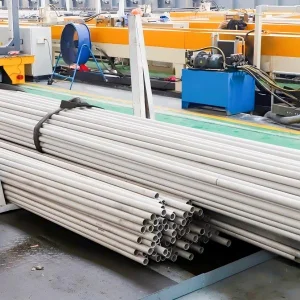






Titanium Grade 9 (Ti-3Al-2.5V): The Ultimate Compromise Alloy
In the hierarchy of titanium tubing alloys, Titanium Grade 9 (UNS R56320 / 3.7194) occupies a uniquely crucial metallurgical space. Positioned precisely between commercially pure grades (Grade 1, Grade 2) and the ultra-high-strength structural titanium alloy Grade 5 (Ti-6Al-4V), Grade 9 provides the ideal synergy of weldability, cold formability, and elevated mechanical strength.
Microstructural Integrity & Alloying Chemistry
Titanium Grade 9 is an alpha-beta titanium alloy containing 3.0% Aluminum and 2.5% Vanadium. The addition of Aluminum acts as an alpha-phase stabilizer, raising the phase transformation temperature and adding solid-solution strength. Vanadium serves as a beta-phase stabilizer, providing cold ductility and enhanced cold-working capabilities. This dual-phase microstructure allows cold pilgering and drawing into high-precision, thin-wall seamless tubes—a process virtually impossible with Grade 5 due to its extreme yield strength and limited room-temperature ductility.
Mechanical Superiority Over Grade 2 & Grade 5
While commercially pure Grade 2 offers exceptional corrosion resistance, its tensile strength (minimum 345 MPa) limits its utility in high-pressure hydraulic and structural tubing. Grade 9 delivers a minimum tensile strength of 620 MPa (86,000 psi) in the annealed condition and up to 860 MPa (125,000 psi) in the Cold Worked Stress Relieved (CWSR) condition, effectively doubling the pressure capacity of Grade 2 while maintaining excellent hydraulic fatigue strength and vibration endurance.
Comparative Alloy Matrix: Titanium Grade 9 vs. Peer Alloys
| Property / Specification | Titanium Grade 2 (CP) | Titanium Grade 9 (Ti-3Al-2.5V) | Titanium Grade 5 (Ti-6Al-4V) | 316L Stainless Steel |
|---|---|---|---|---|
| UNS Designation | UNS R50400 | UNS R56320 | UNS R56400 | UNS S31603 |
| Tensile Strength (Yield, MPa) | 275 MPa | 483 - 758 MPa (CWSR) | 828 MPa | 290 MPa |
| Density (g/cm³) | 4.51 g/cm³ | 4.48 g/cm³ | 4.43 g/cm³ | 8.00 g/cm³ |
| Cold Formability / Tube Drawing | Excellent | Good to Excellent | Extremely Poor | Excellent |
| Chloride Pitting Resistance | Immune (<100°C) | Immune (<250°C) | High | Moderate (PREN ~24) |
| Key Governance Standards | ASTM B338 / ASTM B861 | ASTM B338 / AMS 4943 / AMS 4944 | ASTM B861 / AMS 4928 | ASTM A213 / ASTM A249 |
Global Industry Trends Driving Titanium Grade 9 Demand (2025–2035)
The global market for high-performance titanium tubing is experiencing structural demand growth, driven by deep decarbonization goals, aerospace modernization, and subsea energy transitions.
Commercial Aerospace Expansion
Modern commercial aircraft platforms (such as the Boeing 787 and Airbus A350) feature over 15% titanium by structural weight. Grade 9 titanium tubes are the industry standard for 3,000 psi to 5,000 psi aircraft hydraulic fuel lines and environmental control system (ECS) ducting due to their extreme strength-to-weight ratio and fatigue life.
Desalination & Power Generation
Global water scarcity has catalyzed massive construction of coastal reverse osmosis (RO) and multi-stage flash (MSF) desalination plants. Titanium Grade 9 seamless tubes replace copper-nickel and super duplex alloys in heat exchangers exposed to high-velocity, high-temperature chlorinated seawater.
Green Hydrogen & Electrolyzers
Next-generation Proton Exchange Membrane (PEM) water electrolyzers operate under acidic, oxidizing conditions at high pressures. Titanium Grade 9 tubular conduits provide high chemical stability against hydrogen embrittlement while maintaining structural integrity during cyclic pressure shocks.
Subsea Deepwater Exploration
Offshore oilfield operators are pushing into ultra-deepwater reservoirs (>3,000 meters depth). Grade 9 titanium umbilical lines, downhole pressure tubes, and riser components prevent stress corrosion cracking (SCC) caused by sour gas ($H_2S$) and high-salinity brines.
Global Enterprise Procurement Needs & Quality Verification Intent
B2B procurement leaders and chief engineers searching for "Titanium Tube Grade 9 Suppliers & Factories" are not merely seeking pricing; they are executing a complex risk management audit. Modern procurement workflows focus heavily on vendor verification across five key pillars:
Full Heat Traceability & MTC EN 10204 3.1/3.2
Every structural batch must be backed by authentic Material Test Certificates (MTC). Enterprise buyers require complete ladle chemical analysis, vacuum consumable arc remelting heat numbers, and independent third-party verification (TÜV, Lloyd’s Register, DNV) validating conformance to ASTM B338 / AMS 4943 standards.
Dimensional Precision & Wall Tolerances
For automated orbital welding lines and aerospace hydraulic fittings, standard commercial tolerances are insufficient. Buyers demand tight wall thickness variations (< ±7.5%), ovality control under 0.5%, and ultra-smooth inside diameter (ID) surface roughness ($Ra < 0.4 \mu m$) achieved through internal honing or bright annealing.
100% Non-Destructive Testing (NDT) Protocol
Critical applications require absolute immunity to microscopic micro-cracks or voids. Reliable titanium tube factories integrate dual-frequency Eddy Current Testing (ECT), Hydrostatic Testing (up to 30 MPa), and Ultrasonic Inspection (UT) directly into their continuous cold-rolling mill production lines.
China Industry 4.0: Supply Chain Resilience & Mill Efficiency Advantages
The global supply chain landscape for specialty alloys has undergone a seismic shift. Modernized Chinese manufacturing centers—such as the advanced industrial clusters in Zhejiang and Shaanxi—have integrated smart factory architectures that redefine cost efficiency, quality control, and production scalability for Titanium Grade 9 tubing.
Vertical Integration: Sponge Titanium to Finished Tube
China leads the world in raw titanium sponge capacity. Tier-1 factories utilize fully integrated production lines: starting with Vacuum Arc Remelting (VAR) furnaces to create homogenous Ti-3Al-2.5V ingots, followed by rotary forging of heavy-wall tube hollows, multi-pass cold pilgering mills, and vacuum bright annealing furnaces. This total internal loop eliminates supply chain friction, stabilizes raw material costs, and guarantees 100% heat origin control.
Smart Factory Automation & Digital Twin Traceability
Leading Chinese exporters leverage Industry 4.0 IoT frameworks. Laser micrometer arrays continuously log outer diameter (OD) and wall thickness profiles along every meter of tubing. Digital Twin systems store ultrasonic defect maps linked directly to a QR code on the EN 10204 3.1 MTC, allowing global procurement officers to audit full manufacturing histories remotely in real time.
Localized Industrial Application Scenarios
Engineers specify Titanium Grade 9 seamless and welded tubing across harsh operating environments where failure is not an option. Key field deployments include:
Aerospace Hydraulic Lines
Operating under severe pressure spikes (up to 350 bar) and extreme temperature fluctuations (-55°C to +135°C), Grade 9 cold-worked stress-relieved (CWSR) tubing provides lightweight, high-fatigue hydraulic conduits in commercial and defense aircraft flight control surfaces.
Marine Surface Condensers
Coastal power stations and naval vessels utilize thin-wall Grade 9 welded-and-drawn tubing in steam surface condensers. Grade 9 resists high-velocity seawater erosion-corrosion, impingement attack, and sulfide pollution far superior to brass or 316L stainless steel.
Chemical Process Heat Exchangers
In chemical plants producing nitric acid, organic acids, and oxidizing chlorides, Grade 9 titanium U-bend tubes deliver long-term service life in shell-and-tube heat exchangers, preventing costly unscheduled plant shutdowns.
High-Performance Sports Equipment
Beyond heavy industry, Grade 9 is the premier alloy for elite bicycle frames, motorsport exhaust systems, and wheelchair structures. It offers unparalleled dampening of road vibration combined with exceptional yield strength.
Oilfield Subsea Umbilicals
Deepwater oil and gas operations utilize continuous coiled Grade 9 titanium tubing inside steel umbilical cables to inject chemicals, hydraulic fluids, and corrosion inhibitors directly downhole under extreme external hydrostatic pressures.
Nuclear Power Secondary Circuits
Nuclear energy plants specify Grade 9 seamless tubing in feedwater heaters and steam generator auxiliary systems, leveraging its zero-susceptibility to stress corrosion cracking under high-purity water conditions.
Frequently Asked Questions (FAQ) for Engineers & Buyers
Direct technical insights resolving procurement inquiries regarding Titanium Grade 9 specifications, standards compliance, and manufacturing tolerances.
Featured Industrial Alloy Tubes (Part II)
Complete product lineup including high-temperature heat-resistant stainless steels and stabilized austenitic grades manufactured to ASTM/EN standards.





Accelerate Your Global Titanium Supply Chain Today
Submit your drawing specifications, ASTM/AMS standard requirements, or bill of materials (BOM). Our metallurgical sales engineering team provides formal quotes and technical compliance reviews within 24 hours.
Request Technical Quote