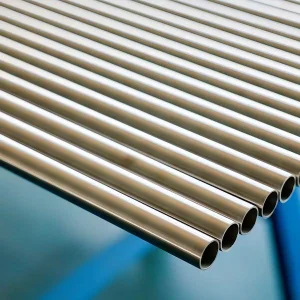
High-Performance Alloys & Specialty Titanium Tubes
Explore our primary inventory of welded and seamless tubes engineered for severe heat transfer, seawater desalination, and aggressive chemical processing environments.

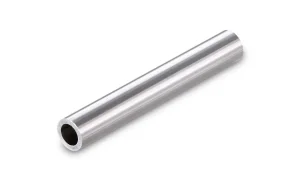



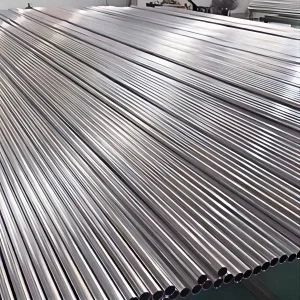
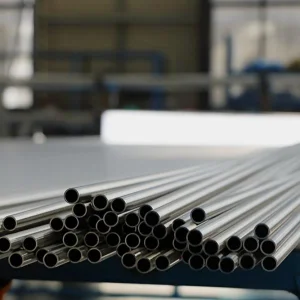

Engineering Metallurgy of Titanium Welded Tubing
An in-depth examination of grain phase control, inert atmosphere shield mechanics, microstructural integrity, and life-cycle durability in aggressive industrial media.
Passivation & TiO₂ Film Stability
Titanium's legendary corrosion resistance relies on the immediate formation of a dense, tenacious, self-healing titanium dioxide ($TiO_2$) passive oxide film. When exposed to oxygen in aqueous environments, this film prevents electron transfer, yielding immunity to pitting in chloride concentrations exceeding 100,000 ppm.
Weld Joint Efficiency ($E = 1.0$)
Through automated Gas Tungsten Arc Welding (GTAW/TIG) and High-Frequency Plasma arc welding, cold-rolled strip is continuously formed and joined. Subsequent cold reduction and vacuum annealing align the weld fusion zone grain structure with the parent metal, restoring joint efficiency to $E = 1.0$.
Inert Shielding Purity Mechanics
Titanium is an active getter material above 400°C, absorbing oxygen, nitrogen, and hydrogen that cause lattice embrittlement. Our processing utilizes multi-stage primary, secondary (trailing cup), and internal purge inert gas chambers maintained at 99.999% pure Argon to guarantee interstitial control.
Historically, engineering codes favored seamless tubing due to joint vulnerability concerns. Modern automated continuous-welding technologies combined with full-body eddy current testing (ASTM E426) and 100% pneumatic/hydrostatic proof testing now yield titanium welded tubes (ASTM B338 Grade 2) with superior wall uniformity, tighter dimensional tolerances, and up to 35% lower total life-cycle procurement costs compared to seamless equivalents.
China Industry 4.0: Supply Chain Resilience & Efficiency Advantage
How Spezilla's Huzhou smart manufacturing ecosystem and Shanghai international logistics hub redefine titanium tube procurement economics.
Vertical Raw Material Traceability
By anchoring our supply chain within China’s premier titanium industrial cluster, Spezilla sources high-purity Kroll-process titanium sponge. Every coil strip undergoes chemical composition analysis via Inductively Coupled Plasma (ICP) optical emission spectroscopy, ensuring iron (Fe) and oxygen (O) contents strictly comply with ASTM B338 Grade 1 (UNS R50250) and Grade 2 (UNS R50400) limits before forming begins.
Automated Continuous Roll-Forming & Vacuum Annealing
Our Huzhou manufacturing facility operates automated multi-stand roll-forming mills integrated with real-time laser wall-thickness measurement and seam positioners. Post-welding, tubes undergo high-vacuum bright annealing at temperatures exceeding 700°C under vacuum levels below $10^{-3}$ Pa. This removes residual stress, restores ductility, and yields a pristine oxide-free bright surface without acid pickling chemical waste.
Macro Industrial Solutions for Critical Environments
Deploying high-reliability titanium and advanced alloy tubing across energy, marine, chemical, and industrial heat exchange infrastructure.
Desalination & Coastal Power Plants
In Multi-Stage Flash (MSF) and Multiple-Effect Distillation (MED) plants, seawater velocity and bio-fouling present severe erosion-corrosion threats. Spezilla Grade 2 titanium welded tubes withstand fluid velocities up to 20 m/s without protective film breakdown, outperforming copper-nickel (CuNi 70/30) and 316L stainless steel by orders of magnitude.
Offshore Oil & Gas / FPSO Units
Weight restrictions on Floating Production Storage and Offloading (FPSO) vessels require high-strength, thin-wall materials. Titanium Grade 2 and Grade 12 welded tubes offer a density of just 4.51 g/cm³—roughly 57% that of steel—enabling total module weight reductions of up to 40% in shell-and-tube heat exchangers.
Chlor-Alkali & Chemical Processing
Titanium tubes are immune to wet chlorine gas, chlorate solutions, and oxidizing media such as nitric acid. Where pitting and stress corrosion cracking (SCC) ruin standard austenitic alloys, Grade 2 and palladium-enhanced Grade 7 provide zero-corrosion allowance design potential.
Technical Roadmap & Future Outlook
Advancing titanium tube manufacturing through laser-arc hybrid joining, microstructural grain refinement, and AI-driven quality assurance.
Laser-Arc Hybrid Welding (LAHW)
Combining deep penetration fiber lasers with precision TIG arcs narrows the Heat-Affected Zone (HAZ) by 60%. This minimizes heat input, prevents excessive grain growth in the beta-phase transformation range, and yields ultimate tensile strengths matching cold-worked parent metal.
Ultrasonic Vibration-Assisted Forming
Integrating high-frequency ultrasonic transducers into the roll-forming tool heads reduces friction coefficients during strip bending. This permits tighter bend radii, eliminates tool surface pickup, and guarantees uniform spring-back control across high-strength titanium alloys.
AI-Driven Online Defect Recognition
Replacing legacy visual inspection, dual-channel high-speed optical vision combined with multi-frequency eddy current sensor arrays scans 100% of the seam weld in real-time. Machine learning algorithms classify micro-discontinuities instantaneously at mill line speeds up to 30 m/min.
Global Enterprise Material Selection Guide
Comprehensive comparison of chemical compositions, mechanical properties, and relative cost indices to guide engineering procurement decisions.
| Grade / Standard | UNS / EN | Nominal Composition | Yield Strength (MPa) | Tensile Strength (MPa) | PREN | Relative Cost Index |
|---|---|---|---|---|---|---|
| Titanium Grade 2 (ASTM B338) | UNS R50400 / 3.7035 | Ti Bal, Fe ≤ 0.30, O ≤ 0.25 | ≥ 275 | ≥ 345 | Immune to Cl⁻ Pitting | 1.00 (Baseline) |
| Titanium Grade 1 (ASTM B338) | UNS R50250 / 3.7025 | Ti Bal, Fe ≤ 0.20, O ≤ 0.18 | ≥ 170 | ≥ 240 | Immune to Cl⁻ Pitting | 1.05 |
| Titanium Grade 12 (ASTM B338) | UNS R53400 / 3.7105 | Ti-0.3Mo-0.8Ni | ≥ 345 | ≥ 485 | High Crevice Res. | 1.35 |
| Super Austenitic 254SMO | UNS S31254 / 1.4547 | 20Cr-18Ni-6.1Mo-0.2N | ≥ 300 | ≥ 650 | PREN ≥ 43 | 1.40 |
| Nickel Alloy 825 | UNS N08825 / 2.4858 | 42Ni-21Cr-3Mo-2Cu | ≥ 241 | ≥ 586 | PREN ≥ 31 | 1.85 |
* Note: Titanium's resistance to chloride pitting is governed by its passive $TiO_2$ surface layer rather than PREN calculations. Relative cost index includes material density savings (Titanium density = 4.51 g/cm³ vs Stainless Steel = 8.0 g/cm³).
Global Compliance & Rigorous NDT Certification
Every length of tube produced by Spezilla undergoes full volumetric, dimensional, and hydrostatic validation backed by international mill test certification.
EN 10204 3.1 & 3.2 Certification
Orders are dispatched with complete EN 10204 3.1 Mill Test Certificates (MTC) detailing heat numbers, raw material melt source, mechanical tensile test data, ring flattening tests, flaring tests, and chemical breakdown. Third-party inspection (TÜV, SGS, DNV, Lloyd's) for EN 10204 3.2 compliance is available upon request.
Non-Destructive Testing (NDT)
Tubes undergo 100% inline Eddy Current Testing (ECT) per ASTM E426 to detect longitudinal and transverse seam imperfections. Hydrostatic proof testing up to 17.5 MPa (or 100% pneumatic air-under-water testing at 0.6 MPa) guarantees zero-leakage reliability under operating pressures.
Export Packaging & Logistics Hub
To safeguard straight lengths up to 25 meters during oceanic transits, tubes are fitted with plastic end caps, bundled with moisture-proof wrapping, and packed into ISPM-15 compliant wooden cases or steel-framed crates. Our Shanghai operations handle export customs clearing seamlessly.
Frequently Asked Technical Questions
Detailed responses to common metallurgical, design, and procurement inquiries from enterprise clients.
What is the primary difference between ASTM B338 Grade 1 and Grade 2 welded tubes?
The main distinction lies in interstitial elemental content, specifically oxygen and iron. Grade 1 (UNS R50250) is the purest unalloyed titanium grade with lowest strength (minimum yield 170 MPa) and highest ductility, making it ideal for extreme tube bending and flaring. Grade 2 (UNS R50400) contains slightly higher oxygen (up to 0.25%) and iron (up to 0.30%), boosting yield strength to minimum 275 MPa while maintaining excellent formability and identical corrosion resistance. Grade 2 is the standard specification for industrial heat exchangers.
How does Spezilla prevent hydrogen embrittlement during titanium tube welding and annealing?
Titanium readily absorbs hydrogen at temperatures above 250°C, forming brittle titanium hydrides ($TiH_2$). Spezilla eliminates this risk by utilizing ultra-pure shielding gas (Argon purity ≥ 99.999%, dew point < -60°C) during automatic TIG welding. In addition, post-weld annealing is executed in high-vacuum furnace chambers maintained below $10^{-3}$ Pa rather than hydrogen-rich or cracked-ammonia atmospheres.
Can titanium welded tubes replace seamless tubes in ASME pressure vessel codes?
Yes. Under ASME Section VIII Division 1 and ASME SB338 specifications, welded titanium tubing is fully recognized. When subject to 100% non-destructive testing (Eddy Current or Radiographic) and supplied with a longitudinal seam joint efficiency factor of $E = 1.0$, welded tubes can be directly substituted for seamless tubes in shell-and-tube heat exchangers, surface condensers, and heaters.
What size dimensions and tolerances can Spezilla achieve for titanium tubes?
Spezilla manufactures titanium welded tubes with outside diameters (OD) ranging from 4.00 mm up to 114.30 mm, with wall thicknesses (WT) from 0.40 mm to 3.05 mm. Dimensional tolerances strictly adhere to ASTM B338 / ASME SB338 standards (e.g., OD tolerance ±0.10 mm for small diameters, WT tolerance ±10%). Custom straight lengths up to 25,000 mm and U-bend tubes are available on request.
Additional Stainless, Duplex & Alloy Tubing Portfolio
Discover our broader range of heat exchanger, hydraulic, and process tubing solutions designed to international ASTM and EN standards.