
Featured Precision Alloy Products
Explore our core manufacturing line of stainless steel, nickel alloy, and specialized non-ferrous tubing engineered for severe chemical, thermal, and marine service environments.







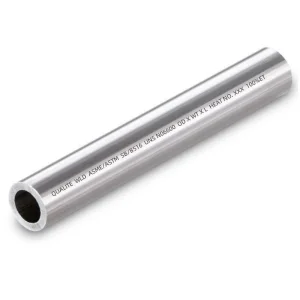
1. Fundamentals of Copper-Nickel Alloys: C70600 (90/10) vs. C71500 (70/30)
Copper-nickel (Cupro Nickel) tubing represents the engineering pinnacle of marine and thermal fluid transfer materials. By blending copper with nickel, iron, and manganese, these alloys exhibit exceptional intrinsic resistance to biofouling, velocity-induced erosion-corrosion, and chloride stress cracking.
UNS C70600 (90/10 CuNi)
Composed of 90% Copper, 10% Nickel, with controlled additions of Iron (1.0–1.8%) and Manganese (1.0%). C70600 is the most widely specified copper-nickel alloy for seawater heat exchangers, power station condensers, and multi-stage flash (MSF) desalination plants due to its optimal balance of high thermal conductivity (45 W/m·K) and robust anti-fouling capabilities.
UNS C71500 (70/30 CuNi)
Contains 70% Copper and 30% Nickel with Iron (0.4–1.0%) and Manganese (1.0%). C71500 provides superior mechanical strength, higher creep resistance, and heightened protection against hydrodynamic shear stress. It is preferentially specified in naval submarine piping, high-pressure sea water systems, and environments exceeding 3.5 m/s fluid velocities.
Passive Protective Film Chemistry
Unlike stainless steels that rely solely on chromium oxide ($Cr_2O_3$), cupro nickel forms an adherent, protective cuprous oxide ($Cu_2O$) surface layer upon exposure to aerated seawater. Over weeks of exposure, this oxide transforms into a multi-layered complex ($Cu_2(OH)_3Cl$), which dynamically suppresses macro-biofouling (mussels, barnacles) without biocide dosing.
Chemical Composition & Physical Property Specification Matrix
| Alloy Grade | Copper (Cu) | Nickel (Ni) | Iron (Fe) | Manganese (Mn) | Tensile Strength (MPa) | Yield Strength (MPa) | Thermal Cond. (W/m·K) |
|---|---|---|---|---|---|---|---|
| C70600 (90/10) | Remainder (88.5 min) | 9.0 – 11.0% | 1.0 – 1.8% | 1.0% max | ≥ 290 | ≥ 105 | 45.0 |
| C71500 (70/30) | Remainder (65.0 min) | 29.0 – 33.0% | 0.4 – 1.0% | 1.0% max | ≥ 360 | ≥ 125 | 29.0 |
| C71640 (66/30/2/2) | Remainder | 29.0 – 32.0% | 1.7 – 2.3% | 1.5 – 2.5% | ≥ 430 | ≥ 160 | 25.0 |
2. Why Global OEMs Source Cupro Nickel Tubing from Specialized Chinese Factories
China's non-ferrous manufacturing sector has evolved from high-volume capacity into a center of high-precision metallurgical engineering. Integrated supply chains ensure raw material security, continuous cold-drawing innovation, and unmatched cost-to-performance metrics.
Upstream Electrolytic Cathode Integration
Leading Chinese factories maintain direct joint-venture partnerships with electrolytic copper refiners and nickel smelters. This backward integration guarantees pure cathode input (99.99% Cu), eliminating trace contaminants like Lead (Pb < 0.02%) and Phosphorus (P < 0.02%) that induce hot shortness or grain boundary embrittlement.
Precision Cold Pilgering & Micro-Drawing
Utilizing high-speed multi-roll cold pilger mills alongside automated hydraulic draw benches, Chinese manufacturers achieve outer diameter (OD) tolerances down to ±0.05 mm and wall thickness (WT) uniformity within ±5%. This precision ensures concentric shell-to-tubesheet fit-ups, minimizing mechanical roll-expansion failures.
Protective Atmosphere Bright Annealing
Fully automated inline continuous bright annealing furnaces operating under pure hydrogen ($H_2$) or cracked ammonia gas ensure zero surface oxidation during thermal processing. The resulting surface finish exhibits mirror-bright reflectivity ($Ra \le 0.4 \mu m$), eliminating the need for aggressive chemical pickling.
Scale Economies & Lead Time Efficiency
Through centralized manufacturing hubs in regions like Huzhou and Zhejiang, raw material processing, cold working, U-bending, Eddy Current NDT, and export logistics occur within tight geographic corridors. Global EPC contractors benefit from 30–45 day lead times—nearly half the industry average of traditional Western mills.
3. International Standards Compliance & Localized Technical Support
Navigating international engineering standards requires absolute compliance with ASTM, ASME, EN, and DIN specifications, alongside third-party marine classification society oversight.
Manufacturing Standards
Our cupro nickel tubes are produced strictly in accordance with:
- ASTM B111 / B111M: Seamless Copper and Copper-Alloy Condenser Tubes.
- ASME SB111: Boiler and Pressure Vessel Code Section II.
- EN 12451: Seamless round copper tubes for heat exchangers.
- DIN 1785 / BS 2871: Copper and copper alloy piping specs.
100% Non-Destructive Inspection
Every tube length undergoes mandatory NDT validation prior to packing:
- Eddy Current Testing (ECT): Per ASTM E243 to detect sub-surface pinholes or longitudinal seams.
- Hydrostatic Testing: Up to 300 Bar (4,350 PSI) sustained pressure verification.
- Pneumatic Testing: Air-under-water bubble leak testing per ASME SA1033.
Marine Society Certification
Full material traceability backed by EN 10204 3.1 Mill Test Certificates. Third-party inspection (EN 10204 3.2) and marine classification approvals are regularly performed by:
4. Technical Specifications Required by Global EPC & OEM Buyers
International engineering teams evaluate total cost of ownership (TCO) through mechanical reliability, thermal efficiency, and packaging standards. Below is our standardized manufacturing capability table.
| Parameter | Standard Manufacturing Range | Custom Engineering Capabilities |
|---|---|---|
| Outer Diameter (OD) | 4.00 mm to 114.30 mm (0.157" to 4.50") | Tolerances down to ±0.03 mm for instrumentation tubes |
| Wall Thickness (WT) | 0.40 mm to 5.00 mm (0.015" to 0.196") | Heavy wall options up to 8.00 mm for high pressure |
| Straight Lengths | Up to 25,000 mm (25 meters / 82 feet) | Custom exact cutting to ±1.0 mm tolerance |
| Bending Capabilities | U-Bent tubes to ASTM B395 / ASME SB395 | Precision heat treatment of bent legs (stress relief) |
| Surface Condition | Bright Annealed (BA), Annealed & Pickled (AP) | Mechanical polishing to Ra < 0.25 µm ID/OD |
5. Localized Application Scenarios & Heavy-Duty Engineering Field Performance
Cupro nickel tubing excels across severe operational environments where conventional austenitic stainless steels suffer from chloride pitting and micro-organism biofouling.
Desalination Brine Heaters & Evaporators
In Multi-Stage Flash (MSF) and Multiple Effect Distillation (MED) thermal desalination facilities in the Middle East, C70600 tubing is used in brine heater bundles. Operating at temperatures up to 120°C, the alloy resists concentrated brine attack while delivering high heat flux.
Naval Shipbuilding & Submarine Piping
Defence standards require C71500 (70/30) for submarine seawater cooling loops, fire mains, and hydraulic actuator systems. The alloy's immunity to stress corrosion cracking under high shock loads guarantees operational readiness for naval fleets.
Offshore Oil & Gas Splash Zone Heat Exchangers
Floating Production Storage and Offloading (FPSO) vessels deploy cupro nickel heat exchanger bundles due to their resilience in polluted or estuarine waters where sulfide-reducing bacteria (SRB) cause premature failure in standard stainless grades.
Coastal Steam Turbine Condensers
Nuclear and fossil-fuel power stations situated along ocean coastlines deploy C70600 seamless straight and U-tubing in surface condensers. The superior resistance to steam-side ammonia attack and erosion under high steam velocities minimizes unscheduled shutdowns.
6. Future Trends in Copper-Nickel Metallurgy & Thermal Exchange Engineering
Driven by global decarbonization targets and marine efficiency mandates, cupro nickel manufacturing is witnessing several technological advancements.
1. Micro-Alloying Optimization (C71640)
The adoption of high-iron, high-manganese modified copper-nickel (CuNi 66/30/2/2 - UNS C71640) is accelerating in thermal desalination. C71640 allows fluid flow velocities exceeding 4.5 m/s without experiencing erosion-corrosion, enabling thermal equipment designers to increase flow rates and boost overall heat transfer coefficients.
2. Green Hydrogen & Marine Fuel Cells
As hydrogen-powered shipping and offshore electrolysis gain traction, cupro nickel tubing is increasingly specified in marine fuel cell cooling units. Its combined anti-biofouling performance and compatibility with synthetic coolants make it an ideal thermal management interface.
3. Automated CNC U-Bending & Internal Cleanliness
Modern specifications demand zero carbon residues inside heat exchanger tubes. Advanced factories utilize automatic closed-loop solvent degreasing and nitrogen purging before and after stress-relief annealing of U-bends, satisfying stringent nuclear-grade cleanliness standards.
Complete Product Line Catalog
Select any product standard below to inspect material data, dimension charts, factory capabilities, and request immediate mill quotes.
7. Frequently Asked Questions (FAQ) for Cupro Nickel & Alloy Tubing Procurement
Detailed responses to critical metallurgical, compliance, and logistics queries submitted by global procurement officers and engineering consultants.
What is the primary operational difference between Cupro Nickel C70600 (90/10) and C71500 (70/30)?
The main distinction lies in nickel content and mechanical velocity resistance. C70600 (90/10) offers higher thermal conductivity (45 W/m·K) at a lower cost, making it ideal for general heat exchangers and condensers with flow rates up to 3.0 m/s. C71500 (70/30) has a higher nickel concentration, providing superior tensile strength, greater resistance to erosion-corrosion, and tolerance for flow velocities up to 4.5 m/s, making it the standard choice for naval vessel systems and severe offshore marine service.
Why is iron (Fe) and manganese (Mn) added to copper-nickel tube alloys?
Iron and manganese additions are critical for enhancing velocity-induced erosion-corrosion resistance. Iron (typically 1.0–1.8% in C70600) dissolves into the alpha matrix and significantly strengthens the protective cuprous oxide film against hydrodynamic shear forces. Manganese acts as a deoxidizer during melting and improves hot workability and mechanical strength.
How does cupro nickel prevent biofouling in marine heat exchangers without biocide dosing?
Cupro nickel continuously releases copper ions ($Cu^{2+}$) at a microscopic, controlled rate within the surface oxide layer ($Cu_2O$). This creates a natural bio-inhibitory surface layer that prevents macro-organisms like barnacles, macro-algae, and mussels from settling and attaching, eliminating the need for expensive online chlorination or biocide chemical dosing systems.
Which international specifications govern cupro nickel tube manufacturing?
Main specifications include ASTM B111 / B111M (Seamless Condenser Tubes), ASME SB111 (Boiler & Pressure Vessel Code), EN 12451 (Seamless Copper Heat Exchanger Tubes), DIN 1785, and MIL-T-16420K (US Military specification for marine piping). For U-bent heat exchanger tubes, ASTM B395 / ASME SB395 applies.
What quality documentation accompanies international orders from Chinese factories?
Standard shipments include an EN 10204 3.1 Mill Test Certificate detailing actual heat chemical analysis, mechanical property test results (Tensile, Yield, Elongation), Hardness, Flaring/Flattening tests, Grain Size examination, and 100% Eddy Current / Hydrostatic test results. EN 10204 3.2 certificates issued by third-party agencies like DNV, ABS, LR, or TÜV are provided upon request.
What are the precautions when welding cupro nickel tubes to tubesheets?
Cupro nickel tubes can be expanded or TIG/GTAW welded to matching copper-nickel or clad tubesheets. It is vital to maintain clean joint surfaces free of oil, grease, or carbon residue, as carbon causes embrittlement. Matching filler metals such as ERCuNi (for 90/10) or ERCuNi-3 (for 70/30) must be used with high-purity Argon shielding gas to prevent porosity.
How does bright annealing compare to traditional black annealing and pickling?
Bright annealing occurs in a closed furnace under a protective hydrogen atmosphere, yielding a bright, unoxidized surface directly out of heat treatment. Traditional open annealing forms a heavy black copper oxide scale that requires acid pickling. Bright annealing preserves tight dimensional tolerances, eliminates micro-pitting caused by pickling acids, and delivers a superior internal bore surface ($Ra \le 0.4 \mu m$).
Can cupro nickel tubing handle sulfide-polluted harbor waters?
While cupro nickel is robust in clean, aerated seawater, exposure to deaerated water containing sulfides ($S^{2-}$) can form a porous, less protective copper sulfide film. To prevent sulfide attack in polluted harbors, initial commissioning should use clean, aerated seawater for 30–60 days to form a mature cuprous oxide protective layer, or introduce ferrous sulfate ($FeSO_4$) dosing during early operation.
