
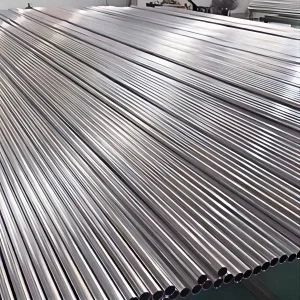
UT-Inspected Seamless & Welded Alloy Tubing
Explore our premium grade austenitic, duplex, super austenitic, and high-nickel alloy piping, 100% verified via automated immersion and angle-beam ultrasonic testing.







The Metallurgical & Quality Imperative of Ultrasonic Testing (UT) in High-Nickel Alloy Tubing
In modern extreme-environment processing—ranging from deepwater subsea oilfield extraction to high-temperature nuclear reactors and corrosive chemical processing units—the mechanical integrity of piping infrastructure is non-negotiable. High-nickel alloys, including Inconel 625 (UNS N06625), Incoloy 825 (UNS N08825), Hastelloy C276 (UNS N10276), and Monel 400 (UNS N04400), offer exceptional resistance to pitting, stress-corrosion cracking (SCC), and high-temperature oxidation. However, the performance of these superalloys depends entirely on the structural homogeneity of the pipe wall.
Sub-surface micro-cracks, inclusions, wall thinning, seam voids, or intergranular laminations generated during cold extrusion, hot rolling, or welding can act as catastrophic stress intensity nodes. Ultrasonic Testing (UT) has emerged as the global benchmark non-destructive testing (NDT) methodology to guarantee zero-defect compliance for high-nickel tubular products across critical industrial sectors.
E-E-A-T Quality Assurance Note: Unlike standard hydrostatic testing—which only confirms immediate burst strength without revealing latent micro-flaws—full-body Ultrasonic Inspection detects volumetric flaws as small as 3% to 5% of wall thickness in longitudinal, transverse, and radial vectors per ISO 10893-10, ASME Section III NB-2550, and ASTM B444 standards.
1. Global Industrial Landscape & Demand Drivers for UT-Inspected Nickel Alloys
The global demand for high-performance nickel alloy pipes inspected via ultrasonic NDT is experiencing unprecedented growth. Driven by deeper offshore drilling, aggressive chemical synthesis routes, and next-generation nuclear power plants, engineers are moving away from traditional destructive sampling toward 100% digitalized volumetric verification.
Key Drivers Reshaping Global Procurement:
- Ultra-Deepwater Subsea Lines: Subsea flowlines operating under hydrostatic pressures exceeding 300 bar require zero internal defects to prevent hydrogen embrittlement and catastrophic stress cracking caused by sour gas (H₂S and CO₂).
- Nuclear Clean Energy Systems: Steam generator tubes made of Alloy 600, 690, and 800HT mandate automated Immersion Ultrasonic Testing (IUT) to guarantee zero wall variance over 30-year operational lifespans under intense neutron bombardment.
- Chemical Process Intensification: Highly concentrated sulfuric, hydrofluoric, and nitric acid processing units utilize Hastelloy C-276 and Alloy 20 piping. UT testing ensures that wall thickness profiles meet ASME Code Case pressure safety margins.
2. Metallurgical Challenges: Overcoming Acoustic Scattering & Grain Anisotropy
Ultrasonic inspection of austenitic high-nickel alloys poses unique physical challenges compared to carbon steel or standard 304/316 stainless steels. Nickel alloys form coarse, columnar grain microstructures during solidification and heat treatment. These grains create severe acoustic attenuation, sound wave refraction, and beam skewing.
To overcome acoustic scattering and maintain a high Signal-to-Noise Ratio (SNR), sophisticated NDT facilities utilize customized multi-frequency shear wave probes and dual-element compression wave (TR) transducers. By adjusting probe angle, pulse wavelength, and focusing depth, our advanced ultrasonic systems penetrate dense austenitic nickel matrices to isolate real discontinuities from structural noise.
3. Technical Matrix: Nickel Alloy Grades & UT Inspection Standards
The table below summarizes key nickel alloy grades supplied by our factory, detailing their primary chemical designations, acoustic velocities, primary industrial standards, and specialized NDT requirements:
| Alloy Grade | UNS / EN Code | Longitudinal Velocity (m/s) | Primary Application Standard | UT Inspection Criteria |
|---|---|---|---|---|
| Nickel Alloy 600 | UNS N06600 / 2.4816 | ~5,830 m/s | ASTM B167 / ASME SB167 | 100% Full-Length Shear Wave & Longitudinal Probe (N5 Notch) |
| Nickel Alloy 625 | UNS N06625 / 2.4856 | ~5,800 m/s | ASTM B444 / ASME SB444 | Immersion UT, Longitudinal & Transverse Defect Calibration |
| Nickel Alloy 825 | UNS N08825 / 2.4858 | ~5,770 m/s | ASTM B423 / ASME SB423 | Multi-Channel Wall Thickness & Internal Laminar Flaw Scanning |
| Hastelloy C-276 | UNS N10276 / 2.4819 | ~5,630 m/s | ASTM B622 / ASME SB622 | High-Frequency PAUT Scanning for Micro-Porosity & Inclusions |
| Super Austenitic 254SMO | UNS S31254 / 1.4547 | ~5,740 m/s | ASTM A312 / EN 10216-5 | 100% Hydrostatic + UT Dual-Method Verification |
| Duplex 2205 | UNS S31803 / S32205 | ~5,900 m/s | ASTM A789 / ASTM A790 | Phase Balance Verification & Flaw Depth Sizing per ISO 10893 |
4. State-of-the-Art NDT Inspection Methodologies Implemented in Our Factory
Our manufacturing facilities utilize a multi-layered ultrasonic inspection architecture to eliminate human error and achieve precision flaw sizing across complex geometries:
Full-Body Immersion Ultrasonic Testing (IUT)
Pipes are submerged in a temperature-controlled water medium that acts as a uniform acoustic couplant. Rotating transducer arrays scan 100% of the pipe surface in a continuous helical path, measuring wall thickness variation down to 0.01 mm and identifying internal inclusion voids.
Phased Array Ultrasonic Testing (PAUT)
Featuring 64-channel array probes with electronic beam steering, PAUT generates real-time cross-sectional imagery (S-scans) of the weld zone and base metal. This allows precise depth sizing and angular characterization of lack-of-fusion defects in welded nickel alloy pipes.
Full Matrix Capture & TFM Imaging
For ultra-critical aerospace and nuclear applications, Full Matrix Capture (FMC) records every raw A-scan signal from probe arrays, enabling Total Focusing Method (TFM) algorithms to construct crystal-clear volumetric images of coarse-grained Inconel and Hastelloy walls.
5. Field-Proven Application Scenarios & Localized Engineering Use-Cases
A. Subsea Umbilical, Riser & Flowline (SURF) Systems
In deepwater Gulf of Mexico, North Sea, and Santos Basin offshore fields, high-pressure subsea injection lines are subject to harsh cyclic fatigue and sour crude environments containing hydrogen sulfide (H₂S). UT-tested Incoloy 825 and Inconel 625 clad pipes eliminate sub-surface lamination defects that could trigger sour gas cracking or subsea fluid leakage.
B. PTA & Acetic Acid Synthesis Process Piping
Purified Terephthalic Acid (PTA) and vinyl acetate monomer plants operate under high temperatures with bromide-catalyzed acetic acid solutions. Hastelloy C-276 and Super Austenitic 254SMO seamless pipes, verified by immersion ultrasonic NDT, prevent local pitting corrosion and crevice attack along nozzle joints and heat exchanger bends.
C. High-Temperature Heat Exchangers & Nuclear Power Plant Steam Generators
Nuclear reactor primary loops require seamless Alloy 600 / 690 tubing with zero micro-cavities. Automated ultrasonic immersion scanning ensures complete wall concentricity across long tube runs (up to 25 meters), preventing tube rupture and thermal stress failures in steam generation units.
6. Technology Roadmap & Future Outlook (2025–2035)
The field of non-destructive testing for specialty alloys is undergoing a technological transformation driven by digitalization, artificial intelligence, and robotic automation. Our engineering center is actively executing a 10-year technology deployment roadmap:
AI-Powered Automated Defect Recognition (ADR)
Integration of deep learning neural networks into real-time UT signal streams to automatically classify flaws (e.g., crack vs. porosity vs. inclusions) with over 99.4% accuracy, eliminating operator fatigue.
3D Volumetric Digital Twin Certification
Every delivered length of Inconel or Hastelloy pipe will be supplied with a 3D digital NDT map embedded in a secure QR/Blockchain record, enabling plant asset managers to track wall thickness throughout the pipe's operating lifecycle.
Laser Ultrasonic & Non-Contact EMAT Inspection
Deployment of high-energy Laser-Ultrasonic NDT and Electro-Magnetic Acoustic Transducers (EMAT) for high-speed, non-contact flaw detection on hot-extruded nickel alloy pipes directly on the mill production line at temperatures up to 800°C.
7. Macro Industry Solutions & Comprehensive Factory Quality Management
As an integrated manufacturer and exporter, our factory provides end-to-end quality assurance protocols that extend far beyond standard mill practices:
- Full Traceability from Melt to Inspection: Complete raw material validation with optical emission spectroscopy (OES) and positive material identification (PMI) on 100% of incoming nickel billets.
- Dual NDT Certification Strategy: Combining 100% Eddy Current Inspection (ET) for surface defect screening with 100% Ultrasonic Testing (UT) for internal volumetric validation.
- EN 10204 3.2 Third-Party Inspection: Independent certification witnessing by international inspection bodies including TÜV, Lloyd's Register, DNV, and Bureau Veritas.
- Custom Surface Finishing & Precision Bending: Bright annealing in pure hydrogen atmospheres, outer diameter/inner diameter polishing up to Ra < 0.4 µm, and U-bend fabrication for shell-and-tube heat exchangers.
Frequently Asked Questions (FAQ)
In-depth answers to critical procurement, NDT engineering, and metallurgical specification questions.
High-Nickel & Heat-Resistant Pipe Series
Complete your procurement requirements with our certified specialty stainless steel and nickel superalloy products.








