
High-Performance Corrosion & Heat-Resistant Tubing for Hamburg Procurement
Direct mill delivery options engineered to meet stringent DIN EN, ASTM, and ASME standards for Port of Hamburg maritime infrastructure and industrial complexes.

Titanium Grade 2 Tube for Hamburg Marine Condensers
Unmatched resistance to brackish water corrosion, perfect for Elbe River and North Sea cooling systems.
High-Quality Titanium Tubes • Grade 2 • UNS R50400
Duplex Steel 2205 (1.4462) for Hamburg Offshore Engineering
High yield strength combined with high resistance to chloride stress corrosion cracking in maritime environments.
High-Quality Duplex Steels 2205 • S31803/S32205 • 1.4462
Super Austenitic 254SMO (1.4547) Heavy Industrial Tubing
Designed for chemical processing plants operating within Hamburg's port industrial zone.
Super Austenitic Steels 254SMO • UNS S31254 • 1.4547
Custom Nickel Alloy 20 Tubes for Acid Handling Systems
Superior protection against sulfuric acid corrosion, ideal for chemical refining facilities.
Custom Nickel Alloy Tubes 20 • UNS N08020 • 2.46601. Executive Summary & Hamburg’s Industrial Ecosystem Demand
The Metropolitan Region of Hamburg stands as Northern Europe’s primary logistics hub and a critical center for maritime technology, aviation supply chains, chemical refining (such as the Wilhelmsburg and Harburg industrial complexes), and renewable hydrogen development. As industrial facilities in Hamburg transition toward higher efficiency, carbon-neutral processing, and low-lifecycle-cost equipment, the selection of raw materials—specifically Ferritic and Martensitic Stainless Steels—has emerged as a key strategic consideration for procurement managers and mechanical engineers alike.
While Austenitic grades like 304L (1.4307) and 316L (1.4404) have historically dominated general piping and structural applications, the volatility of global nickel prices has driven German manufacturers to re-evaluate nickel-free or low-nickel steel chemistries. Ferritic stainless steels offer exceptional thermal conductivity, a low coefficient of thermal expansion, and near-immunity to chloride-induced stress corrosion cracking (SCC)—making them ideal for heat exchangers, feed water heaters, and thermal exhaust networks exposed to Hamburg's brackish marine climate. Simultaneously, Martensitic stainless steels deliver high hardenable mechanical strength, wear resistance, and elevated yield points essential for heavy hydraulic machinery, turbine components, and pump shafts utilized across the Port of Hamburg (Hafen Hamburg).
Key Procurement Advantage for Hamburg Engineers
By substituting standard austenitic alloys with stabilized ferritic grades (e.g., 1.4509 / 441 or 1.4521 / 444), plant operators in Northern Germany can achieve up to a 25% to 35% material cost savings without sacrificing pitting resistance, while eliminating nickel-hedging risks in project tendering.
Engineered Precision & Manufacturing Metrics
Delivering high-integrity ferritic, martensitic, and special alloy tubing with full DIN EN compliance.
2. Ferritic vs. Martensitic Stainless Steels: Microstructural Deep Dive
Understanding the fundamental metallurgical differences between ferritic and martensitic crystallographic structures is vital for engineering resilient components designed for Hamburg's rigorous industrial applications.
2.1 Ferritic Stainless Steels (BCC Microstructure)
Ferritic stainless steels possess a Body-Centered Cubic (BCC) crystal lattice. Containing chromium levels typically ranging between 10.5% and 30%, these alloys remain ferritic across all normal working temperatures and cannot be hardened by heat treatment, though they can be cold-worked.
- Thermal Properties: Ferritics exhibit significantly higher thermal conductivity than austenitic steels (approx. 25 W/m·K vs 15 W/m·K at 100°C), reducing thermal stress gradients in boiler tubes and heat exchangers.
- Thermal Expansion: Their coefficient of thermal expansion closely matches that of carbon steel, reducing flange leakage and joint fatigue during cyclic thermal operation.
- Stress Corrosion Cracking (SCC): Due to their BCC matrix, ferritic steels are virtually immune to transgranular chloride SCC, making them exceptionally reliable in the salt-laden atmosphere around the Hamburg Port area and North Sea coastlines.
- Stabilized Grades (Ti/Nb): Modern dual-stabilized grades like 1.4509 (AISI 441) and 1.4521 (AISI 444) utilize Titanium and Niobium additions to bind interstitial carbon and nitrogen, eliminating intergranular corrosion susceptibility following welding processes.
2.2 Martensitic Stainless Steels (Body-Centered Tetragonal / BCT)
Martensitic stainless steels feature higher carbon contents (0.10% to 1.2%) combined with 12% to 18% Chromium. Unlike ferritics, martensitic alloys undergo a phase transformation upon heating into the austenitic field, allowing them to be quenched and tempered to form a high-strength Body-Centered Tetragonal (BCT) martensite phase.
- High Hardness & Mechanical Strength: Tensile strengths can exceed 1,000 MPa, with hardness levels up to 60 HRC depending on carbon content and tempering temperatures.
- Erosion & Wear Resistance: Essential for high-velocity fluid flow, steam turbine blades, hydraulic pump liners, and valve seats operated in heavy marine machinery.
- Key Engineering Grades: 1.4006 (AISI 410) for basic wear-resistant structural parts; 1.4021 (AISI 420) for shafts and fasteners; and advanced soft-martensitic alloys like 1.4418 (X2CrNiMoV13-5-2) offering superior toughness alongside corrosion resistance.
3. Technical Comparison: Ferritic & Martensitic Steel Grades
A comprehensive overview comparing common DIN EN / UNS grades, mechanical characteristics, and local application suitability for German engineering specifications.
| Steel Category | DIN EN Designation | UNS / AISI | Yield Strength Rp0.2 (MPa) | Tensile Strength Rm (MPa) | PREN Value | Typical Hamburg Application |
|---|---|---|---|---|---|---|
| Ferritic | 1.4512 | AISI 409 | ≥ 220 | 380 - 560 | ~ 11 | Exhaust tubing, low-corrosion structural supports |
| Ferritic | 1.4509 | AISI 441 | ≥ 250 | 430 - 630 | ~ 18 | Heat exchangers, solar thermal circuits, food processing |
| Ferritic | 1.4521 | AISI 444 | ≥ 320 | 470 - 670 | ~ 24.5 | Hot water tanks, brackish water piping, boiler tubes |
| Martensitic | 1.4006 | AISI 410 | ≥ 450 | 650 - 850 | ~ 13 | Hydraulic valves, turbine components, pump shafts |
| Martensitic | 1.4021 | AISI 420 | ≥ 550 | 750 - 950 | ~ 14 | Wear-resistant marine shafts, high-strength bolts |
| Soft Martensitic | 1.4418 | X2CrNiMoV13-5-2 | ≥ 700 | 900 - 1100 | ~ 20 | Offshore hydro-turbine components, high-pressure valves |
4. Application Scenarios Across the Hamburg Industrial Region
Port Logistics & Marine Cranes
Martensitic 1.4021 and 1.4418 shafts, pins, and hydraulic cylinders operate inside heavy container cranes at Container Terminal Altenwerder (CTA), resisting heavy wear under dynamic mechanical load.
Hamburg Clean Hydrogen Hub (Moorburg)
High-pressure martensitic valve blocks and ferritic heat dissipation tubing installed in hydrogen electrolyzer cooling loops, ensuring long-term microstructural stability and gas tightness.
Chemical & Refineries (Harburg/Wilhelmsburg)
Ferritic 1.4521 (444) heat exchanger tubing replaces 316L in process steam condensers to permanently eradicate chloride stress corrosion cracking caused by cooling water drawn from the Elbe River.
5. Quality Assurance Standards & China-to-Hamburg Supply Chain Synergy
To meet the rigorous standards demanded by German engineering contractors, TÜV inspectors, and global OEMs operating in Hamburg, our manufacturing processes adhere strict compliance protocols from raw material melting through to final non-destructive testing (NDT).
5.1 German & European Regulatory Compliance
- EN 10204 3.1 & 3.2 Certification: Every production batch is shipped with complete Material Test Certificates (MTC) detailing heat chemistry, mechanical yield, tensile, elongation, hardness tests, and intergranular corrosion testing per EN ISO 3651-2. Third-party inspections (TÜV, DNV, Lloyd's Register) are fully supported for EN 10204 3.2 validation.
- Pressure Equipment Directive (PED 2014/68/EU) & AD 2000-W0: Tubes designated for pressure vessels comply with AD 2000-Merkblatt W0 guidelines, guaranteeing structural integrity under elevated temperature and pressure.
- Dimensional Tolerances: Precision cold-drawing technology enables tight tolerances according to DIN EN 10216-5 (seamless) and DIN EN 10217-7 (welded), maintaining exact outer diameters (OD) and wall thicknesses (WT).
5.2 Direct China Factory Supply Chain to Hamburg Port
Leveraging advanced manufacturing clusters in Huzhou and Shanghai, Spezilla offers global purchasing departments in Hamburg direct factory sourcing advantages:
- Cost Efficiency & Raw Material Scale: Direct access to primary stainless steel coils and billets allows competitive pricing without compromising chemical purity or mechanical tolerances.
- Direct Maritime Shipping Lines: Weekly container shipments route directly from Shanghai Port to the Port of Hamburg (DEHAM), delivering typical port-to-port transit times of 28–33 days with full customs documentation support.
- Custom Lengths & Bright Annealing: Tubes are supplied in custom straight lengths up to 25 meters or coiled formats, finished via inline Bright Annealing (BA) under protective argon atmospheres to eliminate oxide scaling.
6. Technical & Procurement FAQ for Hamburg Buyers
Ferritic grades like 1.4521 (444) offer higher thermal conductivity, lower thermal expansion, and near-immunity to chloride stress corrosion cracking caused by brackish water. Furthermore, being nickel-free, ferritics provide long-term price stability compared to austenitic alloys.
Martensitic steels require strict pre-heating (typically 200°C–300°C) and post-weld heat treatment (PWHT) to prevent hydrogen cracking due to their high hardenable carbon phase. For field welding in Hamburg shipyards, low-carbon soft martensitic grades like 1.4418 provide significantly better weldability.
All shipments are accompanied by EN 10204 3.1 certification detailing full heat analysis, mechanical values, and NDT test results. We also regularly coordinate EN 10204 3.2 inspection witnessed by TÜV, DNV, or Lloyd's Register upon request.
Production cycles generally take 20 to 35 days depending on standard vs non-standard tolerances. Direct sea freight from Shanghai to Hamburg Port takes approximately 28 to 32 days, providing an end-to-end delivery window of 7 to 9 weeks.
Explore Our Complete Range of Certified Industrial Tubing
Providing seamless, welded, and cold-drawn stainless steel, nickel alloy, and heat-resistant grades for international delivery.

High-Quality Austenitic Steels 347 (1.4550)
Stabilized stainless grade resisting carbide precipitation during high-temperature service.
High-Quality Austenitic Steels 347 • UNS S34700 • 1.4550
High-Quality Nickel Alloy Tubes 800HT (1.4959)
Engineered for high-temperature creep resistance in thermal processing equipment.
Nickel Alloy Tubes 800HT • UNS N08811 • 1.4959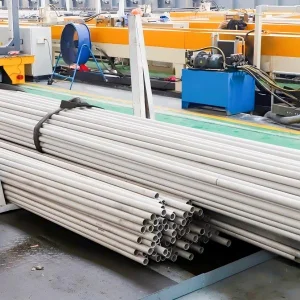
Custom Austenitic Steel ASME SA213 TP317L
Higher molybdenum content providing upgraded pitting resistance in acidic environments.
Custom Austenitic steel ASME SA213 · TP317L
Custom Austenitic Steel ASME SA213 TP316L
The standard benchmark alloy for marine piping, food processing, and general chemical lines.
Custom Austenitic steel ASME SA213 · TP316L
Custom Austenitic Steel ASME SA213 TP347H
High-carbon stabilized grade designed for elevated temperature boiler and superheater tubing.
Custom Austenitic steel ASME SA213 · TP347H
Custom Austenitic Steels 316Ti (1.4571)
Titanium-stabilized 316 variant widely specified across German DIN and EN engineering projects.
Austenitic Steels 316Ti • UNS S31635 • 1.4571
High-Quality Austenitic Steel ASME SA269 TP304
General service tubing compliant with strict dimensional and surface cleanliness tolerances.
Austenitic steel ASME SA269 · TP304
Custom Austenitic Steel ASME SA213 TP304L
Low-carbon 18/8 stainless steel ideal for welded assemblies and structural fluid lines.
Custom Austenitic steel ASME SA213 · TP304LPartner with a Global Leader in Specialty Steel Tubing
Get in touch with our technical sales team today. We provide full engineering datasheets, factory-direct pricing, and comprehensive EN 10204 MTC support tailored for your Hamburg applications.
