
High-Performance Corrosion Resistant Tubing
Explore our certified inventory of precision austenitic, super austenitic, and custom titanium tubing products designed to international ASME, ASTM, and EN standards.


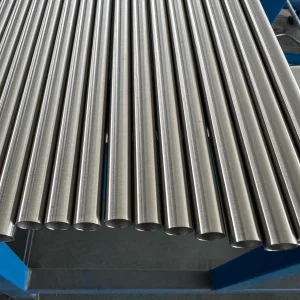





1. Technical Metallurgy & Material Selection of 1.5 Titanium Tubing
In modern high-consequence process environments—ranging from deepwater subsea extraction manifolds to thermal desalination evaporators—the specification of custom nominal 1.5-inch outer diameter (1.5" OD / 38.1mm OD) titanium tubing represents a critical engineering decision. The selection of titanium as a primary piping material is governed by its unique position at the intersection of extreme specific strength (strength-to-weight ratio), exceptional fatigue immunity, and unmatched thermodynamic resistance to chloride-induced localized corrosion.
When procuring 1.5 titanium tubes, engineering procurement teams must evaluate both standard commercial purity (CP) grades and specialized titanium alloys. The primary metallurgical variants specified for 1.5-inch tube applications include:
-
Commercially Pure Grade 2 Titanium (UNS R50400 / 3.7035): The industrial workhorse for thermal exchangers and condensers. Featuring an unalloyed alpha crystal microstructure (Hexagonal Close-Packed, HCP), Grade 2 titanium balances high ductility, easy cold formability, and superb resistance to oxidizing media, wet chlorine, and elevated temperature seawater.
-
Titanium Grade 9 (Ti-3Al-2.5V / UNS R56320): A near-alpha alloy engineered primarily for aerospace hydraulic tubing and high-pressure chemical lines. Offering a 20% to 50% increase in tensile and yield strength over CP Grade 2 while maintaining superior cold rollability, Grade 9 allows design engineers to reduce wall thickness (WT) down to sub-1.0mm profiles without sacrificing bursting pressure safety factors.
-
Titanium Grade 7 (Ti-0.15Pd / UNS R52400) & Grade 12 (Ti-0.3Mo-0.8Ni / UNS R53400): Specialized alloys created to prevent crevice corrosion in severe reducing acid media (such as boiling hydrochloric or dilute sulfuric acid blends) or hot brine environments where temperatures exceed 120°C (248°F). The addition of palladium in Grade 7 significantly shifts the open-circuit corrosion potential into the passive zone.
Unlike austenitic stainless steels or nickel alloys which rely on chromium-iron oxide films susceptible to localized chloride breakdown (pitting), titanium forms a continuous, highly adherent, self-healing rutile and anatase titanium dioxide ($TiO_2$) film within milliseconds of exposure to moisture or oxygen. In 1.5-inch heat exchanger tubes, this $TiO_2$ surface layer prevents ion leaching, biofouling adhesion, and erosion-corrosion up to fluid velocities exceeding 10 meters per second.
2. Mechanical Parameters & Pressure Rating Calculations
Comprehensive engineering data comparing standard 1.5-inch (38.1mm OD) titanium tubing grades manufactured to ASTM B338 / ASME SB338 specifications.
| Titanium Alloy Grade | UNS Designation | Tensile Strength (min. MPa) | Yield Strength (0.2% offset, MPa) | Elongation in 2" (min. %) | Max Temp Limit (°C) | PREN Equivalent Performance |
|---|---|---|---|---|---|---|
| Grade 1 (CP Ti) | UNS R50100 | 240 MPa | 170 - 310 MPa | 24% | 150°C | Immune to Chloride Pitting |
| Grade 2 (CP Ti) | UNS R50400 | 345 MPa | 275 - 450 MPa | 20% | 300°C | Immune to Chloride Pitting |
| Grade 7 (Ti-Pd) | UNS R52400 | 345 MPa | 275 - 450 MPa | 20% | 350°C | Superior in Reducing Acids |
| Grade 9 (Ti-3Al-2.5V) | UNS R56320 | 620 MPa | 483 MPa | 15% | 400°C | High Pressure / High Stress |
| Grade 12 (Ti-Mo-Ni) | UNS R53400 | 483 MPa | 345 MPa | 18% | 300°C | High Temp Brine / Crevice Opt. |
Allowable Working Pressure Formula (ASME Section VIII Division 1)
To determine the maximum allowable working pressure ($P$) for a 1.5-inch titanium tube, mechanical engineers utilize the modified Barlow's equation incorporated in ASME B31.3 process piping codes:
3. Localized Application Landscapes & Field Performance
Analysis of how custom 1.5-inch titanium tubes solve distinct engineering challenges across key global industrial hubs.
Middle East Desalination (GCC Region)
In Multi-Stage Flash (MSF) and Reverse Osmosis (RO) plants across Saudi Arabia, UAE, and Qatar, heat recovery bundler tubes operate under hyper-saline brine at 100°C. Custom 1.5 titanium Grade 2 seamless tubes completely eliminate pitting failures common to 316L and Duplex 2205 stainless steels, extending shell-and-tube heat exchanger lifecycle to 30+ years.
North Sea Offshore Subsea Hydraulics
Operating in harsh deepwater environments exposed to sour gas ($H_2S$) and high-pressure carbon dioxide, subsea umbilical systems rely on 1.5-inch Grade 9 (Ti-3Al-2.5V) cold-drawn seamless tubing. Grade 9 provides the high yield strength required to sustain internal pressures up to 10,000 PSI while reducing overall top-side weight platforms.
North American & EU Chemical Processing
Chemical processing facilities handling chlor-alkali synthesis, terephthalic acid (PTA), and nitric acid recovery utilize custom 1.5 Grade 7 titanium tubing. The palladium modification provides a structural safeguard against micro-crevice corrosion beneath tube-to-tubesheet expanded joints where stagnant chemical deposits concentrate.
4. Advanced Manufacturing Roadmap & Metallurgy Evolution
The manufacturing process for high-integrity 1.5-inch titanium tubing has evolved from standard cold drawing to high-precision cold pilgering paired with multi-axis automated vacuum bright annealing. Understanding the processing route is vital for engineering buyers assessing long-term mechanical reliability.
Cold Pilgering (Cold Rolling) vs. Cold Drawing
To produce custom 1.5-inch titanium tubes with tight wall thickness tolerances ($\pm 5\%$) and flawless internal surface finish ($Ra < 0.4 \mu m$), top-tier mills utilize multi-pass cold pilgering. Unlike conventional drawing through a stationary die, pilgering employs reciprocating stationary dies and a tapered internal mandrel. This tri-axial compressive stress state refines the grain size of the titanium crystal matrix, eliminates internal voids, and yields an ultra-smooth bore ideal for high-purity fluid transmission.
Automated Laser Beam Welding (LBW) & Inert Gas Protection
For welded 1.5 titanium tubes (ASTM B338 Grade 2 welded), advanced manufacturers utilize continuous roll-forming integrated with dual-shielded Laser Beam Welding (LBW) or Gas Tungsten Arc Welding (GTAW/TIG). Because molten titanium aggressively absorbs oxygen, nitrogen, and hydrogen above 400°C—leading to severe interstitial embrittlement—the entire weld zone is isolated under a trailing shield of 99.999% pure argon gas. Post-weld inline eddy-current testing combined with 100% weld seam ultrasonic inspection ensures zero micro-porosity.
Future Horizon: Hydrogen Embrittlement Mitigation & Additive Interfaces
Next-generation 1.5 titanium tubing research centers on surface modified anodization and thermal oxidation techniques that mitigate atomic hydrogen absorption ($H^+$ diffusion) in high-pressure hydrogen storage lines. Furthermore, hybrid manufacturing routes—combining cold-pilgered titanium tubing with 3D-printed selective laser melting (SLM) end-fittings—are establishing new paradigms for aerospace heat exchanger manifolds.
5. Supply Chain Resilience & Production Advantage of Chinese Manufacturers
Global procurement directors increasingly partner with leading Chinese specialized titanium tubing mills to optimize project capital expenditure (CAPEX) without compromising quality assurance. China's integrated titanium industrial ecosystem—centered around the "China Titanium Valley" in Baoji and advanced cold-finishing hubs in Zhejiang—delivers unmatched competitive advantages for custom 1.5-inch titanium tube supply.
-
Vertical Integration from Sponge to Finished Tube: Domestic Chinese manufacturers maintain direct equity alliances with primary Kroll-process titanium sponge smelters and Vacuum Arc Remelting (VAR) ingot facilities. This guarantees full chemical composition control (limiting interstitials like $O_2 \le 0.18\%$, $N_2 \le 0.03\%$, $C \le 0.08\%$) from raw ore to finished 1.5-inch tube bundles.
-
Massive Cold Pilgering & Annealing Capacity: Operating multi-stand high-speed pilger mills and continuous vacuum bright annealing furnaces, Chinese factories provide scalable volume delivery. Orders exceeding 50,000 meters of custom 1.5" titanium tubes can be fulfilled within 30-45 days lead time—nearly half the industry average of Western counterpart mills.
-
Cost Efficiency Matrix: High automation, optimized energy utilization, and localized tooling supply chains yield a 25% to 40% net cost advantage on 1.5 titanium tubes compared to European or North American producers, freeing capital for complex subsea or chemical engineering projects.
6. Quality Control Standards & Global Compliance Framework
To ensure seamless international installation and regulatory compliance, custom 1.5 titanium tubing undergo rigorous destructive and non-destructive quality verification protocols before export dispatch.
Material Certification & Traceability
Every tube lot is delivered with comprehensive EN 10204 Type 3.1 Mill Test Certificates detailing heat number chemical analysis, tensile testing, yield strength, elongation, flattening, and flaring test results. EN 10204 Type 3.2 certification co-signed by independent inspection agencies (DNV, TÜV Rheinland, SGS, Lloyd's Register) is available upon request.
Non-Destructive Testing (NDT) Suite
100% of 1.5 titanium tubes undergo inline Electromagnetic Eddy Current Testing per ASTM E426 to detect longitudinal and transverse surface imperfections. High-pressure hydraulic tubes are subjected to Hydrostatic Testing up to ASME SB338 pressure limits or 100% Ultrasonic Testing (UT) per ASTM E213.
Packaging & Export Logistics
Tubes are fitted with soft plastic protective end caps, wrapped in vapor corrosion inhibitor (VCI) anti-moisture plastic film, and packed in ISPM-15 compliant heat-treated fumigated wooden cases to prevent mechanical bending or atmospheric contamination during ocean freight transit.
Specialty Alloy & Stainless Steel Tubing Portfolio
Discover our complementary line of nickel alloy, duplex steel, and super austenitic steel tubes designed for extreme heat exchangers and harsh chemical processing systems.








Frequently Asked Engineering Questions (Q&A)
In-depth responses regarding custom 1.5 titanium tube selection, machining, welding, and operational performance.
Q1: How does a 1.5-inch Grade 9 (Ti-3Al-2.5V) titanium tube compare to CP Grade 2 in high-pressure hydraulic service?
Titanium Grade 9 (Ti-3Al-2.5V) is an alpha-beta alloy specifically developed to bridge the gap between commercial purity titanium and ultra-high-strength aerospace alloys like Ti-6Al-4V. While CP Grade 2 has a minimum yield strength of 275 MPa, Grade 9 delivers a minimum yield strength of 483 MPa. In a nominal 1.5-inch outer diameter hydraulic system, switching from Grade 2 to Grade 9 allows design engineers to reduce wall thickness by up to 40% while maintaining the exact same bursting safety factor, resulting in dramatic system weight reduction and enhanced fatigue resistance under pulse pressures.
Q2: What are the dimensional tolerances per ASTM B338 for a custom 1.5-inch titanium tube?
Under ASTM B338 / ASME SB338 standards for seamless and welded titanium tubing in surface condensers and heat exchangers, a 1.5-inch (38.1mm) outer diameter tube must adhere to strict dimensional limits: Outer Diameter tolerance is typically $\pm 0.13mm$ ($\pm 0.005$ inches); Wall Thickness tolerance is maintained within $\pm 10\%$ of nominal wall for cold-finished tubes; and Straightness tolerance requires a maximum curvature variation of no more than 1.0mm per 1000mm of tube length. Custom precision tolerances ($\pm 0.05mm$ OD) can be produced upon engineering agreement.
Q3: Can 1.5 titanium tubing be directly welded to stainless steel piping, and what transition fittings are required?
Direct fusion welding between titanium and stainless steel is metallurgically impossible using conventional arc welding techniques. When titanium fuses with iron or nickel, brittle intermetallic compounds (such as $Fe-Ti$ and $Fe_2Ti$) form rapidly in the weld pool, causing instantaneous cracking upon cooling. To join 1.5 titanium tubing to stainless steel or carbon steel lines, procurement teams must utilize either explosive-bonded bimetallic transition joints, flange connections with isolation gaskets, or specialized vacuum brazing utilizing silver-based or copper-titanium filler alloys.
Q4: How does Grade 2 titanium perform compared to Super Duplex 2507 in high-temperature marine environments?
While Super Duplex 2507 (UNS S32750) provides high mechanical strength and an excellent Pitting Resistance Equivalent Number (PREN > 42), it remains vulnerable to chloride stress corrosion cracking (SCC) in seawater above 110°C and erosion-corrosion at high slurry fluid velocities. Titanium Grade 2 is completely immune to chloride-induced pitting, crevice corrosion, and stress corrosion cracking at all salinity levels and temperatures up to 300°C. Furthermore, titanium exhibits zero biofouling corrosion deterioration, making it superior for long-term maintenance-free heat exchanger service.
Q5: What surface treatments are recommended to prevent hydrogen embrittlement in titanium tubes operating in reducing acids?
Hydrogen embrittlement occurs when atomic hydrogen ($H^+$) diffuses into the titanium hexagonal crystal lattice, forming brittle titanium hydride ($\delta$-phase $TiH_2$) precipitates. To mitigate hydrogen ingress in reducing acid service, manufacturers apply thermal oxidation treatment (heating tubes in air at 600°C for 30 minutes to thicken the protective $TiO_2$ rutile oxide layer), specify Grade 7 (Pd alloyed) or Grade 12 (Mo-Ni alloyed) material, or apply platinum-group metal anodizing to catalyze hydrogen recombination into harmless $H_2$ gas before diffusion occurs.
Q6: What is the typical bending radius achievable for 1.5-inch titanium tubing without structural flattening?
For cold rotary hydraulic bending of 1.5-inch (38.1mm OD) Grade 2 titanium tubes in fully annealed condition (Annealed Temp 650°C–700°C), the minimum centerline bending radius ($CLR$) without internal mandrel support is $3 \times OD$ (114.3mm). When utilizing a precision internal ball mandrel and wiper die, a tight bending radius of $1.5 \times OD$ (57.15mm) can be achieved with ovality maintained under 5% and wall thinning kept under 12% per ASME B31.3 specs.
Q7: Why is vacuum bright annealing critical during the cold processing of 1.5 titanium tubes?
Titanium is a potent getter gas absorber at temperatures exceeding 400°C. If annealed in open air or improper atmosphere, oxygen and nitrogen dissolve into the surface metal, creating an extremely hard, brittle layer known as "alpha case." Alpha case acts as a micro-crack initiation site, causing premature catastrophic fatigue failure when tubes are pressurized. Vacuum bright annealing at vacuum pressures below $10^{-4}$ Torr ensures complete metallurgical stress relief, fully recrystallized grain structure, and a brilliant oxidation-free surface finish without alpha case formation.
Q8: How do Chinese titanium tube suppliers maintain compliance with EN 10204 3.2 third-party inspection requirements?
Leading Chinese titanium mills maintain permanent working protocols with international accredited registrars including DNV, TÜV Rheinland, Lloyd's Register, and Bureau Veritas. For EN 10204 3.2 certification, independent surveyors witness the entire quality verification chain: selecting mechanical test coupons directly from the production lot, witnessing tensile, flattening, and flaring tests, reviewing 100% Eddy Current and Hydrostatic NDT charts, and verifying positive material identification (PMI) chemical analysis prior to stamping final mill certificates.
