
Precision Corrosion-Resistant Tubing Portfolio
Explore our foundational range of certified seamless, welded, and cold-drawn austenitic stainless steel and high-nickel alloy tubes engineered for extreme operating environments.







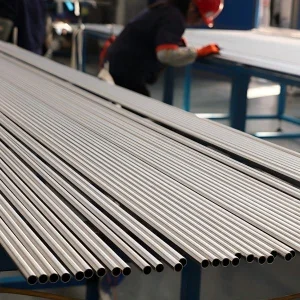
304 Stainless Steel Tubing: Chemical Kinetics & Structural Mechanics
Grade 304 (UNS S30400 / EN 1.4301) represents the absolute benchmark of nominal 18/8 austenitic stainless steel alloys. Engineered with a nominal composition of 18% Chromium and 8% Nickel, this metallurgical equilibrium yields a face-centered cubic (FCC) crystal structure that provides exceptional ductility, non-magnetic characteristics in the solution-annealed state, and superior toughness across cryogenic and elevated temperature spectrums.
When specified for OEM industrial fluid transfer, thermal heat exchangers, and structural hydraulic circuits, custom 304 stainless steel tubing relies heavily on the spontaneous formation of an ultra-thin, self-healing Chromium Oxide (Cr₂O₃) passive film. This passive oxide layer, measuring merely 1 to 3 nanometers in thickness, acts as an impenetrable kinetic barrier against atmospheric oxidation, organic acids, and aggressive chemical reagents.
Understanding the critical distinction between 304, 304L (Low Carbon, UNS S30403), and 304H (High Carbon, UNS S30409) is essential for engineering procurement. When subjected to temperatures between 425°C and 860°C (800°F–1500°F), standard 304 experiences chromium carbide precipitation ($Cr_{23}C_6$) along grain boundaries. This depletes localized chromium below the 10.5% threshold required for passivity, triggering intergranular corrosion (IGC). Spezilla’s custom 304L tubing limits carbon to $\le 0.030\%$, effectively suppressing sensitization during welding operations without sacrificing mechanical structural integrity.
| Grade Designation | UNS / EN Number | Carbon (%) | Chromium (%) | Nickel (%) | Tensile (MPa) | Yield (MPa) | Max Hardness (HRB) |
|---|---|---|---|---|---|---|---|
| TP304 Standard | UNS S30400 / 1.4301 | 0.08 max | 18.0 - 20.0 | 8.0 - 11.0 | ≥ 515 | ≥ 205 | 92 HRB |
| TP304L Low Carbon | UNS S30403 / 1.4307 | 0.030 max | 17.5 - 19.5 | 8.0 - 12.0 | ≥ 485 | ≥ 170 | 90 HRB |
| TP304H High Carbon | UNS S30409 / 1.4948 | 0.04 - 0.10 | 18.0 - 20.0 | 8.0 - 11.0 | ≥ 515 | ≥ 205 | 92 HRB |
| 304LN Nitrogen Enhanced | UNS S30453 / 1.4311 | 0.030 max | 17.5 - 19.5 | 8.5 - 11.5 | ≥ 550 | ≥ 240 | 95 HRB |
304 SS Tubing Technical Roadmap & Future Outlook (2025–2035)
The manufacturing landscape for custom 304 stainless steel tubing is undergoing a paradigm shift driven by stringent decarbonization targets, sub-micron surface roughness mandates, and real-time smart sensor integration. As industrial systems operate under increasingly hostile pressures and thermal cycles, technical advancements in tubing fabrication focus on four core pillars:
1. Sub-Micron Surface Modification & Electropolishing (EP)
Future high-purity fluid delivery systems demand inner-diameter (ID) surface roughness values of $Ra \le 0.13\,\mu\text{m}$ ($5\,\mu\text{in}$). Next-generation electropolishing techniques employ non-aqueous ionic liquids and computerized pulse-reverse current technologies to eliminate micro-peaks, minimizing mechanical entrapment sites for bacterial biofilms and corrosive halogen ions.
2. Green Steel Production & Hydrogen-Annealing Integration
Leading Chinese custom 304 tubing factories are transitioning to Electric Arc Furnaces (EAF) powered by 100% renewable energy and direct reduced iron (DRI) processes. Furthermore, conventional natural-gas-fired bright annealing furnaces are being replaced by high-purity hydrogen ($H_2$) continuous induction furnaces, reducing carbon intensity per meter of tubing by up to 68% while guaranteeing a scale-free, mirror-bright surface finish.
3. Ultra-Thin Wall & Micro-Capillary Pilgering Precision
Advancements in multi-roll cold pilgering and floating-plug precision cold drawing enable wall thickness tolerances down to $\pm 0.005\,\text{mm}$. Micro-capillary 304 SS tubing with outside diameters under $1.0\,\text{mm}$ and wall thicknesses under $0.10\,\text{mm}$ is paving the way for next-generation medical HPLC instrumentation, aerospace capillary cooling loops, and specialized sensor housing sleeves.
4. AI-Powered NDT & Digital Twin Traceability
Incorporating artificial intelligence into non-destructive testing (NDT) workflows allows multi-channel Eddy Current Testing (ECT) and phased-array Ultrasonic Testing (UT) to operate continuously at line speeds up to 120 meters per minute. Flaws down to 3% of wall thickness are dynamically classified, mapped, and permanently logged in a cloud-based Digital Twin accessible via QR code printed directly on every individual tube length.
Macro-Industry Solutions & Global System Integration
Custom 304 stainless steel tubing serves as the structural and operational backbone for critical process industries. Below is an engineering analysis of how tailored 304 tubing specifications solve distinct sector challenges:
Chemical & Petrochemical Systems
Challenge: Resistance to organic chemicals, nitric acid, and mild inorganic solutions under moderate heat.
Engineering Solution: Spezilla manufactures ASTM A213 / A312 TP304 tubes with fully solution-annealed structures ($1040^\circ\text{C}$ to $1100^\circ\text{C}$ rapid water quench), ensuring a complete absence of carbide networks and zero residual cold-working stress, protecting heat exchangers from stress corrosion cracking (SCC).
Food, Beverage & Dairy Processing
Challenge: Hygiene compliance, preventing bacterial colonization, and surviving CIP (Clean-in-Place) caustic cycles.
Engineering Solution: Custom 304L sanitary tubing built strictly to ASTM A270 / DIN 11850 standards. Features mechanically polished inner walls ($Ra < 0.4\,\mu\text{m}$) and argon-shielded TIG welds, providing zero pit initiation sites for organic acids or sanitizing agents.
Pharmaceutical & Biotechnology
Challenge: Strict compliance with ASME BPE standards for Water-For-Injection (WFI) and high-purity steam distribution.
Engineering Solution: High-purity electropolished custom 304L tubing with stringent dimensional tolerances ($\pm 0.05\,\text{mm}$ OD) and 100% helium leak testing. Shipped double-bagged with nitrogen purged and end-capped protection.
Power Generation & Thermal Energy
Challenge: High-pressure steam containment and elevated-temperature creep strength in boiler feedwater superheaters.
Engineering Solution: High-carbon TP304H (UNS S30409) heavy-wall seamless tubing engineered according to ASME Boiler and Pressure Vessel Code (BPVC) Section I. Provides superior long-term creep rupture strength at temperatures exceeding $525^\circ\text{C}$.
Semiconductor UHP Gas Delivery
Challenge: Elimination of outgassing, particle generation, and moisture contamination in ultra-high purity specialty gas lines.
Engineering Solution: Ultra-Clean 304L tubing processed in Class 10 cleanroom environments. Treated via specialized passivation in nitric/citric acid baths to elevate the surface $Cr/Fe$ ratio above $1.8$, ensuring absolute molecular purity.
Automotive & Aerospace Fluid Power
Challenge: High cyclic pressure fatigue, extreme vibration resistance, and complex 3D mandrel bending capability.
Engineering Solution: Cold-drawn welded (DOM) 304 tubing produced to ASTM A554 / EN 10305-3 specifications. Optimized elongation ($\ge 45\%$) allows 180-degree tight radius bends without wall thinning, buckling, or micro-fissuring.
Supply Chain Resilience, Scale & Operational Advantages
Partnering directly with advanced Chinese custom 304 stainless steel tubing manufacturers provides global enterprise buyers with unprecedented strategic and financial leverage. China’s modern stainless steel tube manufacturing ecosystem has transformed into a high-tech, vertically integrated powerhouse.
1. Fully Integrated Supply Chain Architecture
From raw stainless steel master coil smelting (Tsingshan, TISCO) to precision cold pilgering, bright annealing, and final NDT inspection, every processing node operates within localized industrial clusters. This reduces master raw material transport lead times from weeks to hours, protecting production schedules from external supply shocks.
2. Automated Smart Mill Infrastructure
Spezilla’s Huzhou production lines utilize continuous high-frequency TIG, Plasma, and Laser welding units integrated with automated X-ray seam tracking, laser gauge dimensional controls, and automated wall thickness compensation. Human error is virtually eliminated, delivering Cpk stability indices $> 1.67$.
3. Exceptional Cost-to-Performance Ratio
Optimized energy consumption, high material yields ($\ge 96.5\%$), and massive domestic manufacturing volume allow Chinese factories to offer premium-grade custom 304 SS tubing at a 20% to 35% cost reduction relative to Western European or North American mills, without compromising on EN 10204 3.1/3.2 certification compliance.
Global Enterprise Purchasing Architecture: Specification Guide
To avoid costly procurement missteps, technical buyers must align RFQ parameters with international standards. When sourcing custom 304 stainless steel tubing, purchasing orders must explicitly define the following seven technical engineering layers:
1. Manufacturing Route & Standard Mapping
Specify exact ASTM/ASME or EN standards based on fluid conditions:
- ASTM A213 / ASME SA213: Seamless Ferritic & Austenitic Alloy-Steel Boiler, Superheater, and Heat-Exchanger Tubes.
- ASTM A249 / ASME SA249: Welded Austenitic Steel Boiler, Superheater, Heat-Exchanger, and Condenser Tubes.
- ASTM A269: Seamless and Welded Austenitic Stainless Steel Tubing for General Service.
- ASTM A312 / ASME SA312: Seamless, Welded, and Heavily Cold Worked Austenitic Stainless Steel Pipes.
- EN 10217-7 / EN 10216-5: European standard for welded and seamless stainless steel tubes for pressure purposes.
2. Dimensional Tolerances & Ovality Constraints
Standard commercial tolerances (e.g., ASTM A1016 / A1016M) may be insufficient for high-precision automated orbital welding. Specify custom tight tolerances:
- Outside Diameter (OD): Standard $\pm 0.10\,\text{mm}$; Custom High-Precision $\pm 0.03\,\text{mm}$.
- Wall Thickness (WT): Standard $\pm 10\%$; Custom Heavy Cold Worked $\pm 5\%$.
- Eccentricity / Ovality: Limit maximum ovality to $< 1.5\%$ of nominal OD for perfect fitting alignment.
Seamless (ASTM A213/A269): Chosen when design codes (ASME Sec VIII Div 1) eliminate longitudinal weld joint quality factors ($E=1.0$), or for severe high-pressure cyclic applications ($> 300\,\text{bar}$). Higher unit cost.
As-Welded (ASTM A249/A554): Economical, high concentricity, uniform wall thickness. Ideal for structural, exhaust, and low-pressure fluid transfer.
Welded & Drawn / DOM (ASTM A249/A269): The ultimate hybrid solution. Cold drawing over a mandrel (plug drawing) recrystallizes the bead weld zone, achieving physical and mechanical properties identical to seamless tubing at 20-30% lower cost.
Localization Support, Quality Testing & Regulatory Compliance
To support global OEMs across Europe, North America, the Middle East, and Asia-Pacific, Spezilla operates a rigorous multi-tier quality control mechanism verified by independent third-party inspection authorities (TÜV, SGS, Lloyd's Register, Bureau Veritas).
Non-Destructive Testing (NDT)
Every single length of custom 304 SS tubing undergoes 100% inline Eddy Current Testing (ECT per ASTM E426 / EN 10246-2) and Hydrostatic Testing (per ASTM A1016) at pressures up to $200\,\text{bar}$ ($2900\,\text{PSI}$), or Pneumatic Underwater Testing at $10\,\text{bar}$ for zero-bubble verification.
Destructive & Metallurgical Tests
Batch sampling includes Flaring (expanding OD by 20% without splitting), Flattening, Reverse Flattening, Tensile/Yield mechanical testing, and Intergranular Corrosion Testing according to ASTM A262 Practice E (Copper-Copper Sulfate-16% Sulfuric Acid Test).
Full Certification & Traceability
All orders are dispatched with comprehensive EN 10204 Type 3.1 Mill Test Certificates detailing exact heat numbers, chemical ladle analysis, mechanical property verification, and NDT results. Optional EN 10204 3.2 co-sign certificates available upon request.
High-Performance Austenitic & Nickel Alloy Range
Discover our complementary line of customized high-temperature, low-carbon, and heat-resistant stainless steel and nickel alloy tubing options for targeted engineering challenges.







Frequently Asked Questions (Q&A)
Expert answers to critical engineering, manufacturing, and procurement inquiries regarding custom 304 stainless steel tubing.
The core distinction lies in carbon content. Standard 304 stainless steel allows a maximum carbon content of 0.08%, whereas 304L is restricted to a maximum of 0.030%. The lower carbon levels in 304L prevent chromium carbide precipitation ($Cr_{23}C_6$) along grain boundaries during welding processes.
This eliminates sensitization and protects welded tube joints against intergranular corrosion (IGC) without requiring post-weld solution annealing. However, standard 304 offers slightly higher tensile and yield strength at temperatures exceeding 400°C.
Spezilla utilizes multi-pass cold drawing over precision tungsten carbide mandrels (plug drawing) combined with continuous multi-roll straightening. Inline laser micrometer gauges continuously measure outside diameter (OD) and wall thickness (WT) across 360 degrees of the tube surface.
This automated loop ensures OD tolerances within $\pm 0.03\,\text{mm}$ and wall thickness variation under $5\%$, providing superior concentricity compared to standard direct-welded tubing.
We supply custom 304 tubing in four primary surface finish conditions depending on application demands:
- As-Welded / Mill Finish: Suitable for non-critical structural or general fluid lines.
- Annealed & Pickled (AP): Acid-passivated finish offering standard corrosion resistance for industrial chemical lines.
- Bright Annealed (BA): Processed under 100% pure hydrogen protective gas, resulting in a mirror-like, scale-free, smooth surface ($Ra \le 0.4\,\mu\text{m}$).
- Electropolished (EP): An electrochemical process yielding ultra-smooth internal surfaces ($Ra \le 0.15\,\mu\text{m}$) for pharmaceutical, WFI, and semiconductor applications.
Grade 304 is generally not recommended for direct, stagnant immersion in seawater due to its Pitting Resistance Equivalent Number (PREN) of approximately ~19. High chloride concentrations ($> 1000\,\text{ppm}$) can initiate pitting and crevice corrosion.
For seawater cooling lines, desalination plants, or offshore applications, Spezilla recommends specifying Super Austenitic Steels (UNS S31254 6Mo), Duplex 2205, Super Duplex 2507, or Titanium Grade 2 tubing.
Every tube order shipped by Spezilla undergoes mandatory 100% non-destructive testing. Depending on the ordering standard (ASTM A213, A249, A269, A312), testing includes Eddy Current Testing (ECT per ASTM E426), Hydrostatic Pressure Testing up to 200 bar, or Pneumatic Underwater Pressure Testing.
All test parameters, inspector stamps, and heat numbers are fully documented on the EN 10204 3.1 Mill Test Certificate provided with shipment.
Enterprise buyers can submit technical CAD drawings (.DWG, .STP) or detailed data sheets directly to our engineering sales office at [email protected]. We offer custom outside diameters from $4.00\,\text{mm}$ to $114.30\,\text{mm}$, custom wall thicknesses from $0.40\,\text{mm}$ to $3.05\,\text{mm}$, straight lengths up to $25\,\text{meters}$, coiled tubing, and precision U-bent tube bundles engineered to TEMA standards.
Ready to Optimize Your Stainless Steel Tubing Supply Chain?
Partner with Spezilla Tube Co., Ltd. for engineering-grade precision, rapid prototyping, scale manufacturing, and full EN 10204 3.1/3.2 certified quality. Our engineering team responds to all global technical inquiries within 24 hours.
