


1. Executive Overview: Metallurgical Engineering of Grade 321 (UNS S32100 / 1.4541)
In thermal processing, refinery cracking, aerospace propulsion, and power generation, selecting material for high-temperature fluid transport requires balancing creep strength, microstructural stability, and resistance to intergranular corrosion (IGC). Standard austenitic alloys such as Grade 304 (UNS S30400) experience carbide precipitation at grain boundaries when exposed to temperatures between 427°C and 816°C (800°F to 1500°F). This phenomenon, known as chromium depletion or sensitization, leaves the matrix adjacent to the grain boundaries vulnerable to catastrophic intergranular attack in aggressive aqueous or chemical environments.
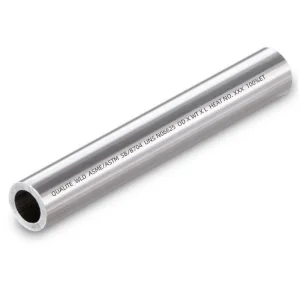
321 Stainless Steel Pipe (UNS S32100 / EN 1.4541) solves sensitization through elemental stabilization. By alloying titanium at a minimum ratio of five times the carbon content ($\text{Ti} \ge 5 \times (\text{C} + \text{N})$ up to 0.70%), titanium preferentially binds with carbon to form stable titanium carbides (TiC) at elevated temperatures. Because TiC forms at temperatures far above chromium carbide ($\text{Cr}_{23}\text{C}_6$) precipitation levels, chromium remains uniformly distributed in solid solution across the austenitic matrix, maintaining full corrosion protection after welding or thermal cycling.
Comprehensive Chemical & Mechanical Comparison Matrix
To evaluate material selection for high-temperature and corrosive applications, the table below compares 321 and 321H with related austenitic and stabilized grades including 304L, 316Ti, and 347.
| Grade / Specification | UNS / EN Number | Carbon (C) % | Titanium (Ti) / Niobium (Nb) % | Chromium (Cr) % | Nickel (Ni) % | Min. Yield Strength (MPa) | Max Service Temp (°C) |
|---|---|---|---|---|---|---|---|
| TP321 (Standard) | UNS S32100 / 1.4541 | 0.08 max | Ti: 5x(C+N) min - 0.70 max | 17.0 - 19.0 | 9.0 - 12.0 | 205 | 816 |
| TP321H (High Carbon) | UNS S32109 / 1.4878 | 0.04 - 0.10 | Ti: 4x(C+N) min - 0.70 max | 17.0 - 19.0 | 9.0 - 12.0 | 205 | 850 (Creep Optimized) |
| TP304L (Low Carbon) | UNS S30403 / 1.4307 | 0.03 max | None | 17.5 - 19.5 | 8.0 - 12.0 | 170 | 425 |
| TP316Ti (Mo-Ti Dual) | UNS S31635 / 1.4571 | 0.08 max | Ti: 5x(C+N) min - 0.70 max | 16.5 - 18.5 | 10.5 - 13.5 | 205 | 800 (Mo Pitting Resistance) |
| TP347 (Nb Stabilized) | UNS S34700 / 1.4550 | 0.08 max | Nb: 10x C min - 1.10 max | 17.0 - 19.0 | 9.0 - 13.0 | 205 | 816 |
2. Manufacturing Processes & Heat Treatment Engineering
Manufacturing seamless and welded 321 stainless steel pipes requires precise temperature control during hot working, cold drawing, and solution heat treatment. Because titanium has a high affinity for oxygen and nitrogen during melting, hot forming, and welding, tight process controls prevent titanium oxide inclusion clusters, which can degrade surface finish and mechanical ductility.
Seamless Pipe Route (ASTM A312 / A213)
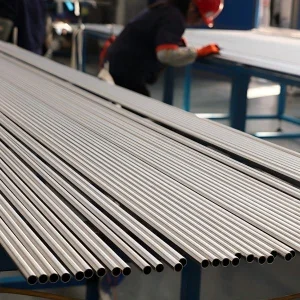
Seamless 321 pipes are produced from high-purity, vacuum-degassed round billets. The process uses hot rotary piercing followed by cold pilgering or multi-pass cold drawing over hard metal mandrels. Cold working refines grain structure, ensures concentric wall thickness tolerances within ±10%, and delivers smooth internal surface profiles suitable for high-velocity fluid flow.
Welded & Drawn (W&D) Route (ASTM A249 / A312)
Welded 321 pipe is manufactured from continuous cold-rolled strip using automated Gas Tungsten Arc Welding (GTAW/TIG) or High-Frequency Plasma Arc Welding without filler metal additions. The weld seam undergoes full-body cold sinking or bead working to align the weld metal micro-geometry with the parent tube body before final heat treatment.
Stabilizing Heat Treatment Protocol
Standard solution annealing occurs between 1040°C and 1120°C followed by rapid water quenching. For critical high-temperature service within the sensitization range, a secondary Stabilization Heat Treatment at 870°C to 900°C for 2 to 4 hours is applied. This forces the complete reaction of available carbon with titanium, maximizing resistance to intergranular stress corrosion cracking.
Quality Verification & Non-Destructive Testing (NDT) Standards
To guarantee zero-defect integrity under high operating pressures and temperature cycles, every batch of custom 321 stainless steel pipes undergoes rigorous quality verification:
- Intergranular Corrosion Testing: Performed according to ASTM A262 Practice E (Copper-Copper Sulfate-16% Sulfuric Acid Test / Strauss Test) and Practice C (Huey Test) to verify absence of chromium-depleted grain boundaries.
- Hydrostatic Testing: 100% full-length pressure testing according to ASTM A999/A999M, holding pressure up to 20 MPa (3000 psi) without leakage or permanent deformation.
- Eddy Current & Ultrasonic Testing (UT): Non-destructive electromagnetic and ultrasonic shear-wave testing per ASTM E213 and ASTM E309 to detect longitudinal and transverse internal flaws.
- Dimensional & Surface Profilometry: Precision laser gauging for outside diameter (OD), wall thickness (WT), ovality, straightness (1 mm/m), and internal surface roughness ($Ra \le 0.4 \mu m$ for bright annealed finishes).
3. Global Industrial Ecosystem & Macro Market Dynamics
Demand for customized 321 and 321H stainless steel piping is driven by global growth in energy processing, heavy chemical manufacturing, low-emission propulsion, and decarbonization infrastructure. As process engineers raise furnace operating temperatures to maximize thermal efficiency and yields, stabilized austenitic piping remains a cost-effective alternative to expensive nickel-base alloys like Alloy 600 or Alloy 800H.
Petrochemical Refining & Hydroprocessing
In Fluid Catalytic Cracking (FCC) units, hydrotreaters, and thermal cracking heaters, 321 stainless steel pipes transport high-temperature hydrocarbon streams containing polythionic acid and hydrogen sulfide ($H_2S$). Grade 321 resists polythionic acid stress corrosion cracking (PASCC) during shutdown turnarounds, where moisture and oxygen interact with iron sulfide scales.
Aerospace Exhaust & Thermal Recirculation
Due to its high yield strength, fatigue endurance, and oxidation resistance up to 816°C, TP321 is widely used in aircraft engine manifold systems, APU exhaust ducting, turbocharger casings, and expansion joints. It withstands rapid thermal shock cycles during engine startup and throttle escalation.
Power Generation & Biomass Syngas
Superheater tubes, reheater coils, and steam headers in modern coal-fired, biomass gasification, and waste-to-energy power plants rely on 321H pipes for creep rupture strength above 600°C. Controlled carbon contents (0.04% to 0.10%) provide long-term structural integrity under high internal pressures.
4. Field Case Studies & Localized Engineering Solutions
Real-world operational environments present complex combinations of high temperatures, mechanical vibration, and corrosive media. Below are field applications demonstrating the performance of custom engineered 321 stainless steel pipe solutions:
Case Study 1: Refinery Hydrogen Generation Reformer Furnace
Challenge: Severe intergranular cracking in standard 304 heat exchanger tubes exposed to steam-methane reforming gas at 650°C during maintenance shutdowns.
Solution: Upgraded to custom ASTM A312 TP321H seamless pipes with a mandatory stabilization heat treatment at 890°C for 3 hours.
Result: Zero intergranular stress corrosion failures over 60 months of continuous operation, extending furnace turnaround intervals by 40%.
Case Study 2: Marine Gas Turbine Thermal Exhaust System
Challenge: Premature cracking in thin-walled exhaust duct pipes caused by thermal fatigue and sulfur-bearing marine combustion gas at 720°C.
Solution: Implementation of custom cold-drawn bright-annealed 321 pipes with controlled grain size (ASTM No. 6–8) and tight wall uniformity.
Result: High-cycle fatigue life increased by 250%, eliminating vibration-induced crack propagation in salt-spray marine environments.
5. Global Standards Compliance & Regulatory Alignment
To simplify international procurement and project execution, our 321 stainless steel pipes are manufactured, tested, and certified to meet global pressure equipment standards, design codes, and third-party inspection protocols.
ASME / ASTM Codes
Full compliance with ASME Boiler & Pressure Vessel Code (BPVC) Section II, Section VIII Division 1/2, ASTM A312 (Seamless/Welded Pipes), ASTM A213 (Boiler/Superheater Tubes), and ASTM A249 (Heat Exchanger Tubes).
European Pressure Equipment Directive (PED)
Certified per PED 2014/68/EU Annex I for pressure installations across the EU, with materials adhering to EN 10216-5 (Seamless stainless steel tubes) and EN 10217-7 (Welded stainless steel tubes).
EN 10204 3.1 / 3.2 Traceability
Shipments include EN 10204 Type 3.1 Material Test Certificates detailing heat chemistry, mechanical properties, NDT results, and grain size. Independent Type 3.2 inspection (TÜV, SGS, Lloyd’s Register, DNV) available upon request.
NACE MR0175 / ISO 15156 Sour Service
Custom solution-annealed and stabilized 321 piping produced under strict hardness controls (max 22 HRC) to meet NACE standards for wet $H_2S$ sour gas extraction and processing equipment.
6. Technology Roadmap: Next-Generation High-Temperature Alloy Tubing
As industrial operations push toward higher efficiency, hydrogen combustion, and net-zero emissions, high-temperature piping must meet increasingly strict thermal and mechanical performance standards. Our R&D engineering program focuses on advanced manufacturing innovations for stabilized austenitic alloys:
Grain Size Engineering for Elevated Creep Life
By deploying advanced thermomechanical processing during cold pilgering, we achieve precise microstructural control of ASTM grain sizes (coarser than ASTM No. 7 for 321H). Coarser grains increase creep rupture strength above 650°C without sacrificing room-temperature ductility or weldability.
Ultra-Clean Vacuum Induction Melting (VIM)
Utilizing double-melt VIM + ESR (Electroslag Remelting) raw material feedstocks lowers non-metallic inclusions, oxygen, and trace sulfur levels to below 0.005%. This significantly improves internal cleanliness, fatigue life, and high-velocity gas erosion resistance.
Aluminized Surface Diffusion Barrier Coatings
For extreme environments exposed to high-temperature carburization, metal dusting, or hot volcanic sulfur gas, we provide internal surface diffusion aluminizing. This creates a protective micro-thin $Al_2O_3$ scale that extends tube life up to 950°C.
7. Technical Frequently Asked Questions (FAQ)
Expert responses to technical questions from engineering buyers, metallurgists, and quality control managers regarding 321 stainless steel piping.