
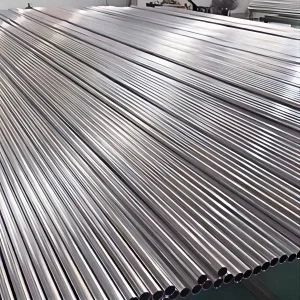
Explore our precision-drawn and seamless heat exchanger tubing portfolio manufactured to strict ASTM, ASME, and EN technical specifications.








In modern industrial process plants, thermal management systems operate under increasingly severe conditions. Shell and tube heat exchangers handling aggressive hydrocarbon streams, sour gas, or high-chloride cooling water demand structural materials that bridge the gap between standard austenitic stainless steels (such as 316L) and highly expensive nickel-base alloys.
Custom Duplex Steel UNS S31803 (EN 1.4462 / Alloy 2205) represents a metallurgical breakthrough engineered specifically to mitigate catastrophic chloride stress corrosion cracking (CSCC) while offering roughly double the yield strength of standard austenitic grades. UNS S31803 features a balanced dual-phase microstructure comprising approximately equal proportions of body-centered cubic (BCC) ferrite and face-centered cubic (FCC) austenite.
The operational longevity of heat exchanger tubing in saline and acidic environments depends directly on its Pitting Resistance Equivalent Number (PREN). The precise chemical balance of UNS S31803 ensures a minimal PREN value of 34, calculated via the standard formula: PREN = %Cr + 3.3(%Mo + 0.5%W) + 16(%N).
| Element | Chromium (Cr) | Nickel (Ni) | Molybdenum (Mo) | Nitrogen (N) | Carbon (C) | Iron (Fe) |
|---|---|---|---|---|---|---|
| Nominal Weight % | 21.0 – 23.0% | 4.5 – 6.5% | 2.5 – 3.5% | 0.14 – 0.20% | ≤ 0.030% | Balance |
| Metallurgical Role | Passive Oxide Film Formation | Austenite Phase Stabilizer | Crevice Corrosion Resistance | Interstitial Solid Solution Strengthening | Prevents Sensitization / Carbide Ppt. | Base Matrix Structure |
While UNS S31803 was the original specification for 22Cr duplex steel, the updated UNS S32205 standard enforces tighter minimum limits on Chromium (22.0%), Molybdenum (3.0%), and Nitrogen (0.14%). Our custom shell and tube heat exchanger tubing is manufactured to dual-certified UNS S31803/S32205 standards, providing end users with maximum corrosion protection and compliance across global engineering codes.
| Alloy Grade | Yield Strength 0.2% (MPa) | Tensile Strength (MPa) | Thermal Expansion Coeff. (10⁻⁶/K) | Chloride SCC Susceptibility |
|---|---|---|---|---|
| Austenitic 316L (UNS S31603) | ≥ 220 | ≥ 520 | 16.5 | High (Fails > 60°C in chlorides) |
| Duplex UNS S31803 / S32205 | ≥ 450 | ≥ 620 | 13.0 | Immune under standard process conditions |
| Super Duplex UNS S32750 (2507) | ≥ 550 | ≥ 750 | 12.5 | Extremely Low |
| Nickel Alloy 825 (UNS N08825) | ≥ 240 | ≥ 580 | 14.0 | Immune |
Shell and tube heat exchangers remain the mechanical backbone of global energy transition, hydrocarbon processing, and desalination infrastructure. UNS S31803 tubing delivers tailored solutions across multi-sector process loops.
In hydrotreating units and sour water strippers, thermal exchange tubes are exposed to wet H₂S, ammonium bisulfide (NH₄HS), and chlorides. UNS S31803 tubing, fully compliant with NACE MR0175/ISO 15156, prevents sulfide stress cracking (SSC) and hydrogen-induced cracking (HIC).
Multi-Effect Distillation (MED) and Multi-Stage Flash (MSF) desalination plants require heat transfer surfaces capable of surviving high-velocity concentrated seawater up to 90°C. UNS S31803 offers robust erosion-corrosion resistance, replacing costly cupronickel tubing.
In Vinyl Chloride Monomer (VCM) and organic acid distillation columns, thermal reboilers suffer from severe crevice corrosion underneath tube sheet joints. UNS S31803's high Molybdenum and Nitrogen content prevents localized pitting beneath deposits.
Producing high-reliability heat exchanger tubing requires rigorous metallurgical control during cold drawing and thermal processing to eliminate intermetallic phase precipitation (such as Sigma σ and Chi χ phases).
Tubes undergo cold rolling (pilgering) or precision cold drawing to achieve exact dimensional tolerances (ASTM A789/A790). This process ensures uniform wall thickness, tight concentricity, and smooth internal ID surface finish (Ra < 0.4 µm) to minimize fluid resistance.
Tubes are rapidly heated to 1020°C – 1100°C (1870°F – 2010°F) in a hydrogen-rich atmosphere, followed by immediate water quenching. This rapid cooling prevents chromium carbide precipitation and ensures a pristine 50/50 ferrite-austenite phase equilibrium.
Every single tube length undergoes combined Eddy Current Testing (ECT) per ASTM E426 and Hydrostatic Testing up to 300 bar (4,350 psi). Ultrasonic Testing (UT) is performed for nuclear and critical offshore applications.
From a CAPEX and OPEX optimization standpoint, specifying Duplex Steel UNS S31803 over conventional 300-series austenitic stainless steels yields substantial financial and operational benefits over a heat exchanger's design life.
Because UNS S31803 possesses double the yield strength of 316L (≥450 MPa vs ≥220 MPa), mechanical design engineers working under ASME Section VIII Division 1 can calculate significantly thinner tube wall requirements. Thinner tube walls translate directly to a 20%–30% reduction in overall bundle weight, lower freight costs, and reduced material spend.
Unscheduled outages caused by tube leaks cost chemical refineries millions of dollars daily. UNS S31803's immunity to chloride stress corrosion cracking eliminates premature thermal fatigue failures, extending bundle replacement cycles from 3–5 years to over 20 years in typical process loops.
UNS S31803 exhibits a lower coefficient of thermal expansion (13.0 × 10⁻⁶/K) than 316L (16.5 × 10⁻⁶/K), closer matching carbon steel tube sheet behavior. This reduces differential thermal stress on welded tube-to-tubesheet joints while maintaining optimal heat flux.
Navigating global engineering procurement requires uncompromised compliance with regional boiler and pressure vessel codes. Every shipment of Spezilla duplex tubing is backed by comprehensive quality documentation and regional engineering consultation.
Manufactured to global pressure vessel standards: ASME SA789 / SA789M, ASTM A789 / A790, EN 10216-5 (Seamless), and EN 10217-7 (Welded). Fully compliant with the European Pressure Equipment Directive (PED 2014/68/EU Annex I) and AD 2000-W2.
Orders are dispatched with EN 10204 Type 3.1 Material Test Certificates detailing complete heat chemistry, grain size, impact testing (-40°C), and microstructural phase counts. EN 10204 3.2 inspection with independent third parties (TÜV, DNV, Lloyd's, BV) is provided on demand.
Custom U-bent tubing supplied with tight radius tolerances per TEMA R/B/C standards. Post-bending stress-relief heat treatment is conducted on bent areas to ensure full resistance to stress corrosion cracking across the bend zone.
As process industries transition toward net-zero targets, carbon capture, and green hydrogen economies, heat exchange equipment must adapt to novel process streams and higher operating efficiency demands.
Custom UNS S31803 tubing is increasingly specified for high-pressure ammonia heat exchangers and hydrogen transport preheaters, where resistance to nitriding and hydrogen embrittlement is essential.
Development of internal micro-finned and low-finned duplex tubes increases thermal surface area by up to 150% without expanding the physical heat exchanger shell size, optimizing space on offshore platforms.
Through closed-loop electric arc furnace (EAF) steelmaking using >80% recycled scrap, Spezilla duplex tubing reduces embodied carbon emissions by over 45% compared to blast-furnace routes.
In-depth technical responses to common engineering and procurement questions regarding material selection, sizing, welding, and quality standards.
UNS S31803 (22Cr Duplex) provides twice the yield strength of 316L (≥450 MPa vs ≥220 MPa) and superior pitting resistance (PREN ≥ 34 vs ~24). Crucially, UNS S31803 is virtually immune to chloride stress corrosion cracking (CSCC) at operating temperatures where 316L routinely fails (>60°C in chloride-bearing fluids).
Seamless tubes (ASTM A213/A789) are required for extreme high-pressure applications (exceeding 200 bar) or design codes prohibiting longitudinal welds. Welded & Cold Drawn (W&D) tubes (ASTM A249/A789) undergo post-weld cold working and solution annealing, restoring full weld-zone corrosion resistance while offering superior wall thickness uniformity and concentricity at lower cost.
UNS S31803 is fully qualified under NACE MR0175 / ISO 15156-3 for sour service, provided the material is in the solution-annealed condition, has a hardness below 28 HRC (or 290 HBW), and partial pressure of H₂S does not exceed limits specified in the standard for 22Cr duplex alloys.
Spezilla supplies custom UNS S31803 heat exchanger tubing in outside diameters (OD) from 4.00 mm to 114.30 mm (0.157" to 4.5"), wall thicknesses (WT) from 0.40 mm to 3.05 mm (0.016" to 0.120"), and continuous straight lengths up to 25,000 mm (82 feet).
Because UNS S31803 has high yield strength and work-hardening rates, roller expansion requires precise control of torque and wall reduction (typically 5%–8%). Strength welding followed by light expansion is recommended. Tubesheet holes must be clean, and tubesheet material should match or be clad with duplex or nickel alloy.
Every shipment includes an original EN 10204 Type 3.1 MTC containing heat number traceability, full chemical analysis, mechanical property test results, microstructural phase ratio (ASTM E562), intergranular corrosion test results (ASTM A262 Pr. E / ASTM A923 Method C), and NDT reports. Third-party EN 10204 3.2 inspection certificates can be provided upon request.
Explore additional high-performance austenitic, super austenitic, nickel alloy, and super duplex tubing options for extreme engineering environments.







Request a Custom Technical Quotation
Partner with Spezilla Tube Co., Ltd. for certified Duplex Steel UNS S31803 shell and tube heat exchanger tubing. Send us your project drawings, design codes, or material datasheets for immediate engineering review.
