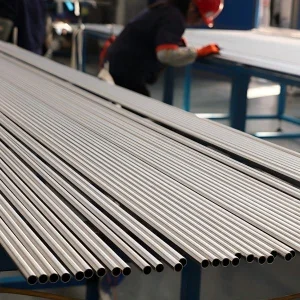
Austenitic & Specialty Alloy Tubing Series
Explore our engineered inventory of custom welded and drawn stainless steel, nickel alloy, and super duplex tubing built for severe heat exchanger and process environments.








Engineering Fundamentals of Custom Welded 304 Stainless Steel Tubing
Grade 304 austenitic stainless steel (UNS S30400, EN 1.4301, ASME TP304) represents the universal benchmark for corrosion-resistant fluid conveyance and structural tubing across global manufacturing sectors. Consisting nominally of 18% chromium and 8% nickel, welded 304 tubing derives its structural resilience from a face-centered cubic (FCC) crystal lattice. When produced via high-precision continuous roll-forming and automated tungsten inert gas (TIG) or laser welding, welded 304 stainless steel tubing delivers exceptional mechanical toughness, deep-drawing ductility, and uniform wall thickness tolerances impossible to achieve in conventional hot-finished seamless pipes.
In modern engineering procurement, specified custom welded 304 tubing requires rigorous metallurgical control. The integration of modern cold-drawing techniques—producing Cold Drawn Welded (CDW) tubing—refines the weld microstructure, homogenizes the heat-affected zone (HAZ), and elevates yield strength through controlled work hardening. Consequently, custom welded 304 tubes are increasingly specified in place of seamless tubing for heat exchangers, condensers, sanitary piping, and high-pressure hydraulic circuitry, offering superior dimensional accuracy and micro-inch surface smoothness at a significantly optimized total cost of ownership.
Weld Seam Integrity & Weld Factor (V=1.0)
Utilizing non-filler autogenous TIG welding or high-power orbital laser welding ensures zero chemical degradation along the seam. Post-weld inline bead reduction and bright annealing guarantee a full weld efficiency factor (V=1.0), matching the parent metal's burst pressure capacity under ASME Boiler and Pressure Vessel Code (BPVC) standards.
Preventing Intergranular Sensitization
Rapid cooling after high-temperature hydrogen annealing (1040°C to 1120°C) suppresses chromium carbide precipitation ($Cr_{23}C_6$) at grain boundaries. For critical welding applications, low-carbon variants such as TP304L (C ≤ 0.030%) are custom manufactured to eliminate sensitization risks entirely during secondary field fabrication.
Surface Topography & Bore Micro-Finish
Through precision plug drawing and automated mechanical polishers, custom internal diameter (ID) roughness profiles down to Ra < 0.4 µm (15 µin) are achieved. This eliminates microscopic crevices, preventing localized pitting corrosion and biofilm accumulation in biopharmaceutical and sanitary applications.
Why Direct Sourcing from China Custom 304 Welded Tubing Factories Delivers Competitive Superiority
Global industrial procurement managers face continuous pressures to balance stringent metallurgical compliance with tight project budgets and supply timelines. Over the past two decades, China’s stainless steel manufacturing ecosystem has transformed into a high-technology industrial hub. Leading Chinese stainless steel tube factories integrate raw steel melting, precision strip cold-rolling, continuous automated welding lines, and rigorous non-destructive testing under unified, vertically integrated production hubs.
Vertical Raw Material Integration & Cost Efficiency
Chinese factory direct sourcing taps into concentrated upstream raw material supply chains (such as Tsingshan, TISCO, and Baosteel). By sourcing ultra-pure 304 mother coil stock featuring controlled trace elements (S ≤ 0.005%, P ≤ 0.025%), Chinese mills minimize raw material cost fluctuations while maintaining strict chemical heat purity. The resulting cost-performance advantage translates into 15% to 30% capital expenditure savings for international EPC contractors compared to European or North American stockists.
Advanced Manufacturing Technology & Capacity Scale
Equipped with multi-head TIG, Plasma Arc, and Laser welding lines integrated with online eddy current seam monitoring, modern Chinese tubing factories operate continuous production lines capable of high volume and custom small-batch production flexibility. Fast tooling changeovers permit outer diameters ranging from capillary sizes (OD 4.00 mm) to large-diameter process pipes (OD 114.30 mm and above) with custom wall thickness variations.
Comprehensive QA/QC Compliance & EN 10204 3.1 Traceability
Tier-1 Chinese suppliers operate fully accredited ISO 9001, ISO 14001, and PED 2014/68/EU quality management systems. Every bundle of custom welded 304 tube is released with transparent Mill Test Certificates (MTC) conforming to EN 10204 3.1 or independent 3.2 third-party inspection (TÜV, SGS, Lloyd’s Register), providing full heat-number traceability from raw ingot to final hydro-tested tube.
Agile Export Logistics & Global OEM Customization
Proximity to major deep-water maritime ports like Shanghai and Ningbo allows Chinese manufacturers to offer expedited ocean and air freight logistics. Coupled with extensive secondary fabrication capabilities—such as precision coil winding, U-bend heat exchanger tube bending, flaring, swaging, and custom laser cut-to-length services—Chinese factories act as total solution partners rather than simple commodity vendors.
Macro Trends Shaping the Next Generation of Welded 304 Stainless Steel Tubing
The global stainless steel tubing landscape is undergoing a structural transition driven by industrial automation, rigorous decarbonization mandates, and high-purity fluid technology. Custom welded 304 stainless steel tubing suppliers are continuously innovating to meet these next-generation industrial requirements.
Industry 4.0 Smart Inline Testing
Leading factories are replacing offline manual inspections with fully digitized inline smart quality assurance systems. Real-time digital Eddy Current Testing (ECT) combined with laser-micrometer wall thickness tracking scans 100% of the weld seam at full mill speeds, logging localized anomalies directly into cloud-accessible quality databases.
Hydrogen & Cryogenic Infrastructure
As global energy sectors pivot toward clean hydrogen and LNG distribution, welded 304/304L tubes engineered for cryogenic toughness down to -196°C are experiencing surged demand. Modern cold-drawing practices optimize grain boundaries to prevent hydrogen embrittlement in medium-pressure refueling lines.
Green Steel & Low-Carbon Manufacturing
In response to Europe’s Carbon Border Adjustment Mechanism (CBAM), top-tier Chinese tube manufacturers are adopting renewable solar micro-grids and Electric Arc Furnace (EAF) steel coils made with high scrap ratios, shrinking the carbon footprint per metric ton of finished tubing by over 40%.
Global Standards Matrix for Custom Welded 304 Stainless Steel Tubing
When submitting Request for Quotations (RFQs) to custom welded 304 stainless steel tubing suppliers, referencing exact international standard designations ensures compliance with operational design codes. Below is an engineering comparison matrix of primary tubing standards.
| Standard | Application Scope | Dimensional Range | Heat Treatment | Testing Requirements |
|---|---|---|---|---|
| ASTM A249 / A249M | Welded Austenitic Steel Boiler, Superheater, Heat-Exchanger, & Condenser Tubes | OD: 1/8" to 5" (3.18 - 127 mm) WT: 0.015" to 0.320" (0.4 - 8.1 mm) |
Bright Annealed or Solution Annealed (min. 1040°C) | Hydrostatic / Eddy Current, Flattening, Flange, Reverse Bend, Hardness |
| ASTM A269 / A269M | Seamless and Welded Austenitic Stainless Steel Tubing for General Service | OD: 1/4" and larger WT: 0.020" (0.5 mm) and nominal |
Solution Heat Treated / Bright Annealed | Flaring, Intergranular Corrosion Test (ASTM A262), Hydro/NDT |
| ASTM A312 / A312M | Seamless, Welded, and Heavily Cold Worked Austenitic Stainless Steel Pipes | NPS 1/8" to 30" Schedules 5S to 80S |
Solution Annealed & Water Quenched | Transverse/Longitudinal Tension, Weld Decay Test, Radiographic NDT |
| EN 10217-7 | Welded Steel Tubes for Pressure Purposes - Stainless Steel Tubes | Custom Mill Standard / Metric Ranges | Solution Annealed (+AT) | EN ISO 10893 Eddy Current / Ultrasonic, Leakage Testing, Dimensional |
| ASTM A554 | Welded Stainless Steel Mechanical & Architectural Tubing | Round, Square, Rectangular OD up to 16" (406.4 mm) |
As-Welded or Annealed (Optional) | Dimensional Tolerances, Visual Inspection, Surface Roughness Check |
Industrial Application Scenarios for Custom Welded 304 Stainless Steel Tubing
Custom welded 304 tubing serves as an essential structural and fluid-conveyance building block across a wide range of industrial verticals. Below are key deployment scenarios where engineered 304 tubing delivers high operational reliability.
Shell-and-Tube Heat Exchangers & Condensers
In petrochemical refineries, chemical processing plants, and power generation facilities, thermal exchange units require thousands of thin-wall U-bent tubes capable of resisting thermal cycling and vibration fatigue. Custom welded 304 tubes compliant with ASTM A249/A688 provide exceptionally uniform wall thickness, ensuring consistent heat transfer coefficients across entire tube bundles while preventing localized stress points during tube-to-tubesheet expanding.
Hygienic Food, Dairy & Beverage Lines
Sanitary process lines require complete freedom from bacterial traps. Custom welded 304 sanitary tubing manufactured to ASTM A270 standards undergoes full ID mechanical polishing or electro-polishing to achieve sub-0.4 µm Ra finishes. Combined with Clean-in-Place (CIP) compatibility, these tubes ensure zero fluid contamination in breweries, dairy bottling systems, and pharmaceutical fluid handling loops.
Automotive Exhaust & EGR Cooling Modules
Modern automotive engineering utilizes thin-walled custom welded 304 tubing in Exhaust Gas Recirculation (EGR) coolers and catalytic converter housings. The alloy’s resistance to high-temperature oxidation (up to 870°C) and acidic exhaust condensate prevents pinhole corrosion, assisting global OEMs in meeting strict EURO 6 and EPA emissions mandates.
Architectural & Structural Systems
For high-end commercial architecture, airport terminals, and marine handrails, decorative custom welded 304 tubing manufactured to ASTM A554 offers high structural strength alongside premium satin, mirror (800 Grit), or PVD-coated finishes that withstand atmospheric weathering without degradation.
Frequently Asked Questions (FAQ)
Direct metallurgical and procurement answers provided by senior technical engineering directors.
What is the key functional difference between Welded 304 and Cold Drawn Welded (CDW) 304 tubing?
Standard as-welded 304 tubing is roll-formed from annealed strip and welded without secondary seam deformation, leaving a minor internal weld bead height. Cold Drawn Welded (CDW) tubing passes through an external die and over an internal precision mandrel post-welding. This cold-drawing process cold-works both weld seam and parent metal, completely erasing the internal bead, refining grain structure, improving concentricity, and boosting mechanical tensile strength by up to 20%.
How does custom welded 304 tubing perform against Chloride Stress Corrosion Cracking (SCC)?
Like all standard 18/8 austenitic alloys, Grade 304 is susceptible to Chloride Stress Corrosion Cracking (SCC) in environments exceeding 60°C (140°F) with concentrated chloride ions. For such aggressive environments, custom factory options include upgrading to molybdenum-bearing Grade 316L (UNS S31603) or Duplex Grade 2205 (UNS S32205). However, for low-temperature or moderate chloride services, solution bright annealing custom 304 tubes effectively eliminates residual stress, significantly improving SCC resistance.
What Non-Destructive Testing (NDT) procedures verify the weld seam quality before shipment?
Every industrial-grade custom welded 304 tube undergoes 100% Non-Destructive Testing. The primary standard method is continuous inline Eddy Current Testing (ECT) conforming to ASTM E426 or EN ISO 10893-2, capable of identifying surface and subsurface micro-cracks. Additionally, tubes undergo hydrostatic pressure testing (up to 200 bar/2900 psi depending on wall thickness) or pneumatic underwater bubble testing to guarantee zero seam leakage.
Can welded 304 stainless steel tubing replace seamless tubing under ASME Boiler & Pressure Vessel Code?
Yes. Under ASME BPVC Section VIII Division 1 (and Section I), welded 304 tubing manufactured to pressure standards like ASTM A249 or ASTM A312 is fully approved for design calculations. When full NDT seam verification and bright annealing are performed, a joint efficiency factor of E=1.0 is assigned, allowing equivalent wall thickness design pressures as seamless tubing while providing superior wall uniformity.
What custom length tolerances and packaging protections are available for ocean export?
Custom factory lengths are produced up to 25,000 mm (25 meters) straight lengths or continuous un-welded coils up to 1,000 meters depending on outer diameter. For international export, tubes are fitted with plastic end-caps, wrapped in protective moisture-proof polyethylene film, bundle-strapped, and encased in ISPM-15 compliant fumigated wooden cases or reinforced steel-frame crates to prevent sea-spray corrosion and physical transit damage.
Super Duplex, Nickel Alloy & High-Temp Austenitic Series
Browse our specialized high-performance tube catalog for severe heat treatment, acidic media, and marine salt environments.