
Precision Engineering in Titanium-Stabilized Austenitic Stainless Tubing
In demanding high-temperature industrial processing environments—ranging from jet engine exhaust collectors to refinery hydrodesulfurization units—material degradation due to intergranular corrosion (IGC) represents a primary structural risk. 321 Stainless Steel Tubing (UNS S32100 / 1.4541 / ASME SA213 SA312 TP321) stands as the premier titanium-stabilized austenitic steel solution engineered to eliminate chromium carbide precipitation within the critical sensitization range of 427°C to 816°C (800°F to 1500°F).
As an authoritative manufacturer and global supplier, our mill integrates advanced cold pilgering, vacuum bright annealing, and rigorous NDT (Non-Destructive Testing) protocols to produce seamless and welded 321 tubing that consistently exceeds ASTM, ASME, EN, and ISO requirements. By adding titanium at a minimum concentration of five times the carbon plus nitrogen content ($\text{Ti} \ge 5 \times (\text{C}+\text{N})$), titanium carbides ($\text{TiC}$) form preferentially over chromium carbides ($\text{Cr}_{23}\text{C}_6$). This preserves the protective chromium oxide passive layer along grain boundaries, guaranteeing long-term mechanical reliability under severe thermal stress and aggressive chemical exposure.
Featured High-Performance Alloys & Tubing Solutions (Part 1)
Explore our precision-manufactured heat exchanger tubes, process pipes, and specialty alloy tubing compliant with international pressure vessel codes.


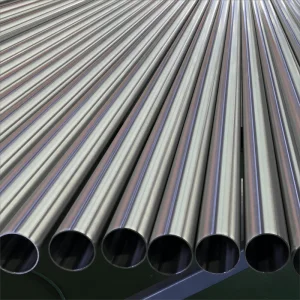

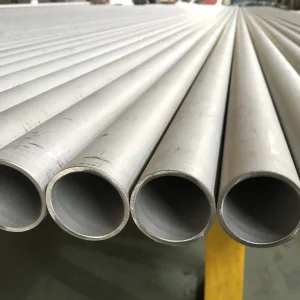



The Chemistry & Kinematics of 321 Stainless Steel (UNS S32100 / S32109)
Grade 321 is a basic 18/8 austenitic stainless steel (Grade 304) modified by adding Titanium. Unlike standard molybdenum-bearing grades like 316L, 321 relies on titanium stabilization to maintain high corrosion resistance following thermal cycles. When standard non-stabilized austenitic steels are exposed to temperatures between 427°C and 816°C, chromium atoms diffuse to the grain boundaries to bond with carbon, creating chromium-rich carbides ($\text{Cr}_{23}\text{C}_6$). This depletes the adjacent matrix of chromium below the 10.5% threshold required for passivity—a phenomenon known as sensitization.
By enforcing a strict Titanium-to-Carbon ratio, Grade 321 prevents this sensitization. Titanium has a far stronger thermodynamic affinity for carbon than chromium does. Consequently, $\text{TiC}$ forms evenly throughout the matrix prior to chromium carbide formation, keeping the grain boundary chromium levels intact.
| Material Standard | UNS / EN Grade | Carbon (C) | Titanium (Ti) | Chromium (Cr) | Nickel (Ni) | Yield Strength (Min) | Tensile Strength (Min) |
|---|---|---|---|---|---|---|---|
| ASTM A213 / ASME SA213 TP321 | S32100 / 1.4541 | 0.08% Max | 5×(C+N) to 0.70% | 17.0 - 19.0% | 9.0 - 12.0% | 205 MPa (30 ksi) | 515 MPa (75 ksi) |
| ASTM A213 / ASME SA213 TP321H | S32109 / 1.4878 | 0.04 - 0.10% | 4×(C+N) to 0.70% | 17.0 - 19.0% | 9.0 - 12.0% | 205 MPa (30 ksi) | 515 MPa (75 ksi) |
| ASTM A312 / ASME SA312 TP321 | S32100 Pipe | 0.08% Max | 5×(C+N) to 0.70% | 17.0 - 19.0% | 9.0 - 13.0% | 205 MPa (30 ksi) | 515 MPa (75 ksi) |
| EN 10216-5 / 1.4541 | X6CrNiTi18-10 | 0.08% Max | 5×C to 0.70% | 17.0 - 19.0% | 9.0 - 12.0% | 210 MPa | 500 - 730 MPa |
321 vs. 321H Microstructural Distinction
While Grade 321 is ideal for service up to ~816°C where corrosion resistance after welding is paramount, Grade 321H (UNS S32109) is specified for higher elevated creep environments ($>537^\circ\text{C}$). 321H requires higher carbon content (0.04–0.10%) and a controlled minimum solution annealing temperature of 1040°C, providing coarse grain size (ASTM No. 7 or coarser) for optimal long-term creep rupture strength.
321 vs. 316Ti (1.4571) Engineering Comparison
Both alloys are titanium-stabilized, but 316Ti contains 2.0–3.0% Molybdenum, boosting resistance to pitting corrosion in chloride-laden environments (PREN ~23-25). Grade 321 (PREN ~18-19) is favored for cost-effective high-temperature oxidation environments and acidic vapor loops where high chloride pitting is not the primary degradation mechanism.
Polythionic Acid SCC Prevention
In petroleum refineries, sulfur compounds form polythionic acid ($\text{H}_2\text{S}_x\text{O}_6$) during maintenance shutdowns. Unstabilized stainless steels suffer catastrophic intergranular stress corrosion cracking (PTA SCC). Stabilized 321 tubing undergoes heat treatments (stabilization anneal at 870°C–900°C) to eliminate PTA SCC failure risks entirely.
Localized Application Scenarios & Sector Solutions
Our 321 Stainless Steel Tubing is qualified and deployed across critical industrial operations globally. Discover how localized thermal and corrosion challenges are solved with our specialized tubing products.
Jet Engine Exhaust & Bleed Air Systems
Commercial aircraft engine exhaust collectors, tailpipes, and cabin heating bleed air lines operate under violent thermal cycling up to 800°C. Seamless 321 tubing provides superior fatigue strength, vibration damping, and scaling resistance under extreme pressure dynamics.
Hydrotreating & Catalytic Reforming Loops
Refinery furnace tubes, heat exchangers, and effluence piping handling hydrogen gas mixed with hydrogen sulfide ($\text{H}_2\text{S}$) at elevated temperatures rely on ASME SA213 TP321. The alloy prevents sulfur attack while eliminating post-weld heat treatment necessity in field installations.
Superheaters & Biomass Boiler Coils
In thermal power plants and waste-to-energy facilities, 321 and 321H U-bent heat exchanger tubes endure high radiant heat and flue gas exposure. Their resistance to high-temperature oxidation up to 850°C prevents wall thinning and premature tube rupture.
Turbocharger Feed & Exhaust Manifolds
Modern high-efficiency diesel and gasoline turbocharger systems use heavy-wall 321 stainless tubes for oil feed, wastegate actuators, and EGR (Exhaust Gas Recirculation) coolers, guaranteeing structural stability under corrosive exhaust condensate.
China Factory Supply Chain Resilience & Production Advantages
Operating from our state-of-the-art production hub in Huzhou, Zhejiang, backed by our international center in Shanghai, we provide unparalleled supply chain stability, competitive lead times, and rigorous quality assurance.
Fully Integrated Industrial Cluster
Our facility sits at the heart of the world’s most concentrated stainless steel industrial ecosystem. Raw material mother hollows, master alloy billets, high-precision cold pilger mills, and bright annealing gas supplies are co-located within a 50 km radius, reducing lead times from months to weeks.
End-to-End In-House Testing Capabilities
We maintain full control over quality without outsourcing. Every batch undergoes 100% Non-Destructive Eddy Current Testing (ET) and Hydrostatic testing up to 300 Bar, along with destructive mechanical testing, grain size verification (ASTM E112), and IGC testing per ASTM A262 Practice E.
Lean Production Lead-Time & Flexibility
Compared to European mills with 16–24 week lead times, our digitized scheduling and raw material stock inventory enable standard orders of seamless 321 tubing to ship within 15–30 days, while keeping custom dimensions fully compliant with international buyer standards.
Technology Roadmap: Next-Gen Processing & Energy Transition
As industrial energy systems shift toward decarbonization, material standards demand higher purity, lower inclusion rates, and superior thermal fatigue performance. Our manufacturing R&D roadmap for 321 Stainless Steel Tubing addresses these emerging technical requirements:
Ultra-Clean Vacuum Bright Annealing (VBA)
Eliminating titanium nitride ($\text{TiN}$) macro-inclusions via electroslag remelting (ESR) and vacuum induction melting (VIM) raw stocks. Advanced VBA atmosphere control prevents surface nitriding and oxidation, ensuring mirror-smooth interior surface roughness ($\text{Ra} \le 0.4\,\mu\text{m}$) for high-purity applications.
Hydrogen Economy & SOEC Tubing Compatibility
High-temperature Solid Oxide Electrolyzer Cells (SOEC) operating at 700°C to 850°C require interconnect lines immune to steam oxidation and hydrogen embrittlement. Stabilized 321 tubing is currently being validated for high-temperature steam loops in green hydrogen synthesis plants.
Additive Manufacturing & Hybrid Tube Bending
Integrating 3D-laser printed complex 321 manifold blocks with precision cold-drawn seamless 321 tubing using automated orbital TIG welding. This hybrid manufacturing approach reduces stress concentrations in aerospace fluid routing networks.
Global Commercial & Industrial Compliance Guarantee
Navigating international pressure equipment directives requires comprehensive material documentation. Our 321 stainless steel tubing fully complies with key regional standards, enabling frictionless integration into global EPC contracts:
North American ASME Code Compliance
Manufactured per ASME Boiler and Pressure Vessel Code (BPVC) Section II Part A (SA213 / SA312 / SA269). Fully compliant with ASME B31.3 Process Piping and ASME B31.1 Power Piping design allowable stress tables up to 816°C.
European PED 2014/68/EU & AD 2000-W0
Certified under Pressure Equipment Directive (PED) with EN 10204 3.1 Mill Test Certificates containing complete heat heat-analysis, mechanical values, intergranular corrosion testing (EN ISO 3651-2 Method A), and non-destructive examination verification. Third-party EN 10204 3.2 inspection (TÜV, SGS, Lloyd's) is routinely executed upon request.
NACE MR0175 / ISO 15156 Sour Service
For oil & gas production environments containing sour gas ($\text{H}_2\text{S}$), our solution-annealed 321 tubing meets maximum hardness threshold limits (Rockwell B90 / 200 HV max), mitigating sulfide stress cracking (SSC) risks in upstream facilities.
Featured High-Performance Alloys & Tubing Solutions (Part 2)
Discover our complementary austenitic, super austenitic, titanium, and heat-resistant stainless steel tube products engineered for severe service environments.








Frequently Asked Technical & Engineering Questions (Q&A)
In-depth responses to common design, procurement, and welding questions regarding Grade 321 Stainless Steel Tubing.
Partner with a Trusted 321 Stainless Steel Tube Manufacturer
Whether you require custom ASME SA213 TP321 heat exchanger U-tubes, heavy-wall ASTM A312 TP321 process piping, or precision cold-pilgered instrumentation tubing, our technical engineering team provides full specification reviews, EN 10204 3.1 certification, and expedited global delivery.
