
Precision Corrosion-Resistant Tubing Portfolio
Explore our certified alloy tube inventory manufactured to rigid ASTM, ASME, EN, and MIL-SPEC engineering standards.




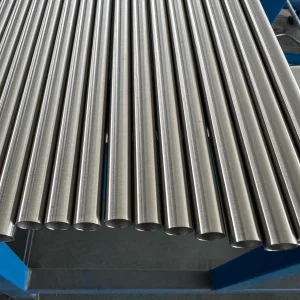



Metallurgical Architecture of Copper-Nickel Tubing Alloys
Understanding the thermodynamics, solid-solution matrix, and surface film passivation kinetics of CuNi 90/10 and CuNi 70/30.
Copper-nickel alloys (known generically as Cupro Nickel) represent a specialized family of copper-based binary alloys containing nickel as the primary strengthening element, augmented by micro-additions of iron ($\text{Fe}$) and manganese ($\text{Mn}$). The metallurgical superiority of cupro nickel tubing stems from the complete solid solubility of copper and nickel across all temperature ranges, yielding a single-phase face-centered cubic ($\text{FCC}$) crystal structure devoid of phase transformations during heat treatment.
In marine, industrial heat exchange, and desalination plants, two dominant grades dictate engineering specifications: CuNi 90/10 (UNS C70600 / EN CW352H / DIN 2.0872) and CuNi 70/30 (UNS C71500 / EN CW354H / DIN 2.0882). The inclusion of controlled iron content ($1.0\% - 1.8\%$ in C70600 and $0.4\% - 1.0\%$ in C71500) is critical; iron significantly enhances resistance to erosion-corrosion and velocity-induced shear stress in turbulent seawater channels.
The Self-Healing Protective Oxide Film Mechanism
Unlike stainless steels which rely on a chromium oxide ($\text{Cr}_2\text{O}_3$) passive layer vulnerable to localized pitting under anaerobic chloride deposits, cupro nickel forms an protective surface layer composed primarily of cuprous oxide ($\text{Cu}_2\text{O}$) overlaid by a nickel-doped ionic lattice ($\text{CuO} \cdot \text{Cu(OH)}_2$). When exposed to aerated seawater, this oxide film develops rapidly within 48 hours and continues to mature over 3 months, offering an extraordinary self-healing barrier against pitting, crevice corrosion, and micro-galvanic cell formation.
| Property / Parameter | CuNi 90/10 (UNS C70600) | CuNi 70/30 (UNS C71500) | Testing & Compliance Norms |
|---|---|---|---|
| Nominal Composition | Cu Rem, 10% Ni, 1.4% Fe, 1.0% Mn | Cu Rem, 30% Ni, 0.7% Fe, 1.0% Mn | ASTM B111 / ASME SB111 / DIN 17664 |
| Tensile Strength (Annealed, min) | 275 MPa (40 ksi) | 360 MPa (52 ksi) | ASTM E8 / EN ISO 6892-1 |
| Yield Strength (0.2% Offset, min) | 105 MPa (15 ksi) | 125 MPa (18 ksi) | ASTM E8 / EN ISO 6892-1 |
| Thermal Conductivity (20°C) | 50 W/m·K | 29 W/m·K | ISO 22007 Thermal Testing |
| Max Seawater Flow Velocity | 2.5 m/s (8.2 ft/s) | 3.5 - 4.5 m/s (11.5 - 14.7 ft/s) | BS 6349 / EEMUA 144 Guidelines |
| Resistance to Macro-Biofouling | Outstanding (Natural copper ion release) | Very High (Reduced dosing required) | ASTM G52 Ocean Exposures |
Global Standards & Engineering Specification Matrix
Rigorous dimensional controls, bright annealing processes, and mill quality verification for seamless and welded tubes.
ASTM & ASME Specifications
Manufactured in strict conformance with ASTM B111 / B111M (Seamless Copper and Copper-Alloy Condenser Tubes) and ASME SB111 for boiler and pressure vessel code construction (Section VIII, Division 1).
- ASTM B466 / B467 (Seamless & Welded Pipe)
- ASTM B543 (Welded Heat Exchanger Tubes)
- ASME SB543 Standards Compliance
European & Defense Standards
Engineered to satisfy European marine and defense specs, including DIN 86019, EEMUA 144 (Publication 144 for offshore tube systems), and BS 2871 Part 2 for naval surface ships and submarines.
- MIL-T-16420K (US Navy Specification)
- EN 12451 / EN 12449 Standards
- NES 779 / NES 780 Defense Specs
Dimensional Capability Range
Advanced cold drawing lines permit precise outer diameter (OD) and wall thickness (WT) manufacturing with minimal eccentricity and smooth inner surface finishes ($Ra < 0.4\,\mu\text{m}$).
- OD Range: 4.00 mm to 114.30 mm
- Wall Thickness: 0.40 mm to 3.05 mm
- Length: Straight up to 25,000 mm or U-Bends
Erosion-Corrosion Velocity Limits & Natural Antifouling Mechanism
Eliminating micro-biofouling while optimizing thermal efficiency in high-shear hydrodynamic environments.
The Science of Natural Antifouling
Macro-fouling by marine organisms—such as barnacles (Balanus amphitrite), blue mussels (Mytilus edulis), and macro-algae—presents a major operational challenge in seawater cooling loops. Traditional titanium and stainless steel heat exchangers require continuous chemical chlorination or biocide dosing to prevent biological growth from choking tube lumens.
Cupro nickel tubes naturally prevent biological attachment through a continuous, micro-controlled release of cuprous ions ($\text{Cu}^+$) from the passive film matrix. This ion release rate (typically between 10 to 20 $\mu\text{g}/\text{cm}^2/\text{day}$) creates a localized bio-inhibitory zone at the fluid-metal interface that prevents cyprid larvae settlement without causing environmental toxicity downstream.
Hydrodynamic Erosion-Corrosion Limits
Erosion-corrosion occurs when localized fluid shear stress exceeds the mechanical stripping threshold of the surface oxide film. Proper hydraulic sizing of cupro nickel tubing networks requires maintaining flow velocities within safe engineering boundaries:
- CuNi 90/10 (C70600): Maximum continuous design velocity of 2.5 m/s (8.2 ft/s) in pipe diameters $\ge 100\text{ mm}$.
- CuNi 70/30 (C71500): Maximum design velocity of 3.5 m/s (11.5 ft/s); can tolerate transient peak velocities up to 4.5 m/s in high-shear pump discharges.
- Minimum Anti-Silt Velocity: Maintain a minimum flow of 1.0 m/s (3.3 ft/s) to prevent suspended marine sediment settling in tube bottoms.
Turnkey Industrial Solutions & Application Domains
From seawater desalination complexes to offshore platform cooling headers, cupro nickel tubes deliver decades of maintenance-free service.
MSF & MED Desalination Plants
Specified as the primary tube material for Multi-Stage Flash (MSF) and Multi-Effect Distillation (MED) heat recovery sections. CuNi 90/10 withstands high-temperature brine evaporator environments up to 120°C without stress-corrosion cracking.
Naval Shipbuilding & Defense
Extensively deployed across US Navy, Royal Navy, and NATO surface fleets for seawater fire mains, cooling systems, hydraulic lines, and submarine condenser bundles conforming to MIL-T-16420K and NES 779.
FPSO & Offshore Oil & Gas
Floating Production Storage and Offloading (FPSO) vessels utilize CuNi 70/30 (C71500) for high-pressure seawater injection coolers, firewater rings, and topside process heat exchangers subject to severe sulfide-bearing marine atmospheres.
Localization Support & Non-Destructive Testing (NDT)
100% trace-certifiable mill production backed by EN 10204 3.1/3.2 certificates and independent 3rd-party inspections.
Rigorous Non-Destructive Testing (NDT)
Every length of cupro nickel tube manufactured in our facilities undergoes mandatory NDT verification prior to dispatch to eliminate subsurface defects, pinholes, or weld line micro-cracks:
- Eddy Current Testing (ECT): Conducted according to ASTM E243 to inspect seamless and welded tubes for longitudinal discontinuities.
- Hydrostatic Pressure Testing: Every tube is pressurized up to 20 MPa (2900 PSI) per ASTM B111 formula: $P = \frac{2St}{D - 0.8t}$.
- Pneumatic Air-Under-Water Test: Air pressure test at 0.7 to 1.0 MPa to verify 100% leak-tight integrity.
Regulatory & Mill Traceability Certification
We provide comprehensive material documentation packages tailored to international procurement standards and regional statutory authorities:
- EN 10204 Type 3.1 & 3.2 Inspection Certificates: Full chemical spectrographic analysis and mechanical batch test records.
- Independent Third-Party Verification: Witness testing available by Lloyd's Register (LR), Bureau Veritas (BV), Det Norske Veritas (DNV), and TÜV Rheinland.
- PMI (Positive Material Identification): 100% XRF optical emission spectrometry verifying Cu, Ni, Fe, and Mn percentages.
Technology Roadmap: Next-Gen Heat Transfer & Decarbonization
Advanced micro-finned surfaces, green hydrogen cooling systems, and circular metallic sustainability.
High-Efficiency Micro-Grooved Tubes
To meet global thermal efficiency imperatives, our advanced cold-forming mills produce internally micro-finned CuNi tubing. This design increases inner surface area by up to 160% and promotes boundary-layer turbulence, boosting overall heat transfer coefficients ($\mathbf{U}$-value) by 35% in condensation applications.
Green Hydrogen & CCUS Integration
As offshore hydrogen electrolysis and Carbon Capture, Utilization, and Storage (CCUS) projects scale globally, specialized CuNi 70/30 alloys are engineered to withstand moist carbon dioxide streams and high-pressure ocean heat sink rejection loops.
100% Circular Metal Recycling
Our manufacturing facilities achieve zero land-fill metallic efficiency. Scrap generated during drawing, trimming, and U-bending is 100% segregated by alloy grade and re-melted via induction furnaces, reducing embodied carbon dioxide equivalent ($\text{CO}_2\text{e}$) emissions by 78% relative to primary copper smelting.
Frequently Asked Questions by Procurement & Engineering Teams
Clear, definitive guidance on alloy selection, welding techniques, and operational maintenance.
Specialty Stainless, Duplex & Nickel Alloy Tubes
Complementary high-performance tubing engineered for extreme high-temperature and acid environments.






Request a Custom Technical Quotation or Datasheet Review
Our metallurgical engineers are ready to evaluate your heat exchanger drawings, corrosive media datasheets, and compliance requirements. Fast response within 24 business hours.
