
Precision Specialty Alloys & Industrial Tubing Solutions
Explore our primary range of precision-manufactured austenitic, duplex, nickel alloy, and titanium tubes engineered for critical fluid control and extreme heat transfer environments.


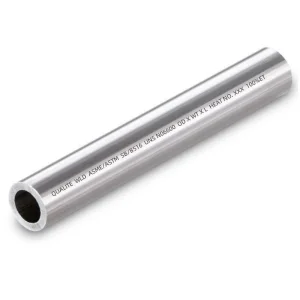




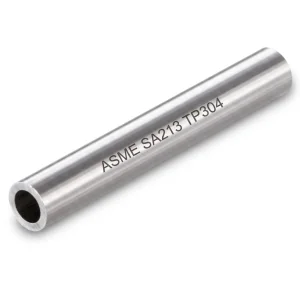
Metallurgical Architecture of Grade 5 Titanium (Ti-6Al-4V) Tubing
Grade 5 Titanium, systematically designated as UNS R56400 or Ti-6Al-4V (3.7165), represents the foundational pinnacle of modern structural titanium alloys. Classified as an alpha-beta ($\alpha+\beta$) dual-phase alloy, Gr5 titanium seamlessly harmonizes the exceptional elevated-temperature strength of an alpha-stabilized lattice with the high ductility, fracture toughness, and heat-treatability of a beta-phase microstructure. When engineered into seamless or high-integrity welded tubing, Gr5 delivers an extraordinary strength-to-weight ratio that remains unmatched by traditional austenitic stainless steels, nickel superalloys, or structural aluminum grades.
Crystallographic Dynamics & Phase Equilibrium
The core performance of Gr5 titanium tubing is governed by the synergistic interaction of its primary alloying elements: 6% Aluminum (Al) and 4% Vanadium (V).
- Alpha-Phase ($\alpha$) Stabilization: Aluminum functions as a potent substitutional $\alpha$-stabilizer, elevating the $\alpha \rightarrow \beta$ transus temperature (typically around $995^\circ\text{C} \pm 20^\circ\text{C}$). The close-packed hexagonal (HCP) lattice of the $\alpha$ phase imparts exceptional resistance to creep deformation, thermal oxidation, and stress-corrosion cracking (SCC).
- Beta-Phase ($\beta$) Stabilization: Vanadium acts as an isomorphous $\beta$-stabilizer, lowering the transformation temperature locally and stabilizing the body-centered cubic (BCC) crystal structure. The presence of the $\beta$ phase provides crucial slip systems that enhance cold transformability, high-strain fatigue toughness, and response to precipitation hardening treatments.
Strict Chemical Composition Standard (ASTM B338 / AMS 4928)
| Alloy Element | Weight Fraction (%) | Metallurgical Functional Role |
|---|---|---|
| Titanium (Ti) | Balance (~88.5 - 90.0%) | Base Metal Lattice Matrix |
| Aluminum (Al) | 5.50 – 6.75% | $\alpha$-Phase Substitutional Stabilizer, Increases High-Temp Strength |
| Vanadium (V) | 3.50 – 4.50% | $\beta$-Phase Isomorphous Stabilizer, Enhances Ductility & Hardening |
| Iron (Fe) | ≤ 0.45% (Max) | Eutectoid $\beta$-Stabilizer, Impurity Control |
| Oxygen (O) | ≤ 0.20% (Gr5) / ≤ 0.13% (ELI) | Interstitial Strengthening Agent (Must be strictly bounded) |
| Carbon (C) | ≤ 0.08% | Prevents TiC Carbide Network Precipitation |
| Nitrogen (N) | ≤ 0.05% | Interstitial Solid Solution Strengthening |
| Hydrogen (H) | ≤ 0.015% (150 ppm) | Prevents Hydride Formation and Hydrogen-Induced Cracking (HIC) |
Precision Manufacturing & Quality Control Architecture
Manufacturing Gr5 titanium tubing demands rigorous thermal and mechanical processing due to the alloy's high yield strength and low modulus of elasticity.
Vacuum Hot Extrusion & Cold Pilgering
Seamless Gr5 tubes start from vacuum-arc remelted (VAR) titanium billets. Billets are hot extruded into heavy-wall hollows at $900^\circ\text{C}-950^\circ\text{C}$. They then undergo multi-pass multi-roll cold pilgering (cold rolling over a stationary tapered mandrel), achieving precise reduction ratios up to 60% per pass while controlling grain orientation.
High-Vacuum Inert Atmosphere Annealing
To eliminate work-hardening and restore phase equilibrium, intermediate and final heat treatments are conducted in high-vacuum furnaces operating at pressures $\le 10^{-4}\,\text{mbar}$ or under ultra-pure Argon atmospheres ($99.999\%$). This prevents alpha-case formation—a brittle oxygen-enriched surface layer that severely impairs fatigue life.
Precision Weld Automation (GTAW & EBW)
For welded and drawn Gr5 titanium tubing, automated Gas Tungsten Arc Welding (GTAW/TIG) or Electron Beam Welding (EBW) is performed inside hermetically sealed vacuum chambers. Trailing shields with inert argon gas cover both internal bore and outer diameter to eliminate oxidation during liquid-to-solid transition.
Zero-Defect Non-Destructive Testing (NDT) Protocol
Every meter of Gr5 titanium tubing manufactured at Spezilla undergoes multi-layered quality control in compliance with ASTM B338, ASTM E213, and ASME Section III standards:
1. Ultrasonic Testing (UT)
Full-coverage rotary probe UT scanning detects longitudinal and transverse micro-flaws, inclusions, and wall thickness variations down to $\pm 0.02\,\text{mm}$.
2. Hydrostatic & Pneumatic Testing
Tubes are hydro-tested under pressures up to 100 MPa (14,500 PSI) or pneumatic underwater bubble-tested at 3.0 MPa to confirm structural seal integrity.
3. Eddy Current Testing (ECT)
High-frequency ECT identifies surface and sub-surface discontinuities in both seamless and welded tubes, eliminating micro-fissure risks before dispatch.
China Factory 4.0: Supply Chain Resilience & Cost-Efficiency Advantages
How modern industrial integration, digital twin automation, and domestic sponge titanium manufacturing provide global buyers with uncompromised quality, agile delivery, and competitive pricing.
1. Vertical Integration from Sponge Titanium to Precision Tube
Unlike regional re-drawers reliant on imported titanium hollows, China’s top-tier titanium manufacturing hubs leverage direct integration with domestic sponge titanium reduction facilities (such as those in Shaanxi and Sichuan). By controlling raw sponge chlorination, Kroll reduction, vacuum arc remelting (VAR), billet forging, and pilgering in one cohesive supply ecosystem, our operations eliminate raw material supply bottlenecks and protect buyers from global commodity price spikes.
This vertical alignment enables complete material traceability—from original titanium sponge batch certificate to finished tube MTC (EN 10204 3.1 / 3.2).
2. AI-Driven Optical Dimensioning
Industry 4.0 automated lines incorporate dynamic laser gauge sensors that measure outer diameter (OD), wall thickness (WT), and ovality across 360 degrees in real-time. Deviations exceeding $\pm 0.015\,\text{mm}$ automatically trigger instantaneous cold pilger roller adjustments.
3. Automated Vacuum Heat Treatment
Continuous vacuum annealing furnaces utilize automated robotic loading and real-time dew-point monitoring systems. This guarantees consistent grain refinement (ASTM E112 Grade 8 or finer) without risk of human error or atmospheric contamination.
4. Agility, Lead-Time Reduction & Global Logistics Optimization
Leveraging Shanghai's global shipping port and integrated inland logistics networks, Spezilla provides rapid fulfillment cycles. Standard size Gr5 tubing orders are processed and dispatched within 15–20 working days, backed by export packaging (wooden crates with moisture-proof vacuum wrapping) designed for international sea and air freight.
Global Procurement Trends & Localized Application Scenarios
The global industrial demand for high-strength Gr5 titanium tubing is accelerating across multiple sectors. Key drivers include green hydrogen transition initiatives, deepwater oil & gas exploration, aerospace fleet expansion, and advanced desalination systems.
Aerospace Hydraulic & Fuel Lines
Operating under continuous operating pressures up to 350 bar (5,000 PSI), aircraft hydraulic actuators and fuel lines demand Gr5 titanium tubes due to their high fatigue limit and weight reduction (save ~43% weight compared to 316L stainless steel lines).
Offshore Subsea Energy & Risers
In deepwater subsea oil wells, Gr5 titanium tubing is used in stress joints, choke-and-kill lines, and downhole hydraulic control lines. Gr5 offers immunity to chloride pitting, crevice corrosion, and sulfide stress cracking (SSC) in sour gas ($H_2S$) environments.
Chemical & Desalination Heat Exchangers
Gr5 titanium seamless tubes excel in multi-stage flash (MSF) ocean desalination heat exchangers and chemical processing units handling hot nitric acid, wet chlorine gas, organic acids, and aggressive ferric chloride solutions.
Global Industrial Market Analysis (2025–2032)
According to current metallurgical procurement market data, global consumption of Grade 5 titanium tubing is projected to grow at a CAGR of 6.8% through 2032. Procurement preferences are shifting toward high-precision cold pilgered tubes with uniform grain structures, tight wall tolerances, and certified trace documentation.
Engineering Benchmark: Gr5 Titanium vs. Alternative Structural Alloys
To assist procurement engineers and design specialists in alloy selection, the matrix below compares Gr5 titanium against commercial pure titanium (Gr2), super austenitic stainless steel (254 SMO), duplex 2205, and nickel alloy 625:
| Material Grade | UNS / EN Number | Density (g/cm³) | Yield Strength (MPa) | Chloride Pitting (PREN) | Max Service Temp (°C) | Cost Multiplier |
|---|---|---|---|---|---|---|
| Gr5 Titanium (Ti-6Al-4V) | R56400 / 3.7165 | 4.43 | ≥ 828 | Immune* | 400°C | 1.0x (Baseline) |
| Gr2 Titanium (CP) | R50400 / 3.7035 | 4.51 | ≥ 275 | Immune* | 300°C | 0.7x |
| Inconel 625 | N06625 / 2.4856 | 8.44 | ≥ 460 | ~ 51 | 980°C | 2.2x |
| Duplex 2205 | S32205 / 1.4462 | 7.80 | ≥ 450 | ~ 35 | 300°C | 0.4x |
| 316L Stainless Steel | S31603 / 1.4404 | 7.98 | ≥ 220 | ~ 24 | 450°C | 0.25x |
*Note: Titanium alloys resist chloride pitting via a self-healing passive $TiO_2$ oxide film, rendering standard PREN formulas non-applicable.
High-Performance Alloys & Specialty Tube Engineering
Explore additional specialized tubes engineered for high-temperature oxidation, severe acid exposure, nuclear heat exchange, and extreme mechanical stress.






Technical Q&A: Gr5 Titanium Tubing Specification & Procurement
Direct, authoritative answers to common inquiries from metallurgical engineers, quality inspectors, and international procurement managers.
