
Precision Engineered Tubing Portfolio (Part I)
Explore our certified austenitic, nickel alloy, ferritic, and titanium tubing designed for heat exchangers, condensers, ultra-pure fluid systems, and severe industrial service.






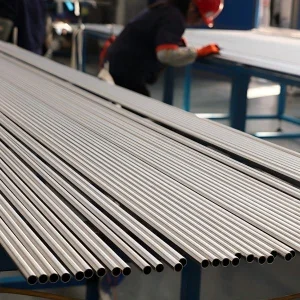

Global Market Dynamics & Commercial Status
An authoritative analysis of high-precision polished stainless steel tubing across advanced manufacturing sectors.
The global demand for high-quality polished stainless steel tubing is undergoing a structural expansion, driven by relentless requirements for purity, corrosion immunity, and extreme mechanical reliability in high-tech industries. According to current metallurgical market intelligence, the global market for high-purity and sanitary stainless tubing is expanding at a CAGR of 6.8%, projected to reach unprecedented demand milestones by 2030.
As modern biopharmaceutical manufacturing shifts toward continuous cell culture processing, semiconductor fabrication nodes shrink below 2 nanometers, and green hydrogen infrastructure scales globally, the quality requirements placed on stainless steel tubing have moved far beyond standard dimensional compliance. Modern engineers require seamless and precision-welded tubing that features ultra-smooth internal topography, controlled passivated oxide layers, and zero microscopic occlusions.
Leading global manufacturers must balance strict international standards—such as ASTM A269, ASTM A270 (S2), ASTM A213, ASME SA312, and EN 10217-7—with localized regulatory and project-specific requirements. Achieving zero contamination in Ultra-High Purity (UHP) gas delivery systems or High-Purity Water for Injection (WFI) loops requires a synthesis of advanced vacuum induction melting (VIM), vacuum arc remelting (VAR), cold drawing, bright annealing (BA), and electropolishing (EP).
Surface Science: Mechanical Polishing (MP) vs. Electropolishing (EP)
Understanding surface topography parameters ($R_a$, $R_z$, $R_{max}$) and passive oxide layer formation in high-grade tubing.
Mechanical Polishing (MP)
Utilizes progressive grit abrasives (180, 240, 320, 400, to 600 Grit) to cut down surface peaks. Yields smooth aesthetic surfaces ($R_a \le 0.4 \mu m$). Ideal for ornamental, architectural, and standard sanitary fluid handling where micro-refinement of the chromium oxide layer is not critical.
Bright Annealing (BA)
Thermal treatment performed in a controlled atmosphere of pure hydrogen or cracked ammonia ($N_2/H_2$). Prevents oxidation during heat treatment, maintaining a mirror-bright finish directly from the mill while relieving internal residual cold-working stresses.
Electropolishing (EP)
An electrochemical process that preferentially dissolves microscopic surface asperities, removing iron and enhancing the Chromium-to-Iron ($Cr/Fe$) ratio to $\ge 1.5$. Results in an ultra-passivated, featureless surface ($R_a \le 0.13 \mu m$) essential for pharmaceutical WFI and semiconductor UHP gas lines.
| Polishing Designation | Typical Grit / Process | Surface Roughness ($R_a$) | Passive Layer Quality | Primary Industrial Sector |
|---|---|---|---|---|
| Commercial MP | 180 - 240 Grit Mechanical | 0.50 - 0.80 µm (20 - 32 µin) | Standard Mill Passivation | Structural, Decorative, Exhaust |
| Sanitary MP (SF1/SF4) | 320 - 400 Grit Mechanical | 0.38 - 0.50 µm (15 - 20 µin) | Chemically Passivated (Citric/Nitric) | Dairy, Beverage, Food Processing |
| Bright Annealed (BA) | Cold Drawn + H2 Anneal | 0.25 - 0.40 µm (10 - 16 µin) | Thermally Preserved Passive Oxide | Instrumentation, Hydraulic, Boiler |
| High-Purity EP (SF5/SF6) | Electropolished + Passivated | 0.13 - 0.25 µm (5 - 10 µin) | High Cr/Fe Ratio (>1.8), Deep Passive Film | Pharmaceutical WFI, Biotechnology |
| Ultra-High Purity UHP EP | Multi-Stage EP + Cleanroom Pack | < 0.10 µm (< 4 µin) | Enriched Cr Oxide, Zero Free Iron | Semiconductor Sub-2nm Fab Lines |
Alloy Chemistry, PREN & Corrosion Immunity
Matching stainless steel, super austenitic, nickel alloy, and titanium grades to corrosive chemical environments.
Selecting the optimal tube alloy requires evaluating chloride ion concentration, operating temperature, pH levels, and fluid velocity. The Pitting Resistance Equivalent Number (PREN) serves as a critical metallurgical metric for determining resistance to localized pitting and crevice corrosion in halide-rich media:
PREN = %Cr + 3.3 × (%Mo + 0.5 × %W) + 16 × %N
Austenitic 304L / 316L
The global benchmark for process lines, biopharma sanitary piping, and heat exchangers. 316L contains 2.0–3.0% Molybdenum, providing crucial resistance to pitting in low-chloride environments.
Super Austenitic 317L / 904L
Engineered for severe acidic media, dilute sulfuric acid handling, and paper pulp bleaching. Offers elevated resistance to crevice corrosion compared to standard 316L.
Duplex & Super Duplex
Dual-phase (austenite-ferrite) microstructure providing double the yield strength of 304/316 alongside exceptional immunity to Chloride Stress Corrosion Cracking (SCC) in marine and offshore service.
Nickel Alloys & Titanium
Reserved for hyper-aggressive chemical processing, high-temperature oxidation environments, and power plant seawater surface condensers where steel alloys fail.
Macro-Industry Solutions & Application Scenarios
Deployment architectures across semiconductor fabs, biopharmaceutical plants, power generation, and energy infrastructure.
Semiconductor UHP Gas Lines
Delivering toxic, flammable, and ultra-pure gases ($N_2, Ar, O_2, SiH_4$) to cleanroom tool bays requires electropolished 316L VIM/VAR tubing. Zero outgassing, minimal moisture retention (< 1 ppb $H_2O$), and particle counts approaching zero are enforced through cleanroom ISO Class 4 double-bagging.
Biopharmaceutical WFI Loops
Water for Injection (WFI) and Clean Steam systems mandate ASME BPE compliant 316L tubing. Electropolished interior surface finish ($R_a \le 0.38 \mu m$) prevents bio-film attachment, micro-bacterial proliferation, and rouge formation in continuous thermal loop re-circulation.
Power Gen & Shell-and-Tube Exchangers
High-pressure feed water heaters, nuclear steam generators, and condensers demand U-bend polished stainless and titanium tubing. Engineered to withstand high thermal fatigue, steam impingement erosion, and tube-sheet expansion stresses under ASME SA213 / SA249 standards.
Next-Generation Manufacturing & Quality Roadmap (2025–2035)
Pioneering advancements in automated laser polishing, inline AI visual inspection, and zero-carbon green stainless steel processing.
1. Automated Femtosecond Laser Polishing
Transitioning beyond chemical electropolishing to ultra-fast femtosecond laser ablation. Enables non-contact micro-smoothing of internal tube bores down to $R_a < 0.05 \mu m$ without chemical effluent generation or acid disposal overheads.
2. AI Optical Profilometry & Defect Detection
Deploying high-frequency endoscopic AI optical sensors inside drawn tubes during the production cycle. Neural networks detect micro-scratches, pits, and weld-line inclusions in real-time with sub-micron accuracy.
3. Green Hydrogen Annealing & Decarbonization
Pioneering net-zero carbon tube production by utilizing 100% green hydrogen derived from renewable electrolysis for all bright annealing furnaces, coupled with scrap-recycled EAF steelmaking.
Precision Engineered Tubing Portfolio (Part II)
Explore specialized high-temperature austenitic grades, heat exchanger tubes, and custom alloy tubing solutions.








Frequently Asked Questions (FAQ)
Expert answers addressing quality control, polishing specs, certification, and global procurement logistics.
