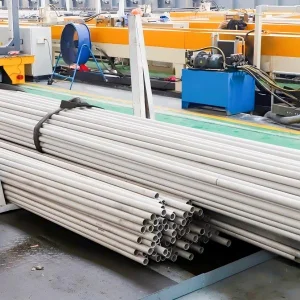
Precision Stainless Steel & Alloy Tubing Portfolio
Explore our certified mill product range manufactured under rigorous ISO 9001 and PED 2014/68/EU quality management protocols for critical heat transfer and fluid transport systems.







Global Industrial Status & Commercial Market Dynamics of SST Tubing
Stainless steel tubing (SST Tubing) and high-performance alloy tubular products represent the critical infrastructure spine of global process industries. From supercritical fossil-fuel boilers and multi-stage flash desalination plants to nuclear containment cooling loops and ultra-clean semiconductor gas distribution, high-quality SST tubing underpins structural integrity, operational safety, and thermal transfer efficiency.
Energy Transition & Decarbonization
The global push toward net-zero emissions has dramatically expanded demand for specialized stainless tubing. Hydrogen economy infrastructure requires high-pressure, embrittlement-resistant 316L and 316Ti tubing, while carbon capture, utilization, and storage (CCUS) projects demand high-molybdenum super austenitic and duplex alloys capable of withstanding wet CO₂ corrosion.
LNG Liquefaction & Cryogenic Service
Global expansion in Liquefied Natural Gas (LNG) export terminals requires vast quantities of low-temperature austenitic stainless steel tubing (e.g., ASME SA213 TP304L and TP316L). These materials maintain superior impact toughness and ductility at cryogenic temperatures down to -196°C (-320°F).
Chemical & Petrochemical Modernization
Modern mega-cracking plants and fertilizer synthesis facilities operate at increasingly severe temperatures and pressures. Procurement directors face strict requirements for mill test traceability (EN 10204 3.1/3.2), precise dimensional wall tolerances (ASTM A450/A1016), and verified resistance to stress corrosion cracking (SCC).
In high-stakes industrial projects, total cost of ownership (TCO) is dictated not by initial tubing purchase price, but by unscheduled outage prevention. High-quality Sst tubing manufacturers mitigate risk by enforcing full chemical heat control (narrowing carbon, nickel, and molybdenum bands within standard ranges) and integrating 100% non-destructive examination (NDE)—combining automated hydrostatic testing with multi-channel Eddy Current inspection.
Comprehensive Metallurgical Classification & Manufacturing Routes
Spezilla Tube Co., Ltd. engineers tubular products tailored to specific operational failure mechanisms—whether high-temperature creep oxidation, chloride pitting, intergranular attack (IGA), or galvanic degradation. Understanding the structural properties of each material family is paramount to proper alloy selection.
| Material Family | Representative Alloys | Standard Specifications | Key Metallurgical Characteristics | Primary Industrial Applications |
|---|---|---|---|---|
| Austenitic Stainless Steels | 304/304L, 316/316L, 316Ti, 321, 310S, 347H | ASME SA213 / SA312 / SA249 ASTM A269 / EN 10217-7 |
Non-magnetic FCC structure; high ductility, excellent general corrosion resistance; stabilized grades (321, 347H, 316Ti) prevent intergranular carbide precipitation. | Shell-and-tube heat exchangers, superheaters, food & beverage sanitary lines, chemical process piping. |
| Duplex & Super Duplex | UNS S31803, S32205, S32750 (2507) | ASTM A789 / A790 EN 10216-5 |
50/50 dual-phase ferrite-austenite matrix; double the yield strength of austenitic grades; outstanding resistance to chloride SCC and pitting (PREN ≥ 42 for Super Duplex). | Offshore oil & gas platforms, subsea umbilical systems, reverse osmosis desalination, pulp bleach plants. |
| Ferritic & Martensitic | 405, 410, 409, 430, 444 | ASTM A268 / A554 EN 10296-2 |
Body-Centered Cubic (BCC) matrix; magnetic; lower thermal expansion coefficient and high resistance to stress corrosion cracking; nickel-free cost stability. | Automotive exhaust systems, boiler feed water heaters, domestic appliance heating elements, structural tubing. |
| Nickel Alloys | Incoloy 825, Inconel 625, Hastelloy C276 | ASTM B515 / B676 / B704 ASME SB163 / SB444 |
High nickel-chromium-molybdenum matrix; extreme resistance to reducing and oxidizing acids; immune to chloride SCC; exceptional high-temperature strength. | Severe chemical synthesis, flue gas desulfurization (FGD), sour gas (H₂S) extraction, nuclear steam generators. |
| Titanium Alloys | Grade 1, Grade 2, Grade 3 (UNS R50550) | ASTM B338 / ASME SB338 | Commercially pure titanium; self-healing passive oxide film (TiO₂); exceptional strength-to-weight ratio; virtually immune to raw seawater corrosion. | Power plant surface condensers, coastal heat exchangers, marine evaporators, aerospace fluid systems. |
Welded vs. Welded & Drawn (W&D) vs. Seamless Routes
Choosing between tube manufacturing methods requires balancing mechanical integrity, wall uniformity, pressure ratings, and budget constraints:
- Seamless Tubes (ASTM A213 / SA213): Manufactured via hot piercing and cold pilgering or drawing. Free from longitudinal weld seams, seamless tubing is specified for extreme pressure environments and applications where design codes strictly forbid welded joints.
- Welded & Drawn (W&D) Tubes (ASTM A249): Produced by continuous autogenous TIG/Laser welding, followed by precision cold drawing over a plug or mandrel. Cold working completely recrystallizes the weld fusion zone, yielding uniform wall thickness, tight concentricity, and smooth inner surfaces ideal for high-duty heat exchangers.
- As-Welded Tubes (ASTM A269 / A554): Roll-formed from high-precision strip and continuously welded. Cost-effective solution for structural, decorative, low-pressure fluid transfer, and sanitary applications.
Advanced Heat Treatment & Bright Annealing
Mechanical forming introduces cold-work stress and can precipitate unwanted carbides or intermetallic phases (such as Sigma phase in duplex steels). Spezilla employs continuous high-vacuum and controlled hydrogen atmosphere bright annealing furnaces:
- Solution Annealing (1040°C – 1150°C): Rapid heating followed by immediate hydrogen gas quenching dissolves chromium carbides back into the austenitic matrix, fully restoring maximum corrosion resistance.
- Bright Finish Quality: Pure hydrogen atmosphere prevents surface oxidation, eliminating the need for aggressive acid pickling while producing a mirror-smooth inner surface (Ra < 0.4 µm).
- Stress Relieving: Tailored low-temperature heat treatment applied to U-bend tubing radii to relieve residual tensile stresses and prevent stress corrosion cracking in shell-and-tube bundles.
Macro Industry Solutions & Regional Application Scenarios
Tubing performance requirements vary greatly across global markets. Sst tubing solutions must comply with local engineering codes while enduring localized environmental stresses.
North America: ASME Boiler & Pressure Vessel Compliance
In the North American market, tube procurement is governed by ASME Section II, III, and VIII. High-temperature power generation projects rely heavily on heavy-wall ASME SA213 TP347H and TP321 heat exchanger tubes engineered to resist high-temperature coal/gas combustion creep and fireside corrosion.
Europe: EN/DIN Standards & Hydrogen Transition
European chemical operators demand strict compliance with EN 10217-7 (welded) and EN 10216-5 (seamless) standards alongside Pressure Equipment Directive (PED 2014/68/EU). High-purity 316L/316Ti tubes with low interior roughness (DIN EN 10357) dominate clean chemical and green hydrogen distribution loops.
Middle East & APAC: High-Salinity Desalination & FPSO
Operating in Gulf seawater ambient conditions requires immunity to chloride pitting. Desalination plants and offshore Floating Production Storage and Offloading (FPSO) units deploy Super Duplex UNS S32750 and Titanium Grade 3 (UNS R50550) tubes to withstand continuous high-velocity saline exposure.
Technology Roadmap & Next-Generation Tubing Innovations
As industrial processing conditions become more intense, tube manufacturing technology is advancing toward ultra-clean purity, real-time quality verification, and sustainable metallurgy.
For semiconductor fabs, aerospace hydraulics, and biopharmaceutical synthesis, standard mechanical polishing is no longer sufficient. Next-generation Sst tubing undergoes multi-stage electropolishing to achieve surface roughness figures below Ra 0.13 µm (5 µin), creating an ultra-passive surface layer that eliminates particle entrapment and micro-contamination.
Industry 4.0 integration introduces artificial intelligence algorithms into high-speed multi-frequency Eddy Current and ultrasonic wall thickness measurement channels. Real-time machine learning models detect micro-cracks, weld seams mismatch, and wall thinning instantly, guaranteeing zero-defect coil and straight-length shipments.
Frequently Asked Questions (Technical & Procurement FAQ)
In-depth responses to fundamental engineering questions regarding standard compliance, material selection, testing standards, and mill capabilities.
High-Performance Alloy & Specialty Tube Series
Advanced nickel alloys, high-temperature austenitic steels, and customized heat exchanger tubing engineered for extreme chemical operating environments.